
Most explanations of E-E-A-T SEO treat it like a technical checklist: add an author bio, get a few backlinks, mention some credentials, done. That framing misses what actually changed in how Google evaluates content, and it’s precisely the businesses treating E-E-A-T as a box-ticking exercise that got hit hardest when Google’s March 2026 Core Update rolled out. Understanding what E-E-A-T actually means, and why Google now weighs it more heavily than ever, has become one of the most consequential things a business publishing content in 2026 can get right.
This guide breaks down what each letter of E-E-A-T means in practice, why the March 2026 update raised the stakes so significantly for E-E-A-T SEO work specifically, how concrete elements like author bios and transparent sourcing actually influence trust, how E-E-A-T reinforces topical authority, and a practical checklist you can apply to any page on your site.
What Each Letter of E-E-A-T Means in Practice?
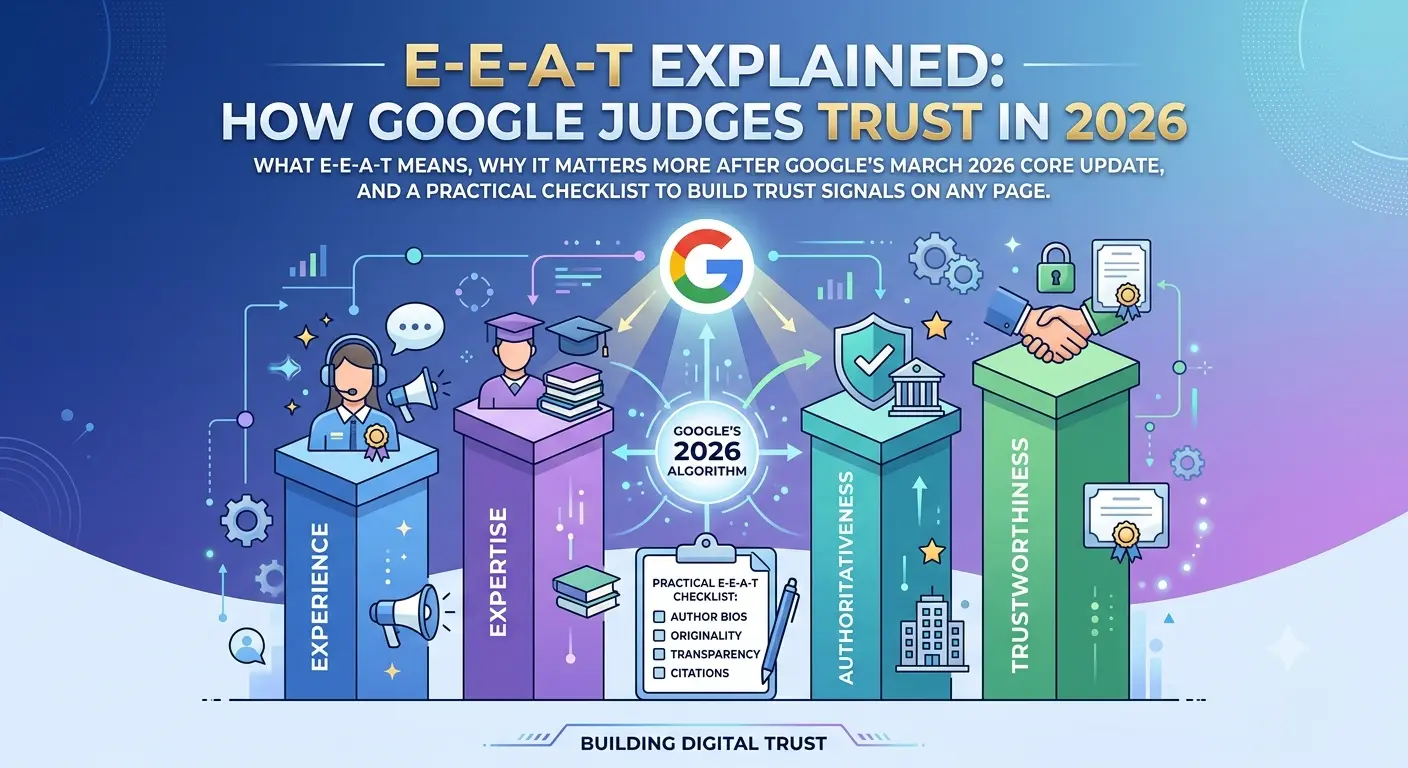
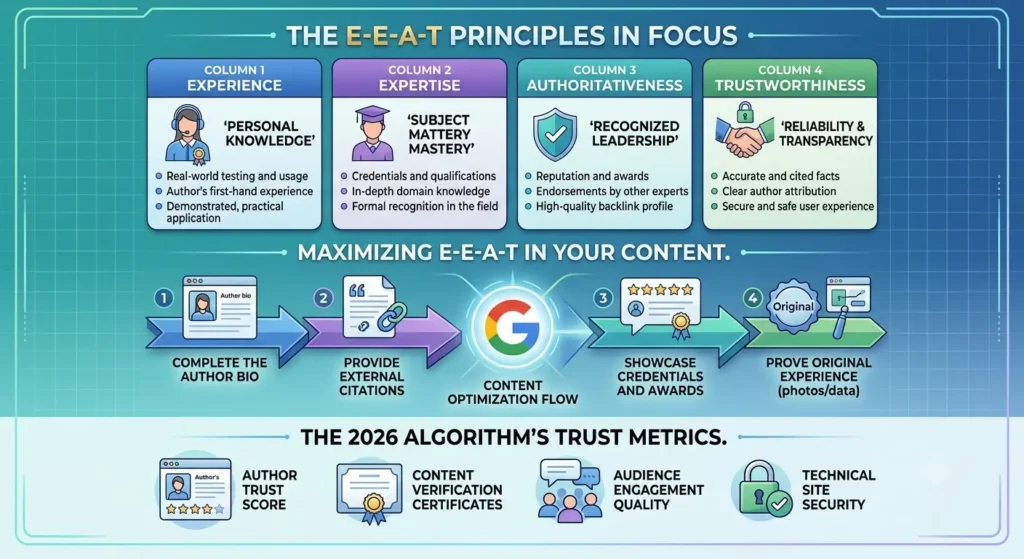
E-E-A-T stands for Experience, Expertise, Authoritativeness, and Trustworthiness — a framework Google’s Search Quality Rater Guidelines use to describe what separates genuinely helpful content from content that merely looks helpful. It isn’t a single ranking factor Google checks off directly; it’s a set of signals Google’s systems infer from many smaller cues across a page and a site.
Experience asks whether the content reflects genuine first-hand involvement with the topic — has the author actually used the product, performed the service, or lived through the situation they’re describing, rather than synthesizing what other articles already say about it. Expertise asks whether the author has the knowledge or qualifications relevant to the topic, which matters more for some subjects than others; a recipe benefits from lived cooking experience, while a legal or medical topic requires formal expertise that experience alone doesn’t substitute for. Authoritativeness asks whether the site and author are recognized as a credible source on the topic by others — other sites linking to them, mentions in the industry, a consistent publishing history in the relevant space. Trustworthiness sits at the center of the framework and is arguably the most important of the four: is the content accurate, honest, transparent about who wrote it and why, and safe for the reader to rely on.
Trustworthiness underpins the other three — expertise and authority mean little if the content isn’t honest or the site isn’t secure and transparent about its identity and intentions.
Why It Matters More After the March 2026 Core Update
Google’s March 2026 Core Update, announced on March 27 and completed by April 8, produced some of the more consequential ranking shifts of the past several years, and E-E-A-T sat at the center of it. The update reportedly re-weighted what’s often called Information Gain — a signal measuring how much genuinely new value a piece of content adds relative to what’s already ranking for the same query, rather than simply restating what competitors already say. Content produced at volume, assembled largely from the same sources as everything else already ranking, tends to add little of that gain regardless of how well it’s optimized.
The update also appears to have strengthened the connection between content quality and verifiable authorship. Content attributed to generic or anonymous author profiles, without a consistent publishing history or verifiable credentials, reportedly lost visibility even when the underlying content itself was reasonably well-written — Google’s systems are increasingly cautious about content they can’t confidently attribute to a credible source. YMYL categories — health, finance, legal, and other topics where inaccurate information can genuinely harm a reader — were affected most heavily, though the shift extended well beyond those categories to any site publishing high volumes of generic content without real depth or firsthand engagement with the subject matter.
For a Lebanese business publishing service content, this means E-E-A-T is no longer a nice-to-have layered on top of decent content; it’s increasingly the difference between content that ranks and content that doesn’t, particularly in competitive or YMYL-adjacent categories like legal services, financial services, medical and dental practices, and home services where trust genuinely matters to the reader.
How Author Bios, Credentials, and Transparent Sourcing Affect Trust?
Concrete, verifiable signals matter more than vague claims of expertise. A real author bio — name, relevant credentials or experience, and ideally a consistent body of published work on the topic — gives Google’s systems and human readers alike something to evaluate, in a way that an anonymous “Admin” byline or no attribution at all cannot. This doesn’t mean every blog post needs an elaborate author biography, but it does mean businesses publishing content around specialized or YMYL-adjacent topics should be attaching real names and real credentials rather than leaving content unattributed.
Transparent sourcing works the same way: citing where specific claims, statistics, or data points come from, rather than presenting information as though it originated from the business itself when it didn’t, builds exactly the kind of trust signal E-E-A-T is designed to reward. This extends to being upfront about business information generally — clear contact details, a genuine physical address where relevant, transparent pricing or service descriptions — all of which contribute to the same underlying trust assessment Google is trying to approximate.
How E-E-A-T and Topical Authority Reinforce Each Other?
E-E-A-T and topical authority aren’t separate concepts competing for attention in an SEO strategy — they build on each other directly. A site that consistently publishes genuinely knowledgeable content across a coherent topic area builds topical authority over time, and that accumulated authority is itself one of the strongest E-E-A-T signals a site can develop. A single excellent article by an unknown author on an otherwise unrelated site carries far less weight than the same article published by a site with a demonstrated history of expertise in that exact subject area.
This is why a scattered content strategy — publishing whatever topic seems to have search volume that week, regardless of whether it fits the site’s actual area of expertise — tends to underperform a focused one, even when individual pieces of content are well-written. Building E-E-A-T isn’t something a single article accomplishes; it’s the cumulative effect of a site consistently demonstrating real expertise within a defined topical space over time.
A Practical E-E-A-T SEO Checklist for Any Page
A few concrete checks apply to nearly any page on a business website, regardless of industry, and form the core of a working E-E-A-T SEO process rather than a one-time audit. Confirm the page has a real, named author with relevant credentials or experience visible, rather than an anonymous byline or none at all. Check that any claims, statistics, or specific facts are sourced transparently rather than presented without attribution. Review whether the content reflects genuine firsthand knowledge of the topic — actual client work, real product experience, direct service delivery — rather than being assembled purely from what other sites already say. Confirm the page and site have clear, accurate contact information, a real business address where applicable, and transparent information about who operates the site. And check whether the content sits within the site’s genuine area of expertise, reinforcing topical authority, rather than being an outlier topic published because it seemed like a quick ranking opportunity.
None of these checks require an overhaul of an entire site at once — applying them consistently to new content going forward, while gradually updating the highest-traffic existing pages, is a realistic way to build E-E-A-T over time rather than treating it as a one-time fix.
E-E-A-T SEO Considerations for Multilingual Content
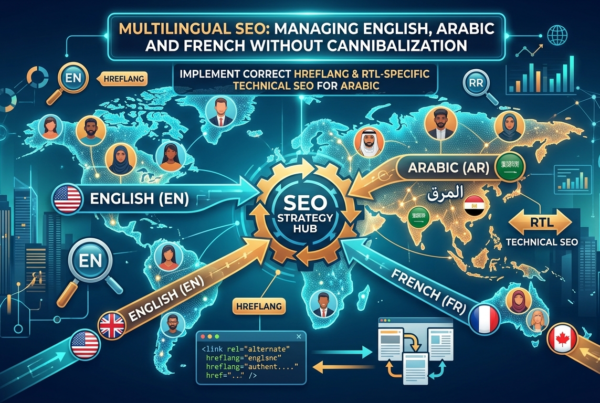
E-E-A-T SEO work gets an added layer of complexity for businesses publishing in multiple languages, which describes most businesses operating in Lebanon. Google evaluates trust signals separately for each language version of a page rather than assuming that strong E-E-A-T on an English page automatically carries over to its Arabic or French counterpart. An Arabic translation that strips out author attribution, sourcing, or the same level of factual specificity as the English original effectively resets the trust signal for that version of the page, even if the English version is genuinely strong.
This means genuine localization — not just translation — matters for E-E-A-T specifically, not only for user experience. Author bios, credentials, and sourcing should carry through consistently across all language versions of a page, and content that’s culturally adapted rather than mechanically translated tends to read as more genuinely authoritative to both readers and Google’s systems in that language. Businesses that treat non-English versions of their site as a lower priority for these details are effectively building strong E-E-A-T in one language while leaving the others comparatively weak.
Frequently Asked Questions
Not in the sense of a single measurable signal Google checks directly. E-E-A-T is a framework from Google’s Search Quality Rater Guidelines that describes what separates trustworthy, helpful content from content that merely appears helpful, and Google’s actual ranking systems infer these qualities from many underlying signals rather than scoring E-E-A-T as one number.
YMYL categories like health, finance, and legal content face the strictest scrutiny because inaccurate information carries real potential harm, but the March 2026 Core Update extended pressure on generic, shallow content well beyond those categories, making E-E-A-T relevant to nearly any business publishing content.
Content that goes through substantive expert review, adds genuine original perspective, and carries verifiable, consistent authorship can perform well regardless of how it was drafted. Content that’s purely generated and published without expert oversight or attribution is where the risk concentrates.
There’s no fixed timeline, since it accumulates through a consistent pattern of expert, well-attributed content over time rather than a single action. Businesses that start applying these principles consistently typically see the cumulative effect strengthen over several months to a year.
Adding real author attribution with genuine credentials to existing content, transparently sourcing any factual claims, and ensuring business and contact information is accurate and complete are the highest-leverage, fastest changes most sites can make.
Ready to Build E-E-A-T Into Your Content Strategy?
E-E-A-T isn’t a checklist you complete once — it’s the standard your entire E-E-A-T SEO strategy should be built around going forward. Get a free SEO audit from Creative 4 All and find out exactly where your site’s trust signals stand today.