
Ask five different agencies in Beirut how much a website costs, and you’ll likely get five different answers, ranging from a few hundred dollars to well over ten thousand. That spread isn’t a sign that someone is overcharging or someone else is cutting corners; it reflects how differently “a website” can be scoped depending on what a business actually needs. Understanding web design cost in Lebanon starts with recognizing that price is really a reflection of complexity, not an arbitrary number pulled from a rate card.
For business owners in Lebanon planning a new site or a redesign in 2026, an unclear picture of web design cost creates a real problem. Without a clear picture of what drives the price up or down, it’s easy to either overpay for features you don’t need or underpay for a site that can’t actually support your business goals. This guide walks through the real cost drivers behind website design pricing in Lebanon, gives you a sense of where different project types typically land, and flags the warning signs of a website that’s priced too low to be sustainable.
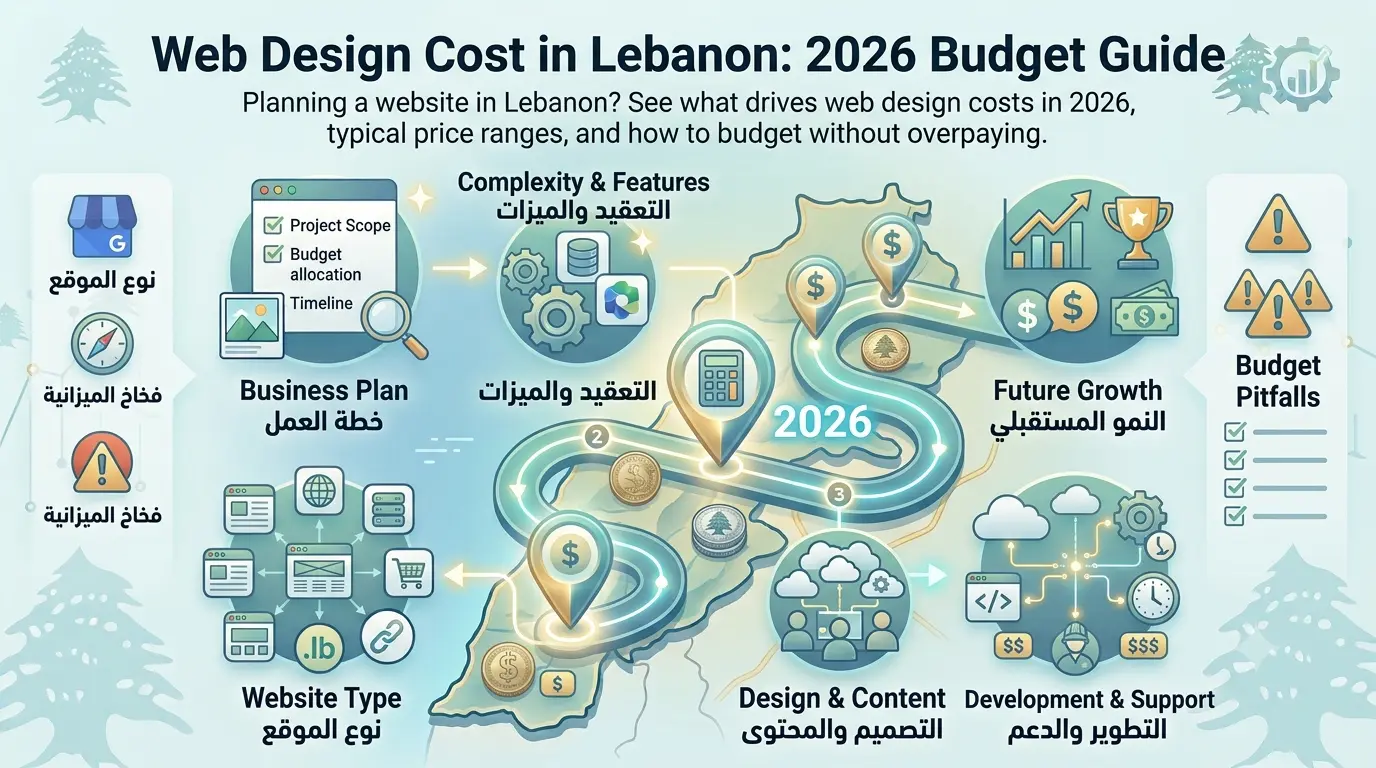
What Actually Drives Web Design Cost in Lebanon?
The single biggest myth about website pricing is that a “website” is a single, comparable product. In reality, a five-page brochure site for a dental clinic and a fifty-page catalog for a construction supplier are barely related projects, even though both technically fall under “web design.” Several factors combine to determine the final web design cost, and understanding them helps you evaluate any quote you receive.
Number of Pages and Content Complexity
The most obvious driver is scope. A landing page with a contact form takes far less design and development time than a full corporate site with service pages, team bios, case studies, a blog, and multilingual content in Arabic, English, and French. Every additional page needs its own layout considerations, content input, and testing, even when templates are reused. Businesses that serve both local Lebanese clients and a broader GCC audience often need trilingual structures, which adds meaningfully to both design and development hours.
Custom Features Versus Standard Functionality
A site that only needs to present information behaves very differently, cost-wise, from one that needs to do something: booking systems, quote calculators, membership portals, or integrations with a CRM or WhatsApp Business API. Custom features require custom logic, and custom logic requires development time that a template simply can’t shortcut. This is one of the clearest lines between design and development cost — design determines how something looks, development determines whether it actually works the way your business operates.
Ecommerce Functionality
If the site needs to sell products online, the cost profile changes substantially. Product catalogs, payment gateway integration, shipping logic, inventory syncing, and secure checkout flows are all specialized work. Even a modest ecommerce build typically costs more than a comparably sized informational site, because the underlying architecture has to handle transactions securely and reliably.
CMS Choice and Licensing
Whether a site is built on WordPress, a headless CMS, or a fully custom framework changes both the upfront cost and the long-term maintenance burden. Open-source platforms like WordPress avoid licensing fees but may require paid plugins for specific functionality. Enterprise platforms or custom-built systems tend to cost more upfront but can offer more control for businesses with complex, evolving needs. Neither approach is universally “better” — the right choice depends on how much flexibility your business needs and who will be managing the site day to day.
Design Depth: Custom vs Template-Based
There’s a meaningful difference between a site built from a customized template and one designed entirely from scratch around a brand’s identity. Template-based builds are faster and less expensive, and they can look perfectly professional when done well. Fully custom design, however, involves original wireframing, brand-specific visual systems, and interaction design tailored to how your specific audience behaves. For businesses competing in crowded categories, like clinics, law firms, or contractors, a distinctive custom design can be the difference between blending in and standing out in local search results.
Typical Cost Ranges by Project Type
Because web design cost in Lebanon varies so widely by scope, it’s more useful to think in terms of project categories than a single number. A simple brochure site for a local service business, covering a handful of pages with standard contact forms and no custom functionality, sits at the lower end of the spectrum. A mid-tier corporate site with more pages, multilingual content, and some custom design work occupies the middle range. Ecommerce stores, membership platforms, and sites with custom booking or automation features land at the higher end, reflecting the added development and QA work those features require.
It’s worth noting that these categories aren’t fixed tiers with hard price walls between them. A five-page site with a highly complex custom booking calculator can easily cost more than a twenty-page brochure site with no special functionality. The features matter more than the page count.
Ongoing Maintenance Costs
One of the most overlooked parts of web design cost in Lebanon is what happens after launch. A website isn’t a one-time purchase; it’s an asset that needs upkeep. Hosting, security monitoring, CMS and plugin updates, backups, and periodic content changes all carry ongoing costs, whether you handle them in-house or pay an agency for a maintenance retainer.
Businesses that skip this step often find themselves with a site that becomes vulnerable to security issues within a year or two, or one that quietly stops rendering correctly after a browser update nobody accounted for. Factoring a modest monthly or annual maintenance budget into your initial decision prevents a much larger, more disruptive cost down the line: rebuilding a neglected site from scratch.
Red Flags of Underpriced Web Design
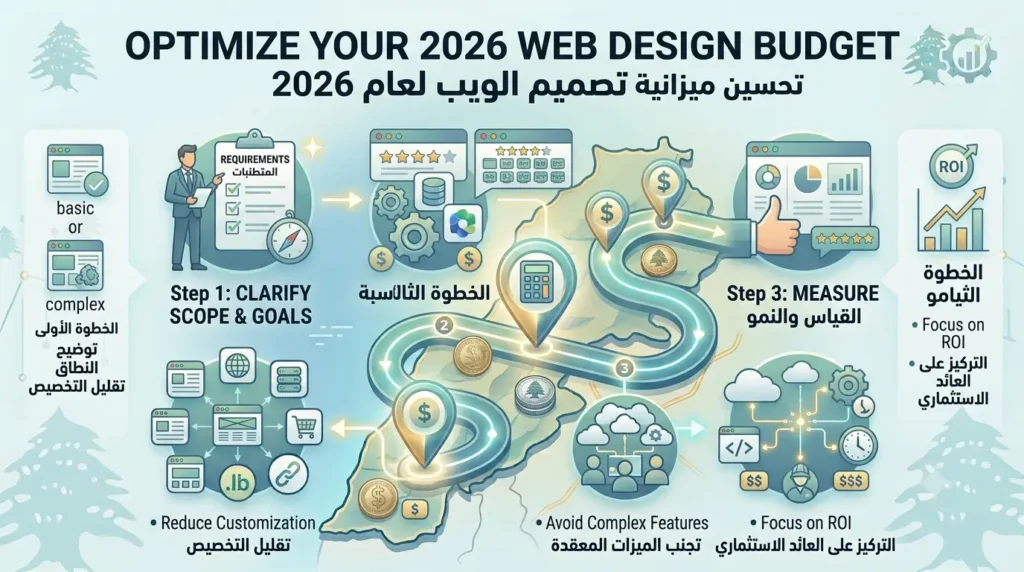
Because web design cost in Lebanon varies so much, it’s tempting to simply choose the lowest quote. This is where a lot of businesses run into trouble. A price that seems too good to be true relative to the scope of work usually means something is being cut: no real discovery process, a recycled template with minimal customization, no attention to page speed or mobile responsiveness, or no plan for search visibility at all.
Watch for agencies that can’t clearly explain what’s included in their quote, that don’t ask questions about your business goals before pricing the project, or that treat SEO and content strategy as an afterthought rather than something built into the site from day one. A cheap website that ranks nowhere and converts nobody isn’t actually cheap; it’s a cost you’ll pay again when you eventually rebuild it properly. The agencies worth trusting are the ones who explain their pricing in terms of what the project actually requires, not just a flat number pulled from a template.
This is also where the distinction between custom development and website builders becomes relevant. Drag-and-drop platforms can look attractive on price, but they often trade away flexibility, performance, and long-term scalability. If you’re weighing that decision, our guide on custom web development versus website builders lays out the tradeoffs in more depth before committing either way.
How Design and Development Costs Split Apart?
A quote for web design cost in Lebanon almost always bundles two distinct disciplines that many business owners assume are the same thing. Design covers the visual identity, layout, user experience, and how a visitor moves through the site. Development covers the underlying code that makes those designs function correctly across devices, browsers, and connection speeds. A beautifully designed homepage that loads slowly on mobile, or breaks on older browsers, hasn’t actually delivered on the design brief; it’s only half-finished.
This split matters when comparing quotes, because two agencies can propose wildly different prices for what looks like the same visual concept simply because one has scoped in real development testing, accessibility checks, and performance optimization, while the other has scoped in only the visual layer. Asking any agency to break down how much of their quote covers design versus development is one of the fastest ways to understand what you’re actually paying for, and it’s a fair question for any business evaluating website design pricing in Lebanon.
Why Local Market Context Changes the Calculation?
Pricing benchmarks from international sources, particularly US or European agencies, rarely translate cleanly to the Lebanese market. Currency volatility, the availability of skilled local developers, and the competitive landscape among Beirut-based agencies all shape what a realistic custom website cost looks like here. A business comparing a Lebanese agency’s quote against a number they found in a generic overseas blog post is often comparing two entirely different cost structures, talent pools, and service inclusions.
This is also why context-driven quoting matters more than published price lists. An agency that understands the Lebanese and broader GCC market can price a project around what actually works for businesses operating in this environment, rather than applying a template built for a different economy altogether.
Getting a Quote That Actually Reflects Your Needs
The most reliable way to understand what your specific project will cost is to get a quote based on a real conversation about your goals, not a generic package list. A good discovery process should cover your target audience, the languages your site needs to support, any custom functionality you’re considering, and how the site fits into your broader marketing and SEO strategy. That context is what turns a rough estimate into an accurate, defensible number.
If you’re planning a new website or considering a redesign, it’s worth starting that conversation now rather than guessing at a budget in isolation. A clear scope, discussed upfront, is what prevents surprise costs later.
Ready to Plan Your Website Budget?
If you’re weighing your options for a new site or a redesign, Creative 4 All can walk you through a realistic, scope-based quote tailored to your business goals. Request a website quote today and get clarity on exactly what your project should cost before you commit to anything.
Frequently Asked Questions
It depends heavily on scope. A simple brochure site with a handful of pages costs far less than a multilingual corporate site or an ecommerce store with custom features. The realistic way to answer this for your business is through a scoped quote rather than a single average figure.
Website builders often have a lower upfront cost, but they can limit design flexibility, performance, and scalability as your business grows. Whether that tradeoff makes sense depends on your goals and how long you expect to keep the site before its next redesign.
Yes, generally. Supporting Arabic, English, and French adds translation, layout, and testing work, since right-to-left Arabic text often requires specific design adjustments that a single-language site never has to account for.
Hosting, security updates, backups, and periodic content changes are standard ongoing costs. Some businesses handle these internally, while others prefer a maintenance retainer with their web design agency.
Be cautious of quotes that don’t reflect a real discovery process, don’t mention SEO or mobile responsiveness, or seem disconnected from the actual scope of your project. A well-scoped quote should explain what’s included and why.