
If you run a business in Beirut, Tripoli, or anywhere in Lebanon and you’re only investing in a website, you’re missing the single highest-return, lowest-cost visibility tool available to you. Google Business Profile optimization consistently outperforms almost every other local marketing tactic on a cost-to-result basis, because it puts your business directly in front of people who are searching with immediate intent — someone typing “dentist near me” or “web design company Beirut” isn’t browsing casually, they’re ready to choose.
And yet, walk through the Google Business Profile listings of most Lebanese SMEs and you’ll find the same pattern: an unclaimed or barely-filled-out profile, outdated hours, no photos beyond a blurry storefront shot, and reviews that go unanswered for months. That gap is an opportunity. A properly optimized profile doesn’t just look more professional; it directly influences whether your business shows up in the coveted “map pack” — the three local results Google displays above the organic listings for location-based searches.
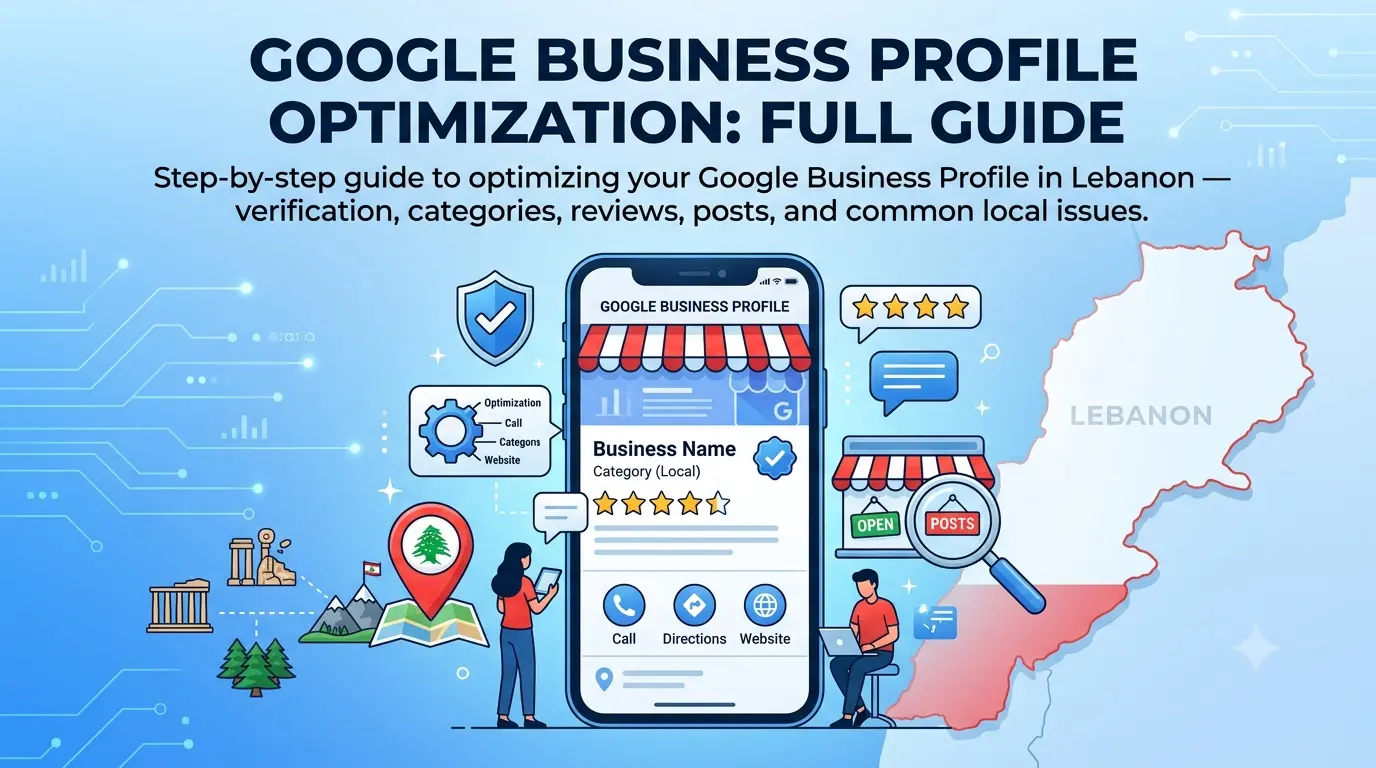
This guide walks through exactly how to claim, verify, and optimize a Google Business Profile for a Lebanese business, along with the specific issues that tend to trip up business owners here, from verification delays to category confusion.
Why Google Business Profile Optimization Matters for Lebanese SMEs?
Before getting into the mechanics, it’s worth understanding why this particular tactic deserves priority. Unlike SEO for your website, which can take months to show measurable movement, a well-optimized Google Business Profile can start generating calls, direction requests, and website clicks within days of going live. It’s also free — there’s no ad spend required to appear in local results, only the time investment to set it up properly.
For service-based businesses especially — clinics, law firms, contractors, salons, agencies — the profile often becomes a customer’s first real impression of the business, arriving before they ever land on the website itself. A profile with strong photos, an accurate category, active posts, and a healthy flow of recent reviews signals legitimacy in a way that a static website alone cannot. This is precisely why Google Business Profile optimization should sit near the top of any local SEO strategy for a business operating in Lebanon.
Claiming and Verifying Your Profile
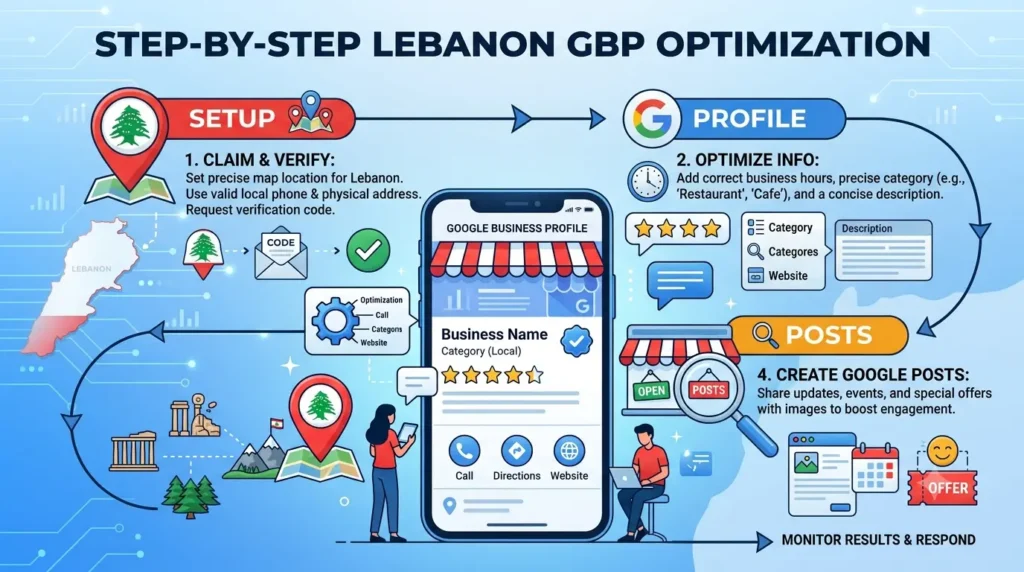
The first step in Google Business Profile optimization is establishing ownership. If your business doesn’t already have a profile, you can create one directly through Google Business Profile Manager by searching for your business name and address. If a profile already exists — often auto-generated by Google from map data or a previous review — you’ll need to claim it instead.
Verification in Lebanon can be less straightforward than in markets with dense Google infrastructure. Postcard verification, Google’s default method in many countries, is unreliable here due to inconsistent mail delivery, and it isn’t always offered as an option. Phone or email verification is faster when available, and video verification — where you record a short walkthrough of your business premises and signage — has become the most common route for Lebanese businesses when other methods aren’t offered. Whichever method Google presents, complete it as soon as possible; an unverified profile has severely limited visibility and can’t run posts, respond fully to reviews, or gather the trust signals Google factors into local rankings.
Choosing the Right Business Categories
Category selection is one of the most underestimated levers in Google Business Profile optimization, and one of the easiest to get wrong. Your primary category should describe what your business fundamentally is, not just what it offers — a marketing agency that also does web design should choose “Marketing Agency” or “Digital Marketing Agency” as primary rather than a narrower service category, then add secondary categories to capture the additional services.
Getting this right matters because Google uses your category selection heavily when deciding which searches your profile should surface for. A business that mis-categorizes itself, or picks an overly broad category to “cover more searches,” often ends up ranking for none of them well. It’s better to have a precise primary category with two or three accurate secondary categories than a scattershot approach that dilutes relevance.
Building Out Photos, Services, and Business Information
A profile with complete, accurate information consistently outperforms a sparse one, and this is one of the parts of Google Business Profile optimization that’s entirely within a business owner’s control.
Photos That Actually Get Used
Photos matter more than most owners assume — profiles with a strong photo count and variety (storefront, interior, team, products or work samples) tend to see meaningfully higher engagement than those with only one or two images. Photos should be updated periodically, not uploaded once and forgotten.
Services and Products
The Services section, along with the Products section for applicable businesses, deserves the same attention as a website’s service pages. Each listed service should have a clear name and, where relevant, a short description using natural language that matches how customers actually search — not internal jargon.
Core Business Information
Business information fields — hours, phone number, website URL, service areas for businesses that travel to customers rather than operating from a single storefront — should be filled out completely and kept current, especially around holidays specific to Lebanon, when hour changes are common and frequently forgotten.
Generating and Responding to Reviews
Reviews are one of the strongest ranking and trust factors tied to a Google Business Profile, and they’re also one of the areas where Lebanese businesses most consistently underperform. A profile with twelve reviews and a business with two hundred reviews in the same category are not competing on equal footing, even if both have similar star ratings.
Building review volume works best as an ongoing habit rather than a one-time push: asking satisfied customers directly, sending a simple link after a completed service, or adding a QR code at the point of sale all work well in practice. What matters more than volume alone, though, is response behavior. Responding to every review — positive and negative — signals to both Google and prospective customers that the business is actively managed. A thoughtful, professional response to a negative review often does more for trust than ten unanswered five-star reviews, because it shows how the business handles problems when they arise.
Using Posts and Q&A to Stay Active
Google Business Profile posts function similarly to social media updates, appearing directly in the profile and occasionally in search results. Regular posts — about promotions, new services, events, or business updates — signal to Google that the profile is actively maintained, which is a modest but real factor in local ranking. Posts have a limited lifespan before they expire, so this works best as a recurring habit rather than a single setup task.
The Questions & Answers section deserves more attention than most businesses give it, because it’s public and searchable, and unanswered or incorrectly answered questions can sit at the top of a profile indefinitely. Proactively seeding a handful of common customer questions, with clear and accurate answers, prevents the section from being filled by guesses from unrelated users and gives potential customers useful information before they ever pick up the phone.
Tracking Performance Through Insights
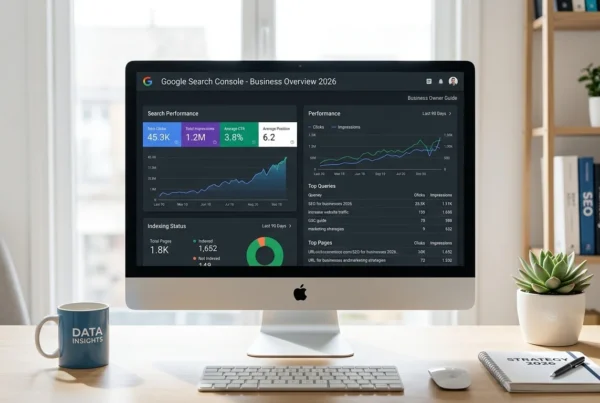
Google Business Profile provides built-in performance data covering how customers found the listing, what actions they took (calls, direction requests, website visits), and how the profile compares over time. Reviewing these insights regularly turns Google Business Profile optimization from a one-time setup task into an ongoing strategy — if direction requests spike after a particular post or photo update, that’s a signal worth repeating; if calls drop after a change to business hours, that’s worth investigating quickly.
Pairing these insights with Google Search Console data, where relevant, gives a fuller picture of how a business’s local presence and website visibility are working together rather than in isolation.
Keeping Your Profile Consistent With the Rest of Your Online Presence
Google Business Profile optimization doesn’t happen in isolation from the rest of a business’s online footprint. Google cross-references the name, address, and phone number on a profile against how that same information appears elsewhere — on the business website, in local directories, and on social media pages. When these details don’t match exactly, even in small ways like an abbreviated street name on one platform and a spelled-out version on another, it can weaken the trust signals that support local ranking.
This is why citation consistency is usually addressed alongside Google Business Profile optimization rather than as a separate project. A quick audit of how your business appears across a handful of directories and platforms is often enough to catch mismatches before they quietly undermine an otherwise well-optimized profile.
Common Verification and Optimization Issues in Lebanon
A few issues come up often enough among Lebanese businesses that they’re worth flagging directly. Duplicate listings are common, particularly for businesses that have moved locations or rebranded, and competing duplicate profiles can split reviews and confuse both customers and Google’s algorithm — these need to be identified and merged or removed. Address formatting is another frequent snag, since Lebanon’s addressing system doesn’t always map cleanly onto Google’s structured address fields, and inconsistent formatting across different listings (website, social media, directories) can undermine the trust signals Google relies on for local ranking.
Suspended profiles are also more common here than business owners expect, often triggered by too many changes made too quickly, or by information that doesn’t match other public records of the business. If a profile gets suspended, the reinstatement process requires clear documentation and patience rather than repeated resubmissions, which can extend the suspension further.
Frequently Asked Questions
It varies by method. Phone or email verification, when available, can be nearly instant. Video verification typically takes a few business days for Google to review, and postcard verification — when offered — is the least reliable option given inconsistent mail delivery.
No. A business should have exactly one profile per physical location. Duplicate profiles split reviews and search visibility and should be merged or reported to Google for removal.
Not necessarily. Service-area businesses that travel to customers rather than operating from a fixed storefront can hide their address and define service areas instead, as long as they still meet Google’s eligibility requirements for the business type.
Weekly or biweekly is a reasonable rhythm for most small businesses, since posts expire after a set period. Consistency matters more than frequency alone.
Completing every available field, adding a strong and varied set of photos, and actively generating and responding to reviews tend to produce the fastest visible improvement, since these are the areas where most competing profiles are weakest.
Ready to Strengthen Your Local Visibility?
An optimized Google Business Profile is one piece of a larger local SEO strategy, and it works best alongside a properly structured website and consistent citations. Get a free SEO audit from Creative 4 All to see exactly where your profile and website stand today, and what to prioritize first.