
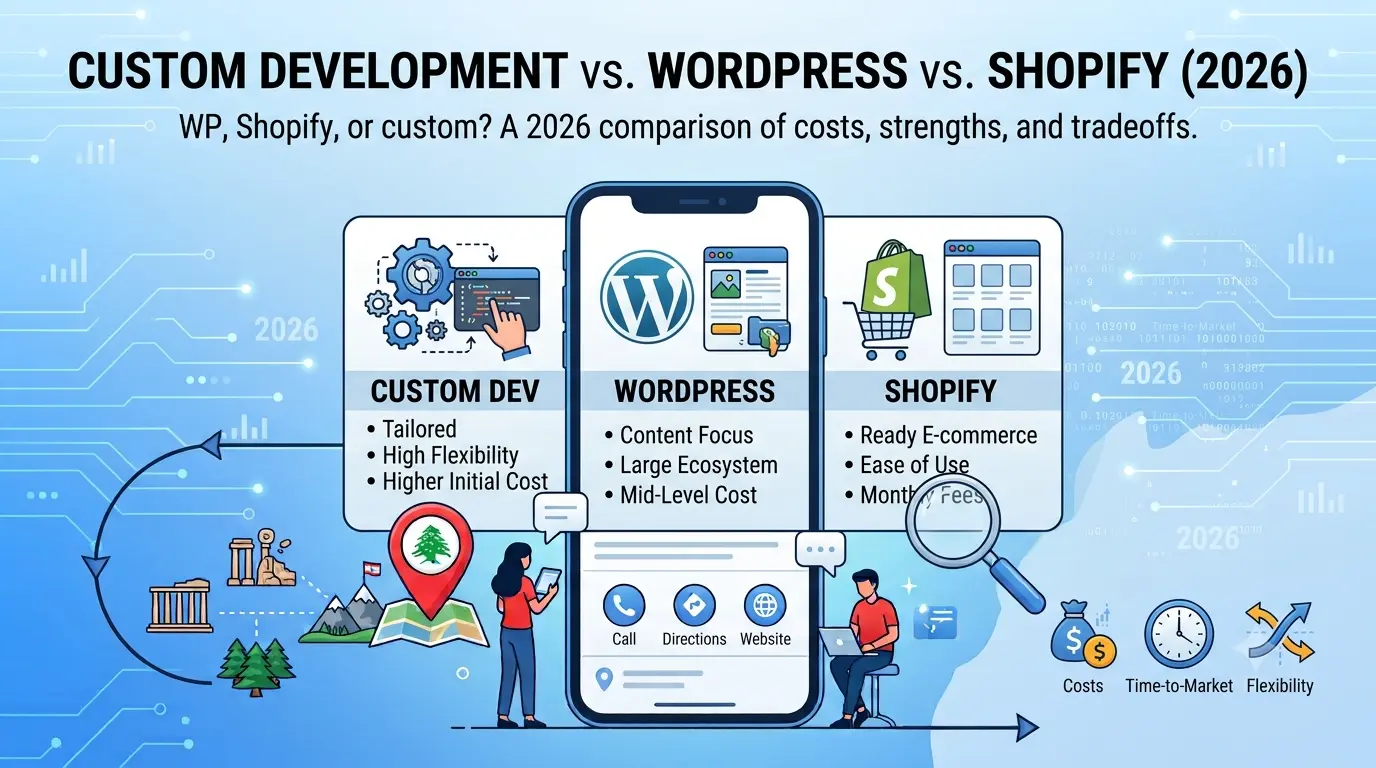
Every website project eventually runs into the same fork in the road: which platform should it actually be built on? For businesses in Lebanon weighing their options in 2026, the decision usually narrows down to three real contenders — WordPress, Shopify, or a fully custom build — and the right answer depends far more on the shape of your business than on which platform is objectively “best.” The debate over custom web development vs website builders isn’t really about which technology is superior; it’s about which tradeoffs match your specific growth stage, budget, and technical needs.
This comparison gets muddied constantly by generic advice that treats the decision as a simple two-way split between “custom” and “off-the-shelf.” In practice, the honest answer requires looking at three platforms side by side, understanding what each one is genuinely good at, and being clear-eyed about where each one falls short. This guide walks through that comparison directly, then offers a decision framework you can actually apply to your own business.
How to Match a Platform to Your Business Type and Growth Stage?
Before comparing features, it helps to be honest about where your business actually sits. A newly launched service business with five pages and no transactional needs has almost nothing in common, platform-wise, with a growing retailer processing hundreds of orders a month, or an enterprise client running a complex booking system tied to internal software. Choosing a platform before answering this question is how businesses end up outgrowing their website within eighteen months, or paying for enterprise-grade infrastructure they’ll never use.
A useful starting point is thinking in terms of three growth stages: early-stage businesses validating an idea with limited budget, established businesses with steady traffic and specific functional needs, and scaling businesses whose website has become core infrastructure rather than a marketing add-on. Each stage tends to map cleanly onto one of the three platforms discussed below, though there are always exceptions worth discussing with whoever is building the site.
WordPress vs Shopify vs Custom Development: Strengths and Weaknesses
WordPress
WordPress remains the most widely used content management system in the world, and for good reason. Its plugin ecosystem covers nearly every common website need, from SEO tools to booking calendars to basic ecommerce through WooCommerce. For content-heavy sites — blogs, service businesses, multilingual corporate sites — WordPress offers a strong balance of flexibility and cost, since a skilled developer can customize it extensively without building everything from scratch.
The tradeoff is that WordPress’s flexibility comes with maintenance overhead. Plugins need regular updates, security vulnerabilities are more common simply because of how widely the platform is targeted by attackers, and a site built by stacking many plugins together can become slow or fragile over time if it isn’t managed carefully. WordPress rewards businesses that either maintain their site actively or have an agency doing it for them; it punishes businesses that set it up once and never touch it again.
Shopify
Shopify was built specifically for ecommerce, and it shows. Checkout flows, payment processing, inventory management, shipping integrations, and abandoned cart recovery all come largely pre-built and well-tested, which removes a huge amount of the specialized development work that a custom ecommerce build would otherwise require. For businesses whose primary goal is selling products online, Shopify usually gets a functional, secure store live faster than any other option.
The limitations show up around content flexibility and non-ecommerce functionality. Shopify is excellent at being a store; it’s a weaker fit for businesses that need extensive content marketing, complex custom booking logic, or a site structure that doesn’t map cleanly onto product pages and collections. Monthly subscription costs and transaction fees also accumulate over time in a way that a one-time development cost doesn’t, which matters when comparing total cost of ownership rather than just the launch price.
Custom Development
A fully custom build, whether on a custom-coded framework or a headless CMS architecture, removes the constraints of any pre-built platform entirely. There’s no plugin to work around, no theme limitation to design against — every part of the site is built specifically for how the business actually operates. For businesses with unusual workflows, complex integrations with internal systems, or performance requirements that off-the-shelf platforms struggle to meet, custom development is often the only option that actually works long-term.
The tradeoff is upfront cost and time. Custom builds take longer to launch and cost more initially than either WordPress or Shopify, because nothing is pre-built — every feature is designed and developed specifically for the project. This makes custom development a poor fit for businesses still validating their model, but a strong fit for businesses that already know exactly what they need and expect to scale significantly over the coming years.
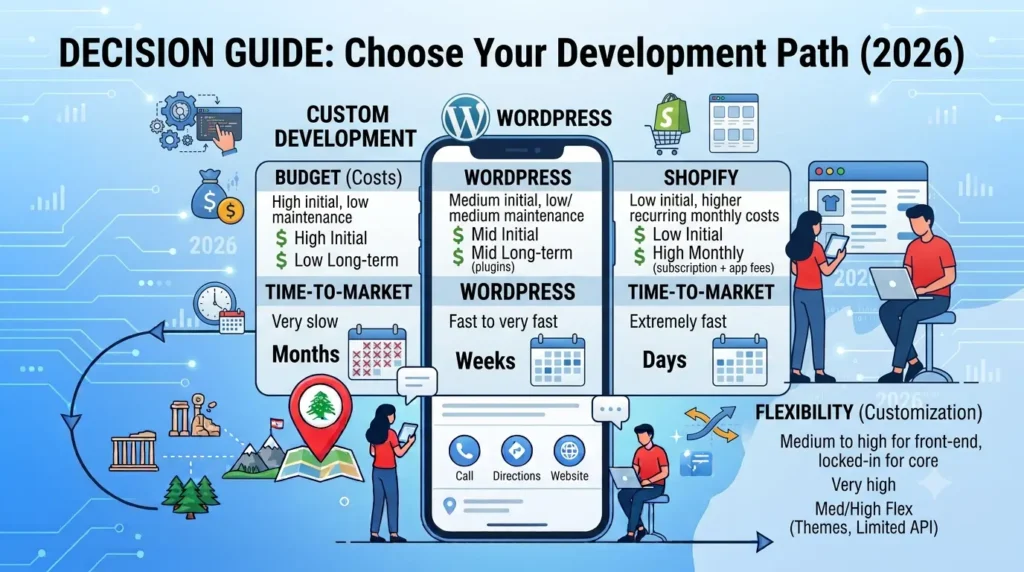
Total Cost of Ownership Over Three Years
Comparing platforms purely on launch price is one of the most common mistakes businesses make in this decision, because it ignores how costs accumulate differently over time. WordPress’s initial cost is often moderate, but ongoing plugin licenses, security monitoring, and periodic redesigns as the business grows add up steadily across three years. Shopify’s monthly subscription and transaction fees are predictable and easy to budget for, but they compound with sales volume — a store doing meaningful revenue can end up paying substantially more in cumulative platform fees than it would have paid for a custom build, especially once transaction volume climbs.
Custom development inverts this pattern: it has the highest upfront cost of the three, but no recurring platform fees or transaction cuts, and maintenance costs are typically limited to hosting, security, and periodic feature updates rather than ongoing licensing. Over a three-year horizon, a business with strong, growing transaction volume may find that a custom build actually costs less in total than Shopify’s cumulative fees, even though the launch price was higher. This is precisely why total cost of ownership, not just launch price, should drive the comparison — a decision that only looks at the invoice from month one is looking at a small fraction of the real cost picture.
Migration Considerations
Whichever platform a business starts on, it’s worth thinking ahead to whether a future migration will be painful or manageable. Moving from WordPress to Shopify, or vice versa, generally involves exporting content and product data, which is well-documented and reasonably straightforward for most standard sites. Migrating away from Shopify to a custom platform is more involved, since store data, customer accounts, and order history need to be carefully preserved through the transition, and downtime needs to be minimized for a business that depends on continuous sales.
Migrating a custom-built site to a different platform, or to a new custom architecture, tends to be the most involved of the three, simply because there’s no standardized export format for a bespoke system — everything depends on how the original build was structured and documented. This is one of the strongest arguments for working with a development partner who documents the build thoroughly from day one, regardless of which platform is chosen, since good documentation is what makes any future migration manageable rather than a rebuild from scratch.
Why This Comparison Matters for Businesses in Lebanon?
The custom web development vs website builders decision carries a few extra wrinkles for businesses operating in Lebanon specifically. Payment gateway availability is one of the first practical questions to resolve, since not every international payment processor supports Lebanese merchant accounts cleanly, and this can affect how well Shopify’s built-in checkout actually performs compared to a custom-integrated solution built around a gateway that does support local banking. Hosting choices matter too — a site with meaningful traffic from both Lebanon and the broader GCC region benefits from infrastructure decisions made with that specific audience in mind, which is easier to control on a custom build or a self-hosted WordPress setup than within Shopify’s more fixed infrastructure.
Currency handling is another practical factor. Businesses pricing in USD while operating locally, or planning eventual expansion into Gulf markets with different currencies, often find that custom development or a well-configured WordPress and WooCommerce setup gives more control over how pricing, currency switching, and multilingual content interact than Shopify’s more standardized approach allows. None of this makes Shopify the wrong choice for Lebanese ecommerce businesses — plenty run successfully on it — but it does mean the custom web development vs website builders conversation should include these regional specifics rather than relying purely on generic global comparisons.
A Simple Decision Framework
Rather than treating this as an abstract debate, it helps to apply a short set of questions directly to your own situation when weighing custom web development vs website builders. If the core need is selling physical products with standard ecommerce workflows and a limited technical team to manage it, Shopify is usually the fastest and most reliable path. If the site is primarily content and service-driven, needs strong SEO flexibility, and will be actively maintained by a developer or agency, WordPress offers the best balance of cost and capability. If the business has unusual functional requirements, plans to scale significantly, or needs deep integration with internal systems that no pre-built platform handles well, custom development is worth the higher upfront investment.
The honest answer to custom web development vs website builders is rarely “always choose one.” It’s a decision that should follow directly from the business’s growth stage, technical needs, and three-year outlook, not from which platform happens to be trending in a given year.
Frequently Asked Questions
Upfront, generally yes. Custom builds require designing and developing every feature from scratch, while WordPress and Shopify both offer significant pre-built functionality. Over a longer timeline, however, a custom build can sometimes cost less in total, particularly for high-volume ecommerce businesses avoiding recurring transaction fees.
Yes, and many growing businesses do exactly this. Starting on a platform with lower upfront cost while validating the business model, then migrating to a custom build once growth justifies the investment, is a common and reasonable path.
Shopify can support some content through its blog feature, but it’s fundamentally built around product pages and collections. Businesses needing substantial content marketing alongside ecommerce often pair Shopify with a separate content strategy or consider a headless setup instead.
Common signs include frequent performance issues despite optimization, security concerns from an accumulation of plugins, or functional needs that plugins can’t reasonably support without heavy custom coding — at that point, a custom build often becomes more cost-effective than continuing to patch WordPress.
Choosing based on launch price alone rather than total cost of ownership, and choosing a platform designed for a business size or type different from their own — either overbuilding early or underbuilding for growth that’s already underway.
Ready to Choose the Right Platform for Your Business?
Every platform decision should start with a clear picture of your business goals, budget, and growth plans, not a generic recommendation. Request a website quote from Creative 4 All and get a platform recommendation built around your specific situation, along with a realistic breakdown of what each option would actually cost.