

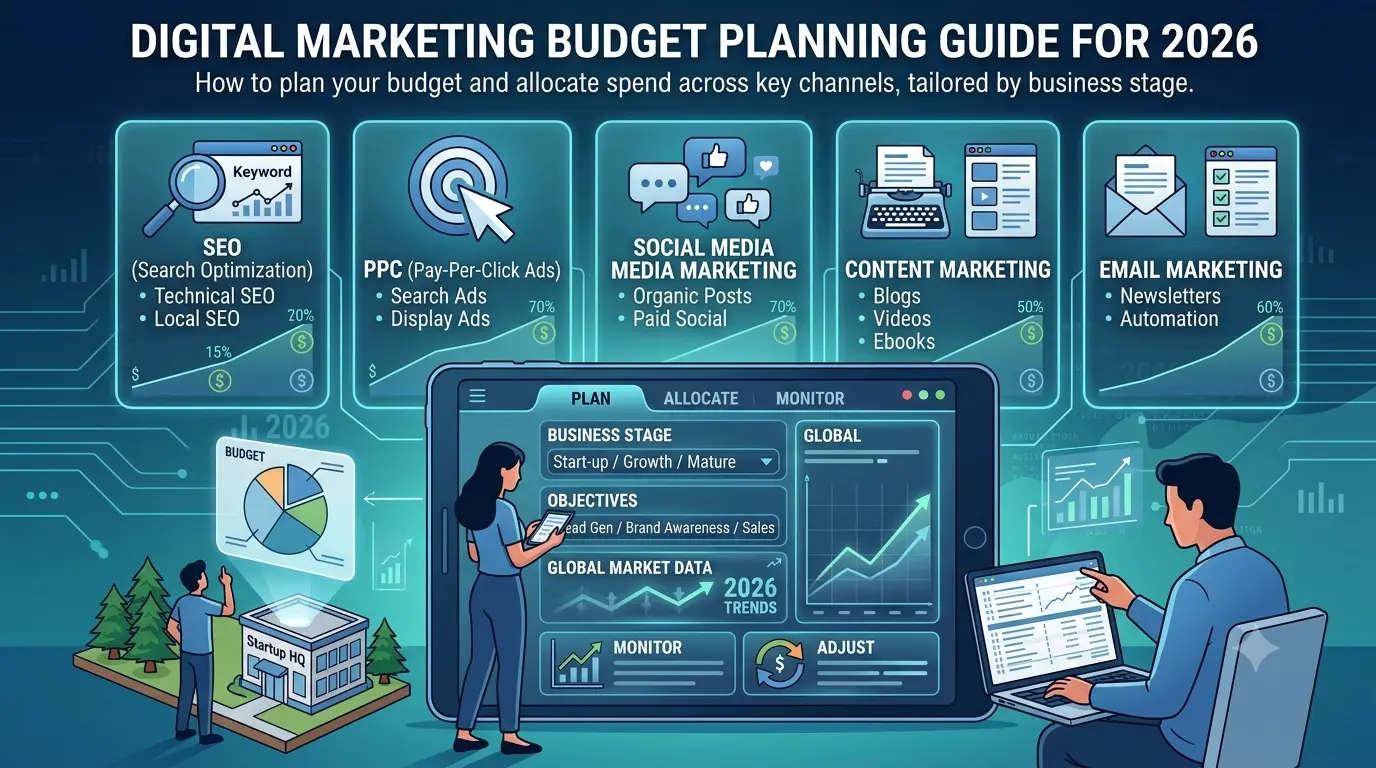
Every year, business owners across Lebanon sit down to plan next year’s numbers, and every year, the marketing line item gets treated differently than the rest of the budget. Sales targets get built from historical data and growth assumptions. Operations costs get calculated from clear inputs. But the digital marketing budget often gets set by gut feeling, by matching whatever a competitor seems to be spending, or by simply carrying over last year’s number without asking whether it was ever right in the first place.
That approach leaves money on the table in both directions. Underspending means missing the compounding returns that consistent SEO, content, and paid channels can build over time. Overspending, especially on channels that aren’t actually driving qualified leads, means capital that could have funded hiring, inventory, or product development instead sitting inside an ad account with a mediocre return. Getting the digital marketing budget right isn’t about finding a magic percentage — it’s about building a framework you can defend, adjust, and actually measure against.
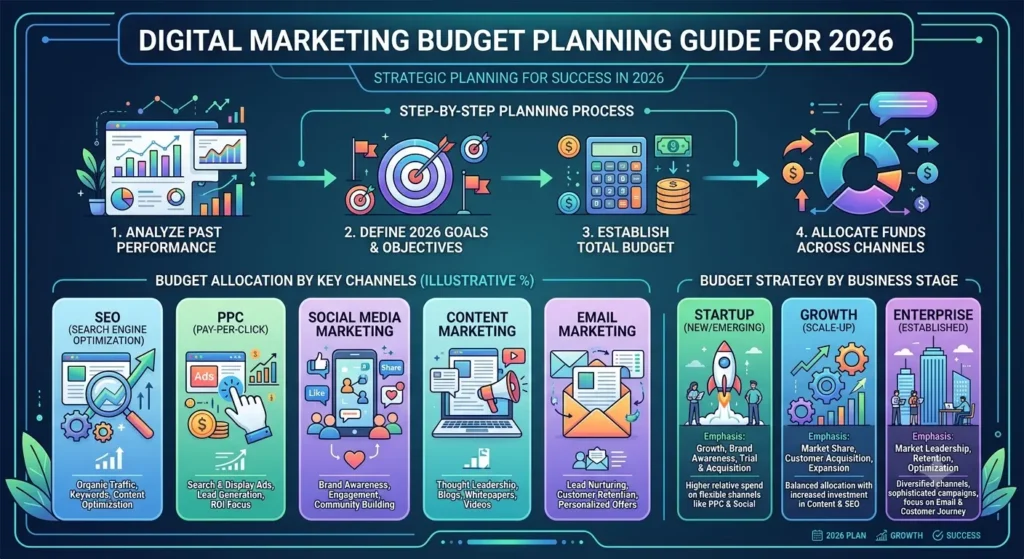
This guide walks through how to think about budget as a share of revenue, how to allocate that budget across SEO, PPC, social, content, and email, how the right mix shifts as a business matures, and the mistakes that consistently trip up business owners building this plan for the first time.
Thinking About Budget as a Percentage of Revenue
The most common starting point for building a digital marketing budget is anchoring it to a percentage of revenue rather than picking an arbitrary dollar figure. Industry benchmarks generally suggest that established businesses spend somewhere between 5% and 12% of revenue on marketing overall, with digital channels making up a growing share of that total each year. Newer businesses, or those pushing aggressively into a new market like the GCC, often need to spend closer to the higher end of that range, or even above it temporarily, since building initial visibility and trust costs more than maintaining an already-established position.
This percentage isn’t a fixed rule so much as a sanity check. A business spending 2% of revenue on digital marketing while trying to compete against established players is almost certainly underinvesting relative to its ambitions. A business spending 20% without a clear plan for what that spend is supposed to accomplish is likely burning capital on channels that haven’t been properly evaluated. The percentage gives you a starting range; the channel allocation and measurement plan is what makes that number defensible.
It’s also worth separating two categories that often get blended together: brand-building spend, which pays off gradually and is harder to attribute directly to revenue, and performance spend, which is measurable in a much more direct way through cost per lead or cost per acquisition. A healthy digital marketing budget typically includes both, but a business in growth mode usually weights more heavily toward performance channels early on, shifting gradually toward a more balanced mix as the brand becomes established.
Allocating Across Channels
Once the overall number is set, the harder question is how to split it. There’s no universal formula, because the right mix depends heavily on what a business sells, who it’s selling to, and how long its sales cycle typically runs. That said, each channel plays a distinct role worth understanding before assigning it a percentage of the budget.
SEO
SEO is a compounding investment rather than a channel you can turn on and off for immediate results. Spend here typically covers content production, technical optimization, and link-building work, and the return builds over months rather than days. Because of that lag, SEO often gets underfunded by businesses focused on quarterly results, even though it frequently ends up being the lowest cost-per-lead channel over a two-to-three-year horizon. A reasonable starting allocation for SEO sits in the range of 15% to 25% of the total digital marketing budget for most service businesses, scaling up for businesses in highly competitive categories.
PPC
Paid search and paid social campaigns deliver the fastest measurable results of any channel, which makes PPC the natural place to allocate budget when a business needs leads now rather than in six months. The tradeoff is that PPC spend stops producing results the moment the budget stops, unlike SEO or content, which continue generating traffic long after the initial investment. PPC allocations tend to run higher for ecommerce and highly transactional businesses, and lower for service businesses relying more heavily on trust-building content and local search visibility.
Social Media
Social media spend splits into two very different functions: organic content that builds brand presence and community, and paid social advertising that drives specific actions like leads or purchases. Businesses often underestimate how much time organic social requires relative to its direct revenue contribution, while overestimating how far a modest paid social budget will stretch. A realistic allocation treats social as a supporting channel for most B2B and service businesses, and a more central one for consumer-facing and ecommerce brands with visually driven products.
Content Marketing
Content marketing budget often overlaps with SEO spend, since much of what fuels organic search growth is the content itself. Beyond blog posts, this category covers case studies, guides, video, and any material that supports both search visibility and the sales process directly, giving a sales team something concrete to send a prospect mid-conversation. Businesses that treat content purely as an SEO tactic tend to underinvest in the sales-enablement side of content, missing an easy way to shorten sales cycles.
Email Marketing
Email consistently delivers one of the highest returns per dollar spent among digital channels, largely because it’s reaching an audience that has already opted in rather than a cold audience being introduced to the brand for the first time. Despite that return, email budgets are often the smallest line item, partly because the tooling costs are modest and partly because the strategic and creative work behind good email campaigns gets undervalued. A well-run email program deserves a modest but consistent allocation, since the audience list itself compounds in value over time.
Adjusting the Mix by Business Maturity
The right channel split shifts meaningfully depending on how established a business is. Early-stage businesses with limited brand recognition typically need to weight budget toward channels that build visibility quickly — PPC and, to a lesser extent, social advertising — while starting SEO and content investment early enough that it has time to compound before the business needs to rely on it. Waiting to invest in SEO until paid channels become too expensive to sustain is a common and costly sequencing mistake.
Established businesses with a steady base of organic traffic and brand recognition can typically shift more weight toward content, email, and retention-focused spend, since the cost of acquiring a new customer through paid channels tends to rise over time as competition in a category increases. Businesses expanding into new markets, such as a Lebanese business entering the broader GCC region, often need to temporarily rebuild the early-stage mix in that new market even while maintaining a more mature allocation in their established one.
Budgeting for Multilingual and Regional Reach
A factor that rarely appears in generic budgeting guides, but matters directly for businesses based in Lebanon, is the added cost of running a digital marketing budget across multiple languages and markets. Producing content, ad creative, and landing pages in Arabic, English, and French isn’t simply a translation line item — each language often performs differently across channels, requires separate keyword research, and sometimes needs distinct messaging to resonate with the audience in question.
Businesses expanding from a Lebanon-only footprint toward the broader GCC market should budget for this transition explicitly rather than assuming existing content and campaigns will translate directly. Search behavior, competitive intensity, and even preferred platforms can differ meaningfully between Lebanon and markets like the UAE or Saudi Arabia, and a digital marketing budget that doesn’t account for that gap tends to underperform in the new market while the business works out these differences through trial and error instead of upfront planning.
Common Digital Marketing Budget Mistakes
A handful of mistakes show up repeatedly in how businesses approach this planning process. Setting the budget once a year and never revisiting it means missing the chance to shift spend toward whatever channel is currently performing best, especially when a channel’s cost or effectiveness changes mid-year. Allocating budget based on what a competitor appears to be doing, rather than on what actually fits the business’s own sales cycle and customer acquisition costs, tends to produce a mix that looks reasonable on paper but doesn’t match the business’s real needs.
Underfunding measurement and attribution is another frequent gap — a business that can’t clearly see which channels are actually producing qualified leads ends up making next year’s allocation decisions with the same guesswork as this year’s. And treating the digital marketing budget as entirely separate from sales and operations, rather than as a connected system feeding qualified leads into a sales process that can actually convert them, often results in strong top-of-funnel numbers that never translate into revenue growth.
Frequently Asked Questions
Most established small businesses fall somewhere between 5% and 12% of revenue, with newer businesses or those entering competitive markets often spending toward the higher end temporarily to build initial visibility.
It depends on how quickly the business needs results and its runway for compounding returns. Businesses that can wait for organic growth to build tend to benefit from front-loading SEO investment; businesses that need leads immediately typically lean more heavily on PPC in the short term while building SEO in parallel.
Quarterly reviews are a reasonable minimum for most businesses, since channel performance and costs can shift meaningfully within a year. Monthly reviews of performance data, even without reallocating the full budget each time, help catch underperforming spend earlier.
Cutting spend entirely during a slowdown often costs more in lost momentum than it saves, particularly for compounding channels like SEO. A more effective approach is usually shifting the mix toward lower-cost, higher-return channels rather than eliminating spend altogether.
Tracking cost per lead and cost per acquisition by channel, rather than looking only at total spend or total leads, is the clearest way to see whether the budget is allocated efficiently or simply spread thin across too many channels.
Ready to Build a Budget That Actually Works?
A digital marketing budget only works if it’s built around your specific sales cycle, customer acquisition costs, and growth goals, not a generic industry percentage. Book a free digital marketing consultation with Creative 4 All and get a channel allocation plan built specifically around your business.