
“How long will this take?” is one of the first questions almost every business asks when starting a website project, and it’s also one of the questions agencies answer least consistently. A realistic website development timeline depends on genuine variables — scope, content readiness, and how quickly a client responds to feedback requests — but the pattern across those variables is predictable enough to describe clearly, rather than leaving a business guessing between “a few weeks” and “several months” with no sense of which factors actually determine the answer.
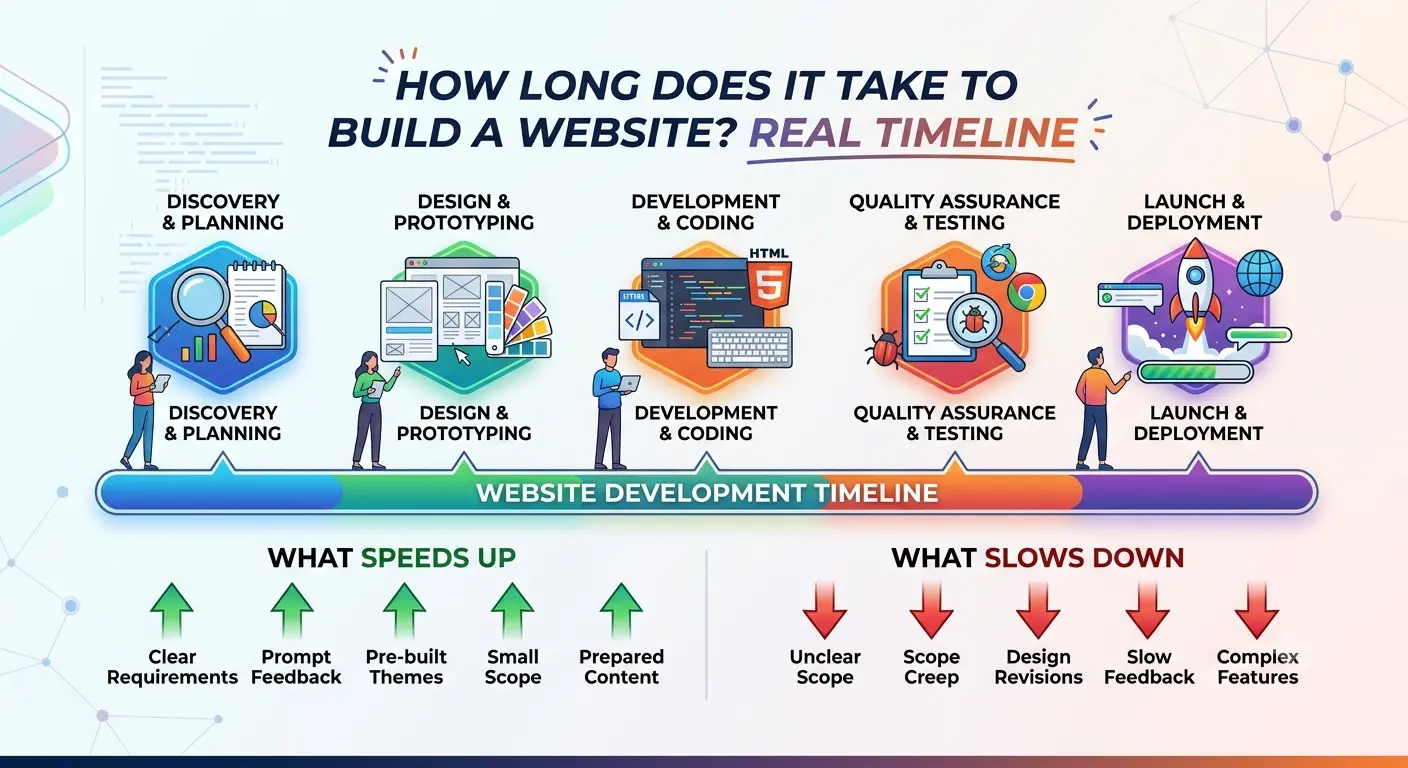
This guide walks through the typical phases of a website project — discovery, design, development, QA, and launch — what speeds up or slows down each phase of the website development timeline, how content readiness affects the overall schedule more than almost any other factor, and how to set milestones that keep a project moving without constant uncertainty about where things stand.
The Typical Phases of a Website Project
Discovery
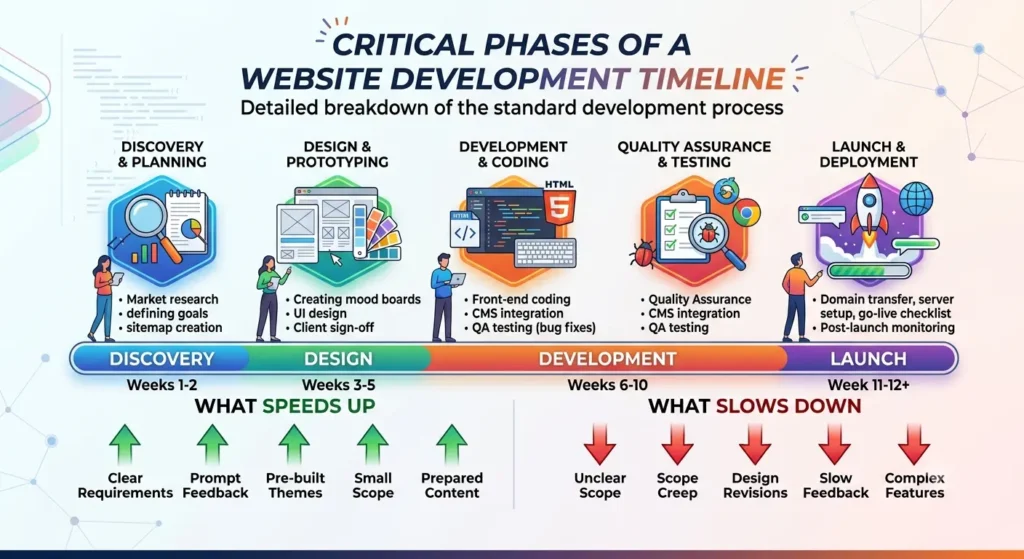
Discovery is where a project actually gets scoped: understanding the business’s goals, target audience, competitive positioning, required features, and content structure before any design or development work begins. For a straightforward business website, discovery typically takes one to two weeks; for a more complex project involving custom functionality or ecommerce, it can extend to three or four weeks, since more variables need to be understood and agreed upon before later phases can proceed efficiently. Rushing discovery to save time almost always costs more time later, since decisions made without proper groundwork tend to get revisited mid-project once a gap in understanding becomes apparent.
Design
The design phase translates discovery findings into an actual visual direction — wireframes establishing layout and structure, followed by full visual design for key page templates. This phase typically takes two to four weeks for a standard business website, though it can extend meaningfully longer if a client requests several rounds of significant revisions rather than refining within an established direction. A well-run design phase includes clear checkpoints — wireframe approval before moving to full visual design, for instance — that prevent a client from requesting a fundamental direction change after visual design work has already progressed significantly.
Development
Development is where approved designs get built into an actual functioning website — coding the front-end, setting up the CMS, building any custom functionality, and integrating the systems the site needs to connect with. This phase’s length varies more than any other based on project complexity: a straightforward brochure site might take two to three weeks, while a site with custom features, ecommerce functionality, or complex integrations can take six to eight weeks or more. Development timelines are also where scope creep does the most damage, since adding functionality mid-development often requires reworking already-completed work rather than simply adding time proportional to the new feature alone.
QA and Launch
Quality assurance testing checks the site across browsers, devices, and use cases before launch — catching broken links, display issues on specific devices, form functionality problems, and any other issues that wouldn’t be obvious without deliberate testing. This phase typically takes one to two weeks for a standard site, though it can extend further for a project with more complex functionality requiring more extensive testing scenarios. Launch itself is usually quick once QA is complete, but it should never be treated as instantaneous — DNS propagation, final content checks, and a brief monitoring period after going live all need to be built into the schedule rather than assumed to happen automatically the moment a switch gets flipped.
How a Good Brief Shortens the Timeline?
The quality of the initial brief a business provides has a direct, measurable effect on the overall website development timeline, since a clear brief reduces how much time discovery needs to spend extracting basic information that could have been provided upfront. A brief that clearly states the business’s goals, target audience, required pages and features, examples of design directions the business likes or dislikes, and any hard constraints (existing brand guidelines, required integrations, budget range) lets discovery move directly into deeper strategic questions rather than starting from a blank page.
Businesses that come to a first meeting only able to say “we need a website” without any further specifics tend to see a longer discovery phase almost by necessity, since that information has to be extracted through additional rounds of questions and follow-up before the project can move forward. Investing time in a thoughtful brief before the project even starts is one of the highest-leverage ways to compress an overall website development timeline without cutting corners on any individual phase.
What Speeds Up or Slows Down a Build?
Beyond the phases themselves, a handful of factors consistently determine whether a website development timeline runs close to its original estimate or stretches well beyond it. Response time to feedback requests is one of the most significant: a client who reviews and responds to design or content approval requests within a day or two keeps a project moving at its planned pace, while a client who takes a week or more to respond at each checkpoint can add weeks to the overall timeline without a single day of actual work time changing.
Scope stability matters just as much. A project with a clearly defined, agreed-upon scope from the start moves through each phase predictably; a project where new features or pages get added mid-way through development inevitably extends the timeline, since that new scope needs its own design, development, and testing regardless of when it’s introduced. Decision-making structure within the client organization also plays a role — a single decision-maker who can approve directions quickly keeps a project moving faster than a structure requiring sign-off from multiple stakeholders with competing opinions, since each additional layer of approval adds time even when everyone eventually agrees.
How Content Readiness Affects Timelines?
Content readiness is one of the most underestimated factors in any website development timeline, and it’s also one of the most common reasons a project runs behind schedule. A website can’t be properly designed around content that doesn’t exist yet — text, images, and any other content assets ideally need to be finalized, or at least substantially drafted, before or during the design phase, not after development has already begun. Projects that start development with placeholder “lorem ipsum” text in place of real content often find that finalized content doesn’t actually fit the designed layout once it arrives, requiring design rework that could have been avoided entirely.
Businesses that come to a project with content already prepared — service descriptions, team bios, photography, case studies — consistently move through the full process faster than those expecting the agency to extract that content from them piece by piece throughout the project. Treating content preparation as parallel work that should begin alongside discovery, rather than something to figure out once design and development are already underway, is one of the most effective ways a business can meaningfully shorten its own project timeline.
Setting Milestones That Keep a Project on Track
A project without clear milestones tends to feel like an open-ended black box to the client, with uncertainty accumulating the longer a phase runs without a visible checkpoint. Breaking a project into concrete milestones — discovery sign-off, wireframe approval, visual design approval, development complete, QA complete, launch — gives both the agency and the client a shared reference point for where a project actually stands relative to its planned timeline, rather than a vague sense of “it’s coming along.”
Each milestone should have a clear definition of what “done” looks like and a specific window for client feedback, since an open-ended “let us know your thoughts whenever” review period is one of the most common ways a well-planned timeline quietly slips. Regular, brief check-ins between milestones — even a short weekly update — keep both sides aligned on progress and catch potential delays early, before they compound into a significant schedule slip discovered only when a milestone deadline has already passed.
Frequently Asked Questions
A straightforward business website with a handful of pages and no custom functionality typically takes six to ten weeks from discovery through launch, assuming reasonably prompt client feedback and content that’s ready or nearly ready when the project starts.
The most common causes are content that isn’t ready when needed, scope changes introduced mid-project, and slow client response times at feedback checkpoints — all factors largely within the client’s control to manage, alongside the agency’s own execution pace.
Sometimes, through additional resources dedicated to the project, but faster timelines have real limits — design and development quality work still takes the time it takes, and rushing certain phases, particularly QA, tends to introduce problems that cost more time to fix after launch than was saved during the build.
Realistically, plan for content preparation to run in parallel with the early project phases rather than starting it only once requested, and budget one to two business days for reviewing and responding to each major approval request to keep the project moving at its planned pace.
Adding scope mid-project is possible but should be expected to extend the timeline, since new functionality needs its own design, development, and testing work regardless of when it’s introduced. A good agency will clearly communicate the timeline impact of any scope addition before proceeding with it.
Ready to Build a Website on a Timeline You Can Actually Plan Around?
A realistic website development timeline starts with a clear scope and honest expectations set before the project begins. Request a website quote from Creative 4 All and get a project timeline built around your specific site’s actual requirements.