
Once a business decides SEO is worth investing in, the next decision is rarely straightforward: build an in-house team, hire an agency, or bring on a freelancer. Each model has genuine advantages, and the right answer in the SEO agency vs in-house SEO debate depends far more on your business’s size, growth stage, and internal capacity than on any universal ranking of which option is “best.” This comparison walks through the real tradeoffs on cost, expertise, and accountability, then gives a practical framework for matching the right model to your specific situation.
Comparing the Three Models on Cost, Expertise, and Accountability
Cost Structures: Salary vs. Retainer vs. Hourly/Project
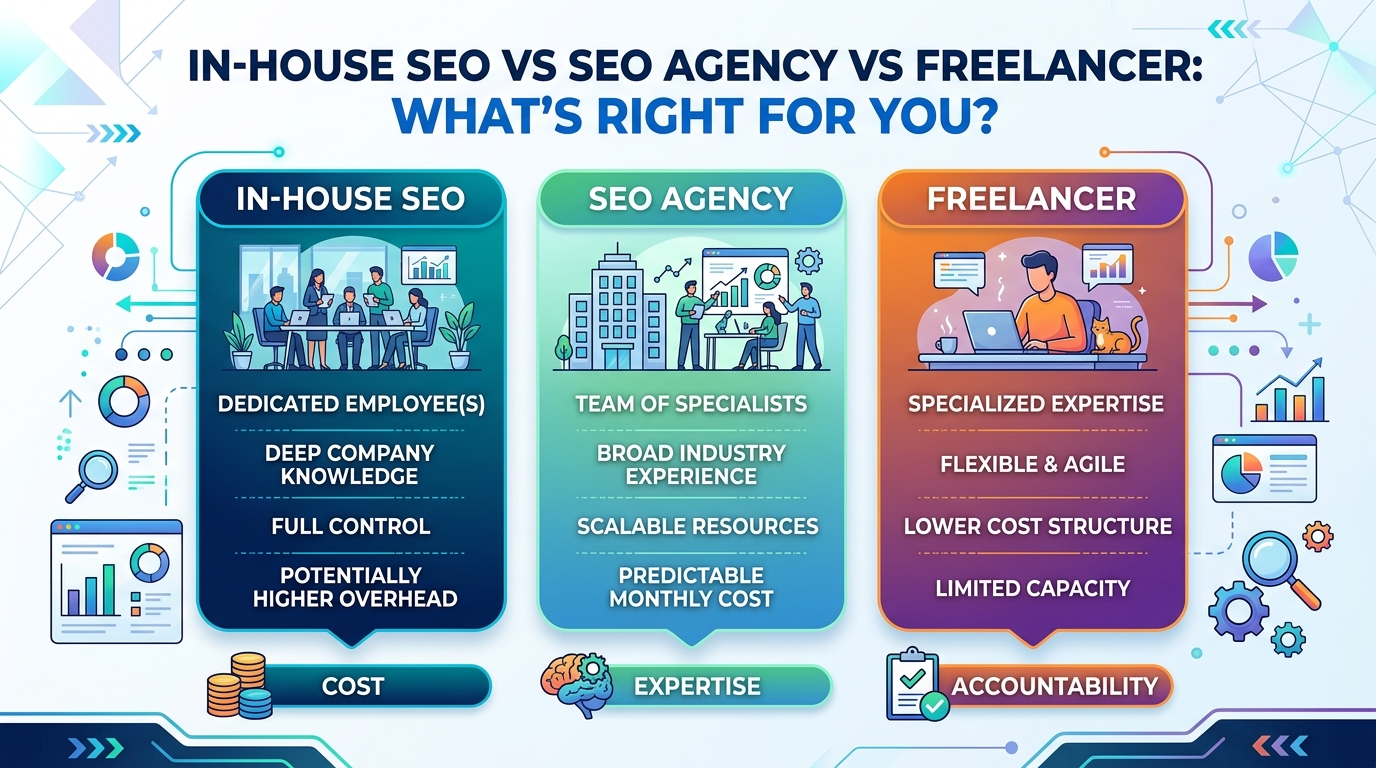
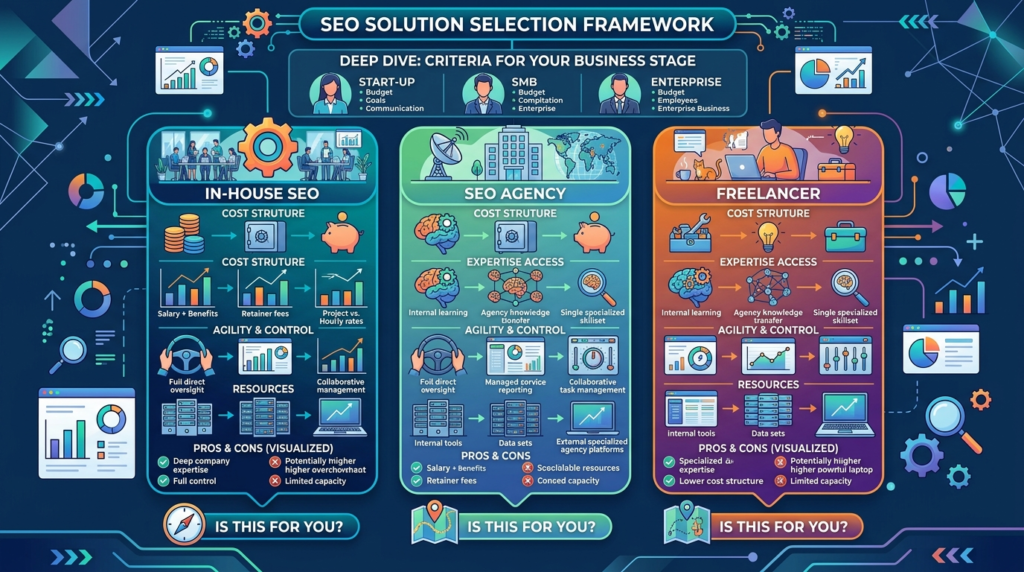
An in-house SEO hire comes with a full salary, benefits, and the ongoing overhead of employment, typically representing the highest fixed monthly cost of the three models but with the most predictable long-term spend once hired. An SEO agency vs in-house SEO cost comparison usually favors the agency at smaller budgets, since a monthly retainer buys access to a full team’s combined expertise without the fixed cost of multiple full-time salaries. Freelancers typically offer the lowest entry cost, billing hourly or per project, but that lower cost usually comes with narrower scope and less redundancy if something goes wrong.
Breadth of Expertise Each Model Realistically Offers
SEO spans technical implementation, content strategy, link building, local SEO, and analytics — a genuinely broad skill set that one person, however skilled, rarely covers with equal depth across every area. An agency’s core structural advantage is access to specialists across these subdomains without a business needing to hire each one individually. A single in-house hire or freelancer, by contrast, typically brings deeper strength in one or two areas and comparatively less depth elsewhere, which is not necessarily a problem if that person’s strengths happen to match the business’s most pressing needs, but becomes a real gap if they don’t.
Who’s Accountable When Rankings Don’t Improve?
Agency accountability is structured differently from an individual hire’s. A reputable SEO agency operates under a service agreement with defined deliverables and reporting expectations, and switching providers is a contractual decision rather than a personnel one if results consistently disappoint. An in-house employee’s accountability is managed through normal performance review processes, which can be slower to act on and more personally complicated, particularly in a small business where there may not be another SEO-literate person able to evaluate whether the employee’s work is actually sound. Freelance SEO risk often centers on this same accountability gap: a freelancer working independently with minimal oversight can underperform for months before a business without internal SEO knowledge notices something is wrong.
When In-House SEO Makes Sense?
Enterprise-Scale Content and Technical Needs
Businesses publishing large volumes of content regularly, managing complex technical SEO across an extensive website, or operating in a highly specialized industry where deep, continuous product knowledge is essential to producing genuinely authoritative content tend to benefit most from an in-house SEO team structure. At this scale, the fixed cost of a dedicated employee (or small team) is usually justified by the sheer volume of ongoing work, and having someone embedded in the business day-to-day allows for a depth of institutional knowledge that an external provider, however skilled, takes considerably longer to build.
Deep Product or Industry Knowledge Requirements
Highly technical or regulated industries — certain B2B software categories, specialized medical fields, complex financial products — often require content written by someone with genuine subject matter depth, not just SEO skill applied generically. In these cases, an in-house hire who combines industry knowledge with SEO competency, or close, ongoing collaboration between an in-house subject matter expert and an SEO specialist, tends to produce stronger results than an outside provider working from secondhand information alone.
When Hiring a Freelancer Is a Real Risk?
Single Points of Failure
The most significant freelance SEO risk is dependency on a single individual with no backup if they become unavailable, whether through illness, a shift in priorities, or simply taking on too many other clients. A business relying entirely on one freelancer for its SEO has no built-in redundancy if that relationship ends unexpectedly, and rebuilding institutional knowledge with a replacement can set momentum back by months. This risk grows more serious the more central SEO becomes to the business’s overall growth strategy.
Limited Scope and Scalability
Freelancers typically operate with limited bandwidth, which works well for narrowly scoped projects but becomes a genuine constraint once a business’s SEO needs expand beyond what one person can reasonably manage. A freelancer handling content, technical SEO, and link building simultaneously for a growing business is often stretched thin across all three, producing adequate but not exceptional results in each area rather than genuine depth in any of them.
What a Good Agency Relationship Actually Looks Like?
Transparency and Reporting Standards
A well-run agency relationship includes regular, specific reporting — not just vanity metrics like overall traffic, but the concrete work completed each period, the reasoning behind strategic decisions, and honest context around results that take time to materialize. Vague monthly updates that report activity without connecting it to measurable progress toward business goals are a warning sign worth taking seriously, regardless of how polished the presentation looks.
Questions to Ask Any Provider Before Signing
Before committing to hire SEO agency or freelancer arrangements, a business should ask specific questions: who exactly will be working on the account day to day, what reporting cadence and format to expect, how success will be measured and over what timeline, and what happens if results underperform relative to what was projected. A provider unwilling or unable to answer these questions concretely and specifically, rather than in generic marketing language, is a signal worth taking seriously before signing any agreement.
How to Match the Right Model to Your Growth Stage?
Early-Stage and Small Businesses
For a small business just getting serious about SEO, a freelancer or a small agency retainer is usually the sensible starting point. The financial commitment is lower, the relationship is easier to end if it is not working out, and the scope of work at this stage — a handful of core pages, a modest content cadence, foundational technical fixes — rarely requires the breadth of a full agency team or the fixed cost of an in-house hire. The decision to outsource SEO at this stage is less about avoiding an in-house team forever and more about not committing to fixed overhead before the business has clarity on how central SEO will become to its growth.
Scaling Businesses With Growing Content Needs
As a business grows and its content, technical, and link-building needs expand beyond what one freelancer can reasonably manage, an agency typically becomes the better fit, since it provides access to a coordinated team without the business needing to directly manage multiple specialists or make several separate hires. This middle stage is where the SEO agency vs in-house SEO decision becomes genuinely close for many businesses, and the deciding factor is often less about cost and more about how much day-to-day involvement the business wants in directing SEO strategy versus delegating it to an outside team.
Large or Highly Specialized Organizations
Once a business reaches a scale where SEO work is essentially continuous — regular content production, ongoing technical maintenance across a large site, and a strategy that needs tight coordination with product, sales, and other internal teams — an in-house team or a hybrid model combining in-house strategy with agency execution support often becomes the most sustainable long-term structure. At this scale, the cost of a dedicated team is typically justified by both the volume of work and the value of having SEO strategy owned by someone embedded in the business rather than managed at arm’s length.
Hybrid Models Worth Considering
Combining In-House Strategy With Agency Execution
Some of the most effective setups do not fit neatly into any single category. A business might keep SEO strategy and prioritization in-house, owned by someone who understands the product and market deeply, while outsourcing execution-heavy work like content production or technical implementation to an agency or freelancer. This hybrid approach captures much of the accountability and institutional knowledge benefit of an in-house role while still accessing the broader specialist bandwidth an agency provides, often at a lower total cost than a fully in-house team of equivalent scope.
When a Hybrid Approach Creates More Complexity Than It Solves?
Hybrid arrangements work best when responsibilities are clearly divided and communication between the in-house and outsourced sides is genuinely consistent. When that clarity is missing, a hybrid model can create the worst of both worlds — unclear accountability when something goes wrong, and duplicated or contradictory work between the in-house and outsourced parties. Before adopting this structure, it is worth explicitly documenting who owns which decisions and how the two sides will stay coordinated, rather than assuming it will work itself out informally.
Frequently Asked Questions
At smaller budgets, outsourcing to an agency or freelancer is usually cheaper than a full-time in-house hire, since a retainer or project fee avoids the fixed overhead of a salary and benefits. As SEO needs grow substantially, the economics can shift, and a dedicated in-house hire may become more cost-effective than an expanding agency retainer.
Ask for specific, verifiable case studies with measurable results, not just a general portfolio. A qualified freelancer should be comfortable explaining their reasoning for strategic decisions in plain language and should be transparent about the limits of what they can realistically handle alone.
Regardless of the model chosen, SEO generally takes three to six months to show meaningful results, sometimes longer in competitive industries. This timeline applies whether the work is done in-house, by an agency, or by a freelancer, since the underlying mechanics of how search engines build trust in content do not change based on who is doing the work.
Yes, and many businesses do exactly this — starting with a freelancer or small agency retainer while budgets are limited, then transitioning to an in-house hire or larger agency engagement as SEO becomes a larger part of the overall growth strategy and the volume of work justifies the change.
Choosing based purely on cost without considering the accountability and scalability tradeoffs each model carries. The cheapest option in the short term can become the most expensive if it leads to months of underperformance that go unnoticed due to a lack of internal SEO expertise to catch the problem early.
Ready to Find the Right SEO Model for Your Business?
Whether in-house, agency, or freelance is the right fit depends on your business’s stage, budget, and internal capacity, not a one-size-fits-all answer to the SEO agency vs in-house SEO question. Creative 4 All offers transparent, accountable SEO services for businesses across Lebanon and the GCC, with clear reporting and no vague promises. Get a Free SEO Audit to see exactly where your current SEO stands and what a well-structured engagement could look like.