The HR manager of a Beirut-based group answers the same questions every week. How many annual leave days do new employees get? What is the policy on remote work? Where is the medical insurance form? The answers exist, buried in a 60-page handbook, three policy updates and an email from last year. Meanwhile, the customer support team does the same with product specifications and return policies. Everyone wants a RAG chatbot for business, even if they have never heard the term: an assistant that answers from the company’s own documents, accurately, without inventing anything.
That is exactly what a RAG chatbot for business is designed to do. RAG, short for retrieval-augmented generation, combines a search over your own documents with an AI model that writes the answer from what it found. This guide explains how it works in plain language, how it differs from fine-tuning and custom GPTs, what it takes to handle Arabic and bilingual content, how to keep answers accurate and secure, and what drives the cost.
Retrieval-Augmented Generation Explained
Large language models, the technology behind tools like ChatGPT, are trained on vast amounts of public text. They write fluently, but they do not know your leave policy, your price list or last month’s product update. Ask them anyway and they may produce a confident, plausible and wrong answer, often called a hallucination.
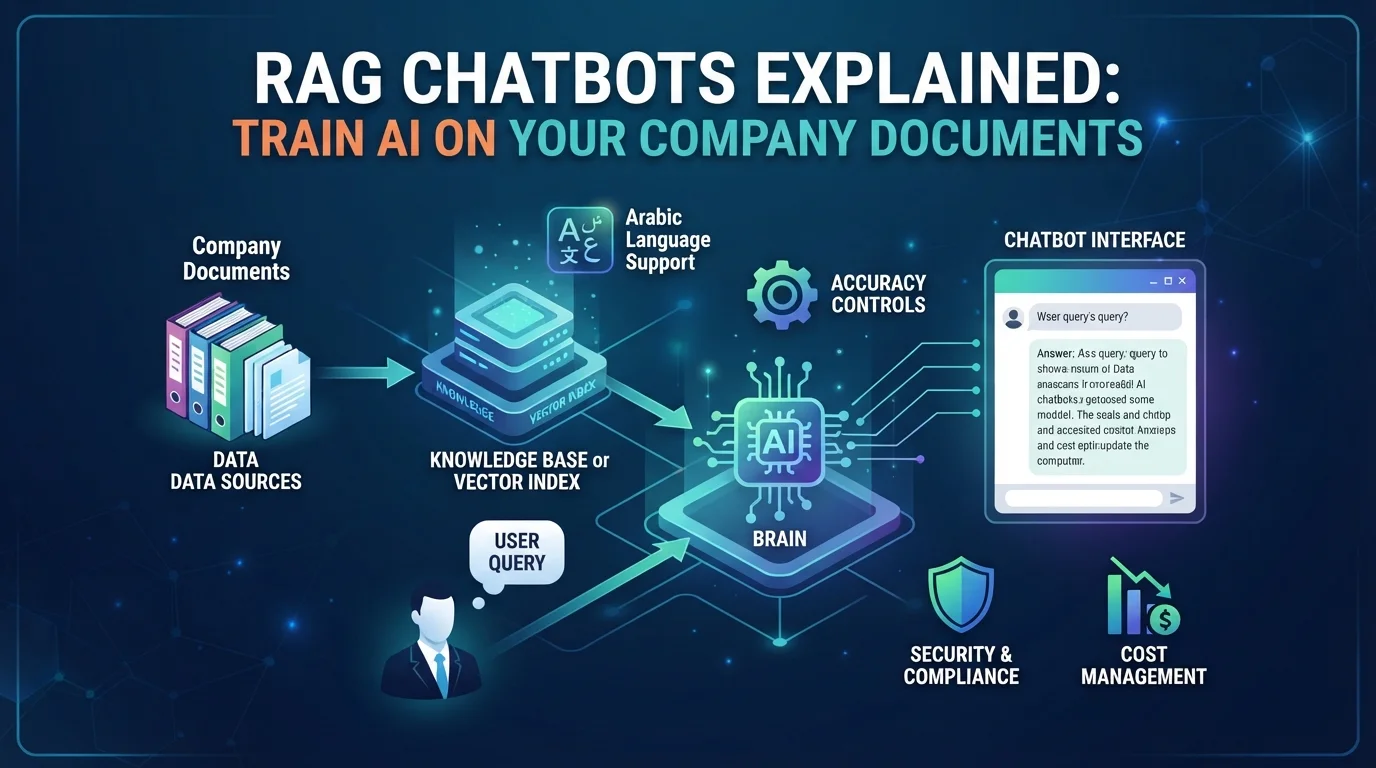
Retrieval-augmented generation explained simply: before the model answers, the system first searches your approved documents for the passages most relevant to the question, then gives those passages to the model with an instruction to answer only from them. The model handles language and phrasing; your documents supply the facts. Because the answer is grounded in specific sources, the bot can also show where each answer came from, so users can check it.
This is why an AI knowledge base chatbot built on RAG is usually the most practical way to train a chatbot on company data. You are not teaching the model new facts permanently; you are giving it the right pages to read at the moment of each question.
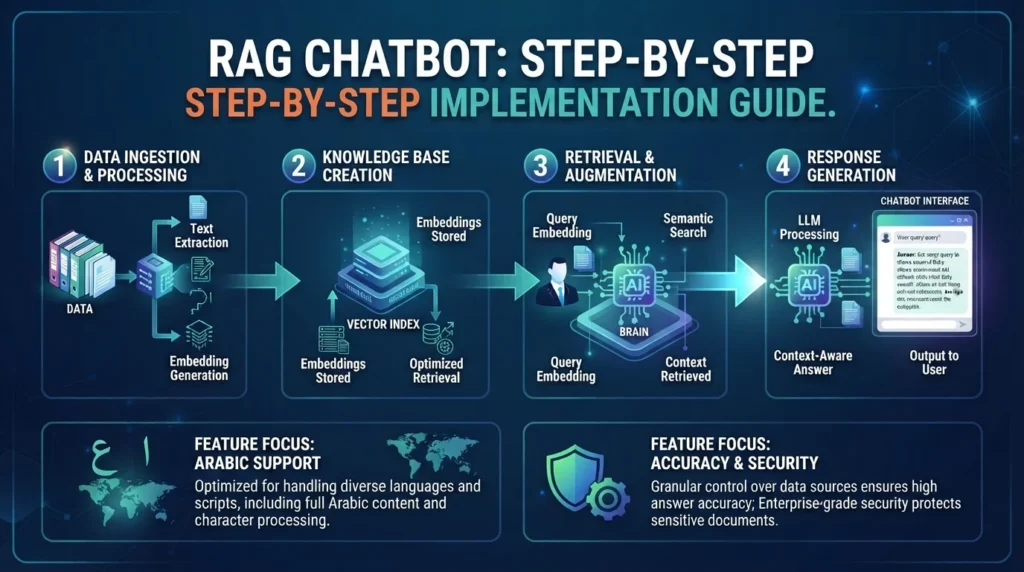
How a RAG Chatbot for Business Works, Step by Step?
Behind the simple chat window, a RAG system follows a clear pipeline.
1. Collect and Prepare the Content
Gather the documents the bot should answer from: policies, manuals, FAQs, product sheets, contracts templates, help-centre articles. Remove outdated versions and duplicates, and decide who owns each document. This step is unglamorous, but it determines quality more than any technology choice.
2. Split Into Chunks and Create Embeddings
Documents are split into smaller sections, often a few paragraphs each, so the system can retrieve precise passages rather than whole files. Each chunk is converted into an embedding: a numerical representation of its meaning that lets the system find passages that mean the same thing even when they use different words.
3. Store and Search
Embeddings are stored in a vector database or search index. When a user asks a question, the system converts the question into an embedding and retrieves the most relevant chunks. Many strong systems use hybrid search, combining meaning-based search with traditional keyword search, which helps with product codes, names and exact terms.
4. Generate an Answer With Sources
The retrieved passages are passed to the language model with instructions: answer only from these sources, cite them, and say clearly when the answer is not in the documents. The response appears in the chat with links or references to the original documents.
5. Hand Off and Learn
When the bot cannot find an answer, or the topic is sensitive, it hands the conversation to a person. Logged questions, especially unanswered ones, show which documents are missing or unclear.
RAG vs Fine-Tuning vs Custom GPTs
Businesses often hear three options and are unsure which they need.
Fine-tuning retrains a model on examples to change its style or behaviour. It is useful for teaching a specific tone or format, but it is a poor way to store changing facts like prices and policies, because updating them means retraining.
A custom GPT for business, in the sense of a configurable assistant inside a platform such as ChatGPT with uploaded files, can be a quick way to experiment with a handful of documents. For company-wide use, it often falls short on access control, integration with your systems, multilingual tuning, branding and logging.
A RAG system built for your organisation keeps facts in your documents, updates as soon as documents change, supports permissions, integrates with your website, WhatsApp or internal tools, and gives you full visibility of questions and answers. For most companies that want a reliable RAG chatbot for business, this is the right foundation. Our article on AI agents vs chatbots vs RPA explains where RAG chatbots sit among other automation options.
Handling Arabic and Bilingual Documents
For companies in Lebanon and the Gulf, language is where many RAG projects succeed or struggle.
Documents often exist in Arabic, English and sometimes French, and employees or customers ask questions in any of them, including Lebanese dialect and Arabizi. Choose embedding and language models that perform well across the languages you use, and test retrieval with real questions: an Arabic question should find an English policy if that is the only version, and the answer should come back in the user’s language.
Scanned PDFs are a frequent obstacle. If policies or contracts exist only as scanned images, they need optical character recognition (OCR) first, and Arabic OCR quality varies, especially with older scans, tables and handwriting. Converting key documents into clean digital text before launch prevents many wrong answers later. Normalising Arabic spelling variants and including common dialect phrasings in FAQs also improves matching. Our guide to Arabic dialect and Arabizi chatbots covers the conversational side in more detail.
Keeping Answers Accurate
A RAG chatbot for business is only as trustworthy as its controls. Instruct the model to answer strictly from retrieved sources and to say “I could not find this in our documents” rather than guessing. Show citations with every answer so users can verify. Keep documents current: assign owners, review dates and a simple process for replacing outdated files.
Before launch, build an evaluation set of real questions with correct answers, including tricky ones and questions the bot should refuse. Test the system against it, and repeat the test whenever you change models, prompts or documents. After launch, review unanswered and low-rated conversations weekly. Our article on the ethics and limits of AI automation discusses where human judgment must remain.
Security, Permissions and Privacy
Not every employee should see every document. An internal assistant must respect permissions, so that a sales representative cannot retrieve HR salary policies or board minutes. This is called permission-aware retrieval, and it should be designed in from the start, typically by connecting the bot to your existing identity system and document permissions.
Check your AI provider’s data terms, including whether your data is used to train their models and where it is processed. Avoid feeding the system documents containing sensitive personal data unless there is a clear need and proper safeguards. Lebanon’s Law No. 81 of 2018 governs personal data processing, and organisations serving Saudi customers must consider the Personal Data Protection Law, including rules on transferring data abroad. For regulated sectors such as healthcare and finance, take legal advice before deployment.
What Drives the Cost of a RAG Chatbot?
Costs fall into a few categories. Content preparation is often the largest effort at the start: collecting, cleaning, digitising and structuring documents. Build and integration covers the retrieval pipeline, chat interface, connections to your website, WhatsApp, intranet or helpdesk, and permissions. Running costs include hosting, the vector database and AI model usage, which grows with the number of questions. Maintenance covers updating documents, monitoring quality and adjusting as models evolve.
A focused internal assistant answering from a few hundred clean documents is a very different project from a customer-facing bot integrated with multiple systems in three languages. Our guide to AI automation costs explains how to scope and budget these projects realistically.
Where a RAG Chatbot for Business Delivers Value?
The best use cases share two features: frequent repeated questions and reliable written answers. Common examples include HR and policy assistants for employees, customer support bots answering from product catalogues and return policies, sales enablement assistants that find specifications and case studies quickly, technical support bots built on manuals, and clinic or school assistants answering routine questions from approved information. In each case, the bot handles the repetitive load and frees people for complex work.
How to Start: A Practical Pilot?
Rather than launching company-wide, start with a pilot. Pick one team and one document set, such as HR policies or a product range. Define 50 to 100 real questions with correct answers, clean the documents, build the assistant and test it against those questions. Launch to a small group, collect feedback for a few weeks, then expand. Our AI readiness checklist helps you assess whether your data and processes are ready before you begin.
Frequently Asked Questions
A RAG chatbot uses retrieval-augmented generation: it searches your approved documents for relevant passages, then uses an AI model to write an answer based only on those passages, usually with citations. This keeps answers grounded in your own information rather than the model’s general knowledge.
For most businesses, the best approach is RAG rather than retraining a model. Collect and clean your documents, split them into searchable chunks, store them in a search index, and connect a language model that answers only from retrieved passages. Test with real questions before launch.
A custom GPT with uploaded files can be useful for quick experiments with a few documents. For company-wide use, you usually need stronger access control, integrations, multilingual tuning, branding and logging, which a purpose-built RAG system provides.
Yes, if the models chosen handle both languages well. Test retrieval with real Arabic questions, make sure answers return in the user’s language, and convert scanned Arabic documents into clean text so they can be searched accurately.
Instruct it to answer only from retrieved sources, show citations, refuse when information is missing, keep documents current, and test regularly against an evaluation set of real questions. Hand sensitive or uncertain cases to a person.
Turn Your Documents Into a Reliable Assistant
Your company already has the answers; they are just hard to find. A well-built RAG chatbot for business makes them instantly accessible to employees and customers in Arabic, English and French, with sources they can trust and safeguards that protect sensitive information.
If you would like to explore a knowledge-base assistant for your team or customers, the Creative 4 All team can assess your documents, design the right architecture and run a focused pilot. Explore our AI agents, automation and chatbot services in Lebanon and book a free automation consultation or chatbot demo through the form or on WhatsApp.