
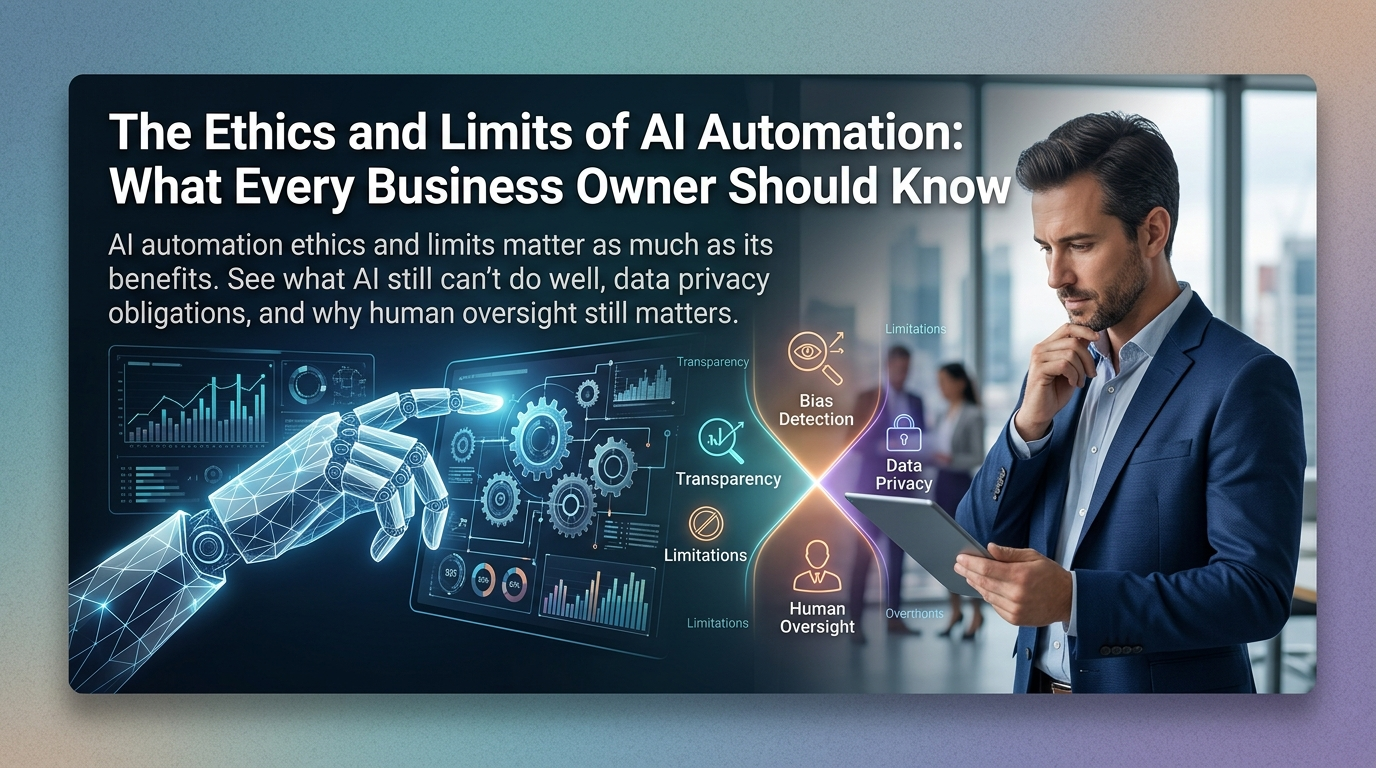
Most conversations about AI automation focus entirely on what it can do, understandably, since that is what sells the technology. A genuinely useful conversation also needs to cover what it cannot yet do well, what obligations a business takes on when it puts AI in front of customers, and where human oversight remains necessary regardless of how capable a given system appears. This is not a case against automation — it is a case for adopting it with clear eyes, since the businesses that deploy AI most successfully tend to be the ones that understand its limits as clearly as its strengths. This article covers exactly that: the current boundaries of what automation handles well, the data privacy and transparency obligations that come with deploying it, and why human oversight remains part of responsible practice rather than a temporary crutch to remove once the technology improves.
What AI Automation Cannot (Yet) Do Well?
Nuanced Emotional and Ethical Situations
AI systems, however sophisticated, still struggle with situations requiring genuine emotional nuance or ethical judgment calls that depend on context an automated system was never designed to weigh. A customer expressing genuine distress, a situation involving competing values with no clean answer, or a case where the “correct” response depends on reading subtle human cues all remain areas where automation performs unreliably at best. Businesses that recognize this limitation route these situations to human staff rather than trusting automation to handle them appropriately.
Truly Novel Problems
Automated systems perform within the boundaries of what they were designed and trained to handle, and situations genuinely outside those boundaries — a scenario nobody anticipated, an unusual combination of circumstances, a problem the system has never encountered in any form — expose the limits of even well-built automation. This is a structural limitation rather than a solvable engineering problem: no system can be prepared for every possible novel situation, which is precisely why ongoing human oversight remains part of a responsible automation deployment rather than something to eliminate entirely once the system seems to be working well.
Data Privacy and Customer Transparency Obligations
What Customers Deserve to Know?
Responsible AI use includes being honest with customers about when they are interacting with an automated system rather than a human being, and about how their data is being used within that interaction. Customers who discover after the fact that they were talking to an AI system, when they believed otherwise, often feel genuinely deceived, and this erosion of trust tends to cost a business considerably more than any efficiency gained by obscuring the automation in the first place.
Handling Data Responsibly
Any AI automation touching customer data carries real data privacy obligations — collecting only what is genuinely necessary, storing it securely, and being clear about how long it is retained and who can access it. Businesses implementing automation should treat these obligations as a design requirement from the start rather than an afterthought addressed only if a customer or regulator raises a concern, since retrofitting privacy protections onto an already-deployed system is considerably harder than building them in from the beginning.
The Case for Human Oversight in Customer-Facing Automation
Why Human-in-the-Loop Still Matters?
A human-in-the-loop approach, where automation handles routine interactions but a human reviews or can intervene in more sensitive or ambiguous cases, provides a meaningful safety net against the automation’s structural limitations. This does not mean every automated interaction needs constant human supervision, but it does mean a business should design clear criteria for when a case gets escalated to human review, rather than assuming the automation will handle everything correctly on its own indefinitely.
Building an Escalation Path That Works
An effective escalation path is specific about what triggers a handoff to a human — expressed frustration, an ambiguous request the system cannot confidently interpret, a topic flagged as sensitive — and ensures the human receiving the escalation has the context needed to pick up the conversation smoothly rather than starting from scratch. A poorly designed escalation path, where a customer has to repeat everything they already told the automated system, undermines much of the goodwill automation might otherwise build.
Setting Realistic Expectations Internally
Avoiding Overpromising to Leadership
Internal stakeholders evaluating an AI automation project sometimes hear pitches emphasizing capability without equally emphasizing limitations, which sets up unrealistic expectations that the actual deployed system cannot meet. Presenting a balanced picture from the outset — what the automation will handle well, what it will not, and where human oversight remains necessary — produces more sustainable internal support than an initial pitch that overpromises and then disappoints once the system is actually running.
Communicating Limits to Staff and Customers
Staff working alongside AI automation need clear communication about what the system does and does not handle, so they know when to trust its output and when to apply their own judgment instead. Customers benefit from similar clarity — knowing that a system is designed to handle common questions but will connect them to a human for anything more complex sets an accurate expectation rather than an inflated one that the system then fails to meet.
Understanding AI Automation Risks Beyond the Obvious
Reputational Risk From a Single Poorly Handled Case
AI automation risks extend beyond technical failure into reputational territory — a single automated interaction that goes badly, especially if shared publicly on social media, can do disproportionate damage to a business’s reputation regardless of how well the system performs in the vast majority of other cases. This asymmetry means businesses should weigh not just the average-case performance of an automated system but the worst-case scenarios it might produce, and design safeguards specifically against those worst cases rather than optimizing purely for typical performance.
Dependency Risk on a Single Vendor or Platform
Building significant business operations around a specific AI automation platform introduces a dependency risk worth acknowledging honestly — if that vendor changes pricing significantly, discontinues a feature, or experiences a major outage, a business that has deeply integrated the platform into critical operations faces real disruption. Maintaining some flexibility in how automation is architected, rather than building irreversible dependency on a single provider’s specific implementation, reduces this risk over the long term.
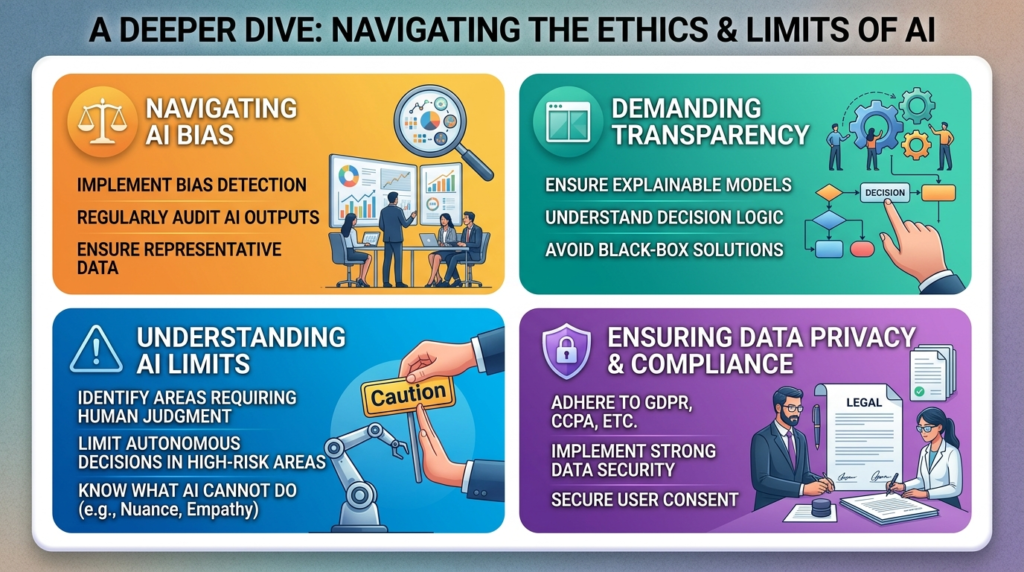
AI Transparency as an Ongoing Practice, Not a One-Time Disclosure
Keeping Transparency Current as Systems Evolve
AI transparency should not be treated as a single disclosure made once when a system launches and then forgotten. As an automated system’s capabilities expand or its role in customer interactions grows, the transparency provided to customers and staff should be updated to reflect what the system is now actually doing, rather than relying on outdated disclosure language that no longer accurately describes the current deployment.
Making Transparency Genuinely Accessible
Transparency about AI use only serves its purpose if customers can actually find and understand it — a disclosure buried in dense legal terms and conditions that nobody reads provides little of the genuine transparency the practice is meant to achieve. Presenting this information clearly, in plain language, at the point where a customer would actually want to know it, reflects a genuine commitment to transparency rather than a technical compliance checkbox.
Frequently Asked Questions
Responsible practice generally means disclosing when a customer is interacting with an automated system, particularly for anything beyond the simplest, most routine interactions. Transparency about this builds trust considerably more reliably than attempting to make automation indistinguishable from a human, which risks a damaging trust breach if discovered.
AI systems processing customer data introduce the same fundamental privacy risks as any data-handling system, plus additional considerations around what data gets used to improve or train the system over time. Businesses should confirm exactly how customer data is used, stored, and potentially shared with any third-party AI provider before deployment.
Yes, AI systems can reflect biases present in their training data or design, sometimes in ways that are not immediately obvious. Regularly reviewing automated decisions or responses for patterns that disadvantage particular groups, rather than assuming a system is neutral simply because it is automated, is a genuine and ongoing responsibility for any business deploying AI.
This depends on the specific use case and stakes involved, but a reasonable baseline includes clear escalation triggers for ambiguous or sensitive situations and periodic human review of automated interactions to catch problems the system itself would not flag. Complete removal of human oversight is rarely advisable for anything customer-facing, regardless of how well the system appears to perform.
Generally no — businesses that communicate honestly about what their automation does and does not do tend to build more durable trust than those making unqualified capability claims that eventually get tested and found wanting. Honest limits, communicated clearly, read as competence rather than weakness to most customers.
Ready to Implement AI Automation Responsibly?
AI automation ethics and limits matter as much as its capabilities, and understanding both is what separates a genuinely successful deployment from an overpromised one. Creative 4 All helps businesses across Lebanon and the GCC implement AI automation with realistic expectations, proper data handling, and appropriate human oversight built in from the start. Book a Free AI Automation Assessment to discuss what responsible automation would actually look like for your business.