
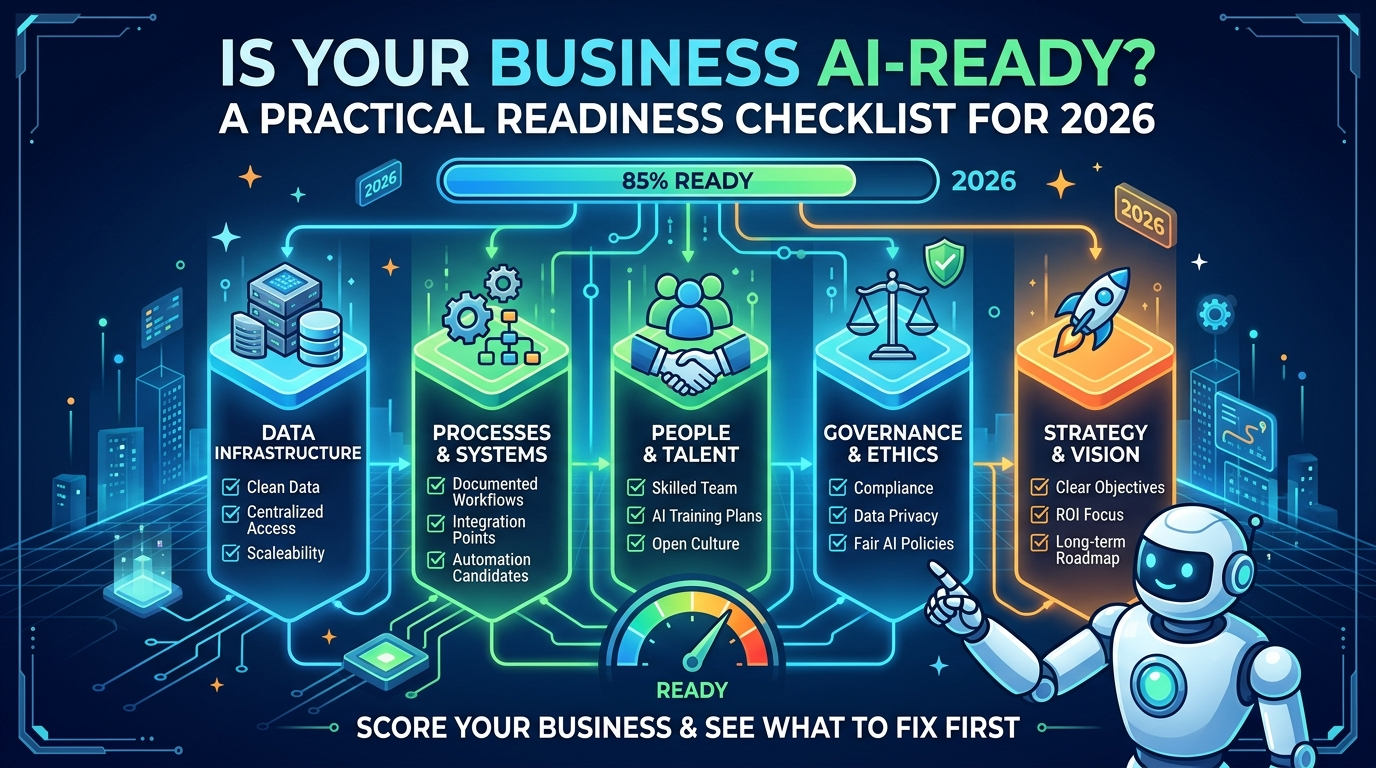
Most conversations about AI automation start with the technology — which platform, which vendor, which use case to try first — and skip the more fundamental question of whether the business is actually ready to get value from it. A business can buy the most capable AI tool available and still see poor results if its underlying data is a mess, its processes exist only in someone’s head, or its team quietly resists using the new system. This AI readiness checklist walks through five dimensions worth honestly assessing before automating anything, gives a simple way to score where you stand, and outlines what to fix first.
The Five Dimensions of AI Readiness
Data Readiness
AI automation depends on data that is accurate, accessible, and reasonably well-organized — whether that is customer records, product information, or historical transaction data. A business whose data lives scattered across spreadsheets, disconnected systems, or someone’s personal notes is not yet ready to automate processes that depend on that data, since an AI system will simply inherit and amplify whatever data quality problems already exist rather than magically fixing them.
Process Clarity
Automating a process requires that the process itself be clearly defined and documented, not just understood informally by whoever currently handles it. If a task’s steps, decision points, and exceptions cannot be written down clearly, they cannot be automated reliably either, since an AI system needs explicit logic to follow rather than the kind of implicit judgment an experienced employee applies without consciously thinking about it.
Tools and Infrastructure
AI automation typically needs to connect to a business’s existing systems — a CRM, a website, a communication platform — through APIs or integrations. A business running on outdated software with no integration capability, or systems that don’t talk to each other at all, faces a genuine technical barrier that needs addressing before automation can function as intended, regardless of how sophisticated the AI component itself might be.
Team Buy-In
Even a technically perfect automation implementation fails if the staff who need to work alongside it don’t trust it, understand it, or actively avoid using it. Team buy-in requires clear communication about what the automation does, what remains a human responsibility, and genuine input from the people whose daily work will actually change, rather than a system imposed from above with no preparation or explanation.
Budget Reality
AI automation involves both upfront setup costs and ongoing operating expenses, and a business needs a realistic sense of what it can genuinely invest before starting, rather than discovering partway through implementation that the budget cannot support proper execution. Underfunded automation projects often produce a half-finished system that satisfies nobody, which usually costs more in wasted effort than either fully committing or waiting until the budget genuinely supports the investment.
A Simple Scoring Checklist
How to Score Each Dimension
Rate each of the five dimensions above on a scale of 1 to 5, where 1 means “this is a significant gap right now” and 5 means “this is genuinely solid and ready.” Be honest rather than optimistic in this scoring — the value of this exercise depends entirely on an accurate self-assessment rather than a score that reflects where you hope the business stands.
Data Readiness: ___ / 5
Process Clarity: ___ / 5
Tools and Infrastructure: ___ / 5
Team Buy-In: ___ / 5
Budget Reality: ___ / 5
Total Score: ___ / 25
Interpreting Your Total Score
A score of 20 to 25 suggests genuine readiness to move forward with a well-scoped automation project. A score of 12 to 19 suggests real potential but specific gaps worth closing first, particularly in whichever dimension scored lowest. A score below 12 suggests foundational work — data cleanup, process documentation, infrastructure upgrades — should come before automation investment, since attempting to automate on top of these gaps typically produces disappointing results regardless of how capable the chosen AI tool is.
What to Fix Before Automating?
Common Gaps and How to Close Them
The most common gap by far is process clarity — many businesses operate successfully day to day through experienced staff applying judgment they have never had to write down. Closing this gap means dedicating focused time to documenting the actual steps, decision rules, and exceptions of a process before attempting to automate it, since this documentation exercise alone often reveals inconsistencies or inefficiencies worth fixing regardless of whether automation follows. Data quality gaps typically require a dedicated cleanup effort — deduplicating records, standardizing formats, filling obvious gaps — before that data can reliably feed an automated system.
When to Fix First vs. Fix in Parallel?
Data and process gaps generally need to be addressed before automation begins, since building on top of broken data or undocumented processes produces an automated system that inherits the same problems at scale. Team buy-in and budget planning, by contrast, can often be addressed in parallel with a pilot implementation, since demonstrating a small, well-scoped automation success frequently builds the organizational confidence and budget justification needed to expand further, rather than requiring perfect buy-in before any implementation begins.
How Our AI Automation Assessment Works?
What Happens on the Call?
A free AI automation assessment call walks through these same five dimensions specifically for your business, identifying where genuine gaps exist and which processes are actually strong candidates for automation given your current state of readiness. This is a genuine assessment conversation, not a sales pitch disguised as one — the goal is an honest picture of where your business stands, not a predetermined recommendation to buy a specific package.
What You Walk Away With?
Following the assessment, you receive a clear picture of your readiness across all five dimensions, specific recommendations for closing the most significant gaps, and a realistic view of which processes could reasonably be automated now versus which need foundational work first. This gives you a concrete starting point regardless of whether you choose to move forward with a formal automation project immediately or address readiness gaps first.
Understanding Business AI Readiness as an Ongoing State
Why Readiness Isn’t a One-Time Checkbox?
Business AI readiness is not something a company achieves once and then stops thinking about — it shifts as the business grows, as data volume increases, and as processes evolve. A business that scored well on this checklist a year ago might find new gaps emerging simply because it added new product lines, expanded into new markets, or grew its team significantly since the original assessment. Revisiting this checklist periodically, rather than treating an initial score as permanently accurate, keeps the picture of readiness genuinely current.
How Readiness Differs by Department?
Business AI readiness often varies considerably by department within the same company — a sales team might have excellent process documentation and clean CRM data while an operations team relies entirely on informal knowledge passed between staff. Assessing readiness at the department or function level, rather than treating the entire business as a single undifferentiated unit, reveals exactly where automation could realistically start versus where foundational work still needs to happen first.
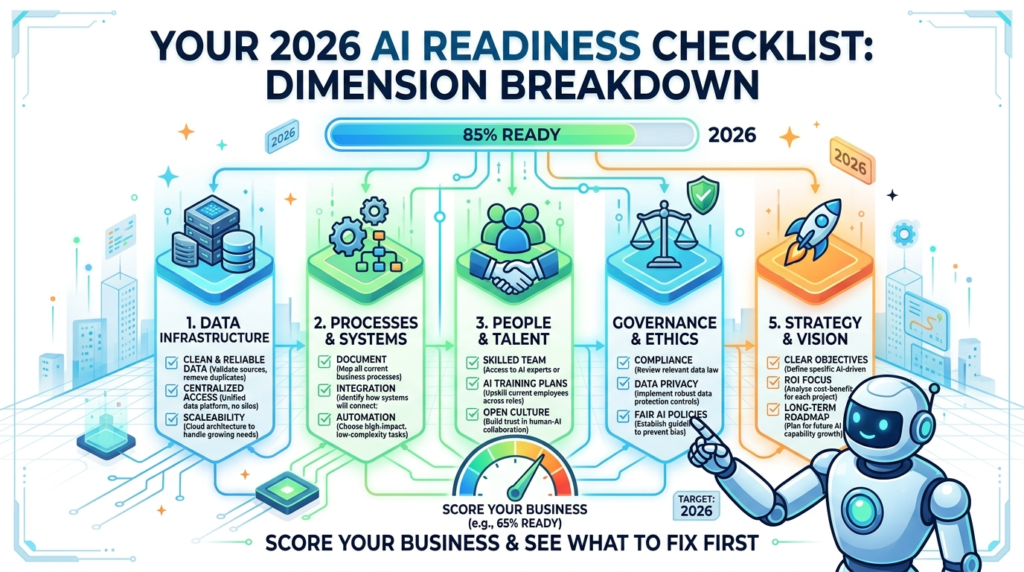
Digital Maturity Assessment as a Broader Context
How This Checklist Fits Into Digital Maturity More Generally?
This AI-specific checklist sits within a broader digital maturity assessment that many businesses benefit from conducting periodically, covering not just AI readiness but overall technology adoption, data governance practices, and digital skill levels across the organization. A business with genuinely low overall digital maturity often finds that addressing foundational technology gaps first makes any subsequent AI automation effort considerably more likely to succeed.
Using Digital Maturity as a Longer-Term Roadmap
Rather than treating AI readiness as an isolated, one-time hurdle to clear, framing it within a longer-term digital maturity roadmap helps a business sequence its broader technology investments sensibly — addressing basic data infrastructure and process documentation needs that benefit the business generally, not just its automation ambitions specifically, before or alongside any AI-specific investment.
Frequently Asked Questions
No. A moderate score with specific, identified gaps is a normal starting point, and many businesses successfully begin with a narrowly scoped pilot project while addressing broader readiness gaps in parallel, rather than waiting for every dimension to be flawless before starting anything.
Data readiness and process clarity generally matter most, since these two dimensions directly determine whether an automated system will actually function correctly. Team buy-in and budget can often be developed alongside a well-chosen pilot project, while poor data or undocumented processes tend to undermine automation regardless of how much budget or enthusiasm exists.
This varies considerably by gap type, but process documentation for a single workflow often takes days to a few weeks, while significant data cleanup across multiple systems can take longer depending on the scale of the problem. Starting with the single highest-impact gap, rather than attempting to fix everything simultaneously, produces faster visible progress.
It applies at any size, though the specific gaps that show up often differ — a very small business might have excellent process clarity (since one or two people handle everything and understand it deeply) but weaker data infrastructure, while a larger business might have the opposite pattern.
The assessment gives you an honest picture either way. If significant gaps exist, you receive specific guidance on what to address first rather than being pushed into an automation project before the business is genuinely ready to benefit from it.
Ready to Find Out Where Your Business Actually Stands?
An AI readiness checklist only has value if it leads to an honest, specific plan rather than a vague sense of where things stand. Creative 4 All offers a free AI automation assessment for businesses across Lebanon and the GCC, walking through these five readiness dimensions and identifying exactly what to address first. Book a Free AI Automation Assessment to get a clear, honest picture of where your business actually stands.