
A growing business facing an increasing workload eventually confronts the same decision: hire someone to handle the additional work, or automate it. This decision gets framed too often as a technology trend to consider rather than what it actually is — a straightforward cost comparison that depends on the specific task, its volume, and how much genuine judgment it requires. Running the real numbers, rather than comparing a headline salary figure to a headline automation price, usually produces a clearer and more useful answer than either option sounds like in the abstract.
The Real Cost of Hiring a New Employee
Beyond Salary: The Hidden Overhead
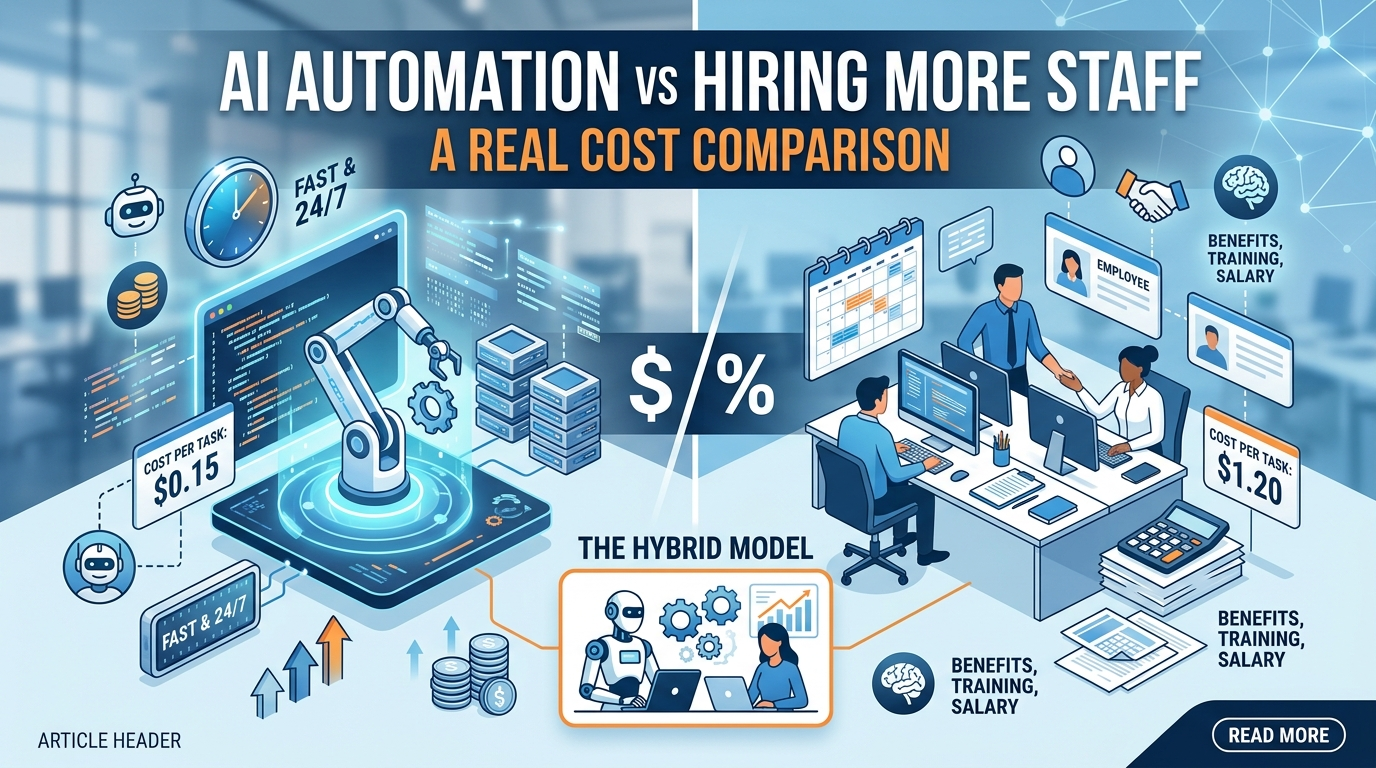
A new hire’s salary is only one part of the total cost, and often not even the largest recurring one once benefits, payroll taxes, equipment, software licenses, workspace, and management overhead are factored in. Depending on the market and role, total employment cost frequently runs 25 to 50 percent above base salary once these additional expenses are included, a gap that headline salary comparisons routinely miss entirely.
Time to Productivity
A new employee does not become fully productive on day one. Onboarding, training, and the natural ramp-up period before someone reaches full competency in a role typically takes weeks to several months depending on complexity, during which the business pays full cost for partial output. This ramp-up cost is real and rarely included in a simple “salary versus automation” comparison, even though it meaningfully affects the true cost of the hiring path in the first months of employment.
The Real Cost of AI Automation
Setup and Ongoing Costs
AI automation involves upfront setup cost (configuration, integration with existing systems, initial testing) followed by ongoing costs that are typically far lower than a comparable salary — subscription fees, occasional maintenance, and periodic adjustments as business needs evolve. The upfront investment can be substantial for a genuinely custom implementation, but this cost is generally a one-time or infrequent expense rather than a recurring monthly obligation that scales with headcount.
Cost Per Task at Scale
The cost-per-task economics of automation improve dramatically as volume increases, since the marginal cost of automating one additional transaction, inquiry, or task is often close to zero once the system is built, while hiring an additional employee to handle increased volume means paying full additional salary and overhead regardless of whether the specific volume increase justifies a full additional headcount. This scalability advantage is precisely why automation vs staffing cost comparisons favor automation more heavily as task volume grows, even when the initial setup cost looks expensive relative to a single employee’s salary.
Where Automation Clearly Wins?
Repetitive, Rule-Based Tasks
Tasks that follow clear, consistent rules — data entry, standard customer inquiries, routine scheduling, basic qualification questions — are ideal automation candidates, since the logic involved does not require the kind of nuanced judgment that would make automation unreliable. These tasks also tend to be the ones employees find least engaging, meaning automation frequently improves both cost efficiency and employee satisfaction by removing the most repetitive work from a human role.
Tasks Requiring 24/7 Availability
Automation genuinely wins for any task requiring availability outside standard business hours, since achieving equivalent human coverage would require shift work, overtime pay, or multiple employees covering different time zones — costs that compound quickly compared to a system that simply runs continuously without additional expense once built. A business serving customers across different time zones or simply wanting to capture leads that arrive outside office hours benefits substantially from this always-available characteristic.
Where Human Judgment Still Wins?
Nuanced Decision-Making and Relationship Building
Tasks requiring genuine judgment calls, emotional intelligence, or the kind of relationship-building that depends on a human connection remain firmly in human territory, at least with current technology. A complex negotiation, a sensitive customer complaint requiring genuine empathy, or a strategic decision weighing considerations an automated system was never designed to evaluate all require human involvement, and attempting to automate these prematurely typically produces worse outcomes than simply hiring for them.
Novel Situations Without Precedent
Automated systems perform well within the bounds of situations they were designed and trained to handle, but genuinely novel situations without established precedent — an unusual customer request, an unexpected operational problem, a scenario nobody anticipated when building the system — require human judgment to navigate appropriately. A business relying entirely on automation for functions that regularly encounter novel situations will find the system’s limitations become apparent precisely when handling them well matters most.
The Hybrid Model Most Businesses Should Adopt
Automating the Routine, Hiring for the Exceptional
The most cost-effective approach for most growing businesses is not choosing exclusively between automation and hiring, but automating the routine, high-volume, rule-based portion of a role while hiring or retaining staff specifically for the judgment-intensive, relationship-driven, or novel-situation portion of the same overall function. This hybrid model captures automation’s cost and scale advantages for the bulk of transactional volume while preserving human involvement exactly where it adds the most genuine value.
A Practical Framework for Deciding
A practical framework for this decision asks three questions about any given task: does it follow consistent, definable rules; does its volume justify the automation investment; and does it genuinely require human judgment or relationship-building to do well. Tasks answering yes to the first two questions and no to the third are strong automation candidates; tasks answering yes to the third question, regardless of the first two, generally belong with human staff. Most growing businesses find that applying this framework task by task, rather than deciding automation-versus-hiring as one binary choice for an entire role, produces the most cost-effective overall structure.
Scaling a Business With AI Without Overcommitting Early
Starting Small Before Full Commitment
Scaling a business with AI does not require an all-or-nothing initial commitment. Piloting automation on a single high-volume, well-defined task first — rather than attempting to automate an entire department at once — lets a business validate the real cost savings and quality outcomes before expanding the approach to additional tasks or functions. This staged approach also reveals practical integration challenges specific to the business’s existing tools and workflows while the stakes and cost of a misstep remain relatively low.
Reinvesting Savings Into Further Automation or Growth
Once an initial automation implementation demonstrates genuine cost savings, businesses that reinvest those savings into either expanding automation to additional tasks or into growth activities that a smaller team could not previously support tend to compound the benefit considerably faster than businesses that simply pocket the savings without a deliberate next step. Scaling a business with AI works best as an ongoing, iterative process rather than a single project completed once and left unchanged as the business continues to grow.
Common Mistakes in the Automation vs Hiring Decision
Comparing Only the Headline Numbers
The most common mistake in this decision is comparing a single salary figure directly against a single automation price quote without accounting for the hidden overhead on the hiring side or the full ongoing cost on the automation side. This surface-level comparison frequently produces the wrong conclusion in either direction, which is why a genuinely accurate decision requires calculating the full cost of each option rather than relying on the numbers that happen to be easiest to find.
Treating the Decision as Permanent and Irreversible
Some businesses treat the automation-versus-hiring decision as a one-time, permanent choice, when in reality task volume, business needs, and available technology all change over time. A task automated today might genuinely need human oversight added back in as the business’s needs grow more complex, and a task currently handled by staff might become a strong automation candidate once volume increases enough to justify the setup investment. Revisiting this decision periodically, rather than treating an initial choice as fixed indefinitely, keeps the overall cost structure genuinely optimized as circumstances change.
Frequently Asked Questions
Not in every case, particularly at low volume where the upfront setup cost of automation may exceed what a task actually costs to handle manually. Automation’s cost advantage grows specifically as task volume increases, which is why the comparison should be run per task rather than as a blanket rule.
Tasks requiring genuine emotional intelligence, complex negotiation, or judgment calls involving considerations an automated system cannot evaluate should generally remain with human staff. Attempting to automate these prematurely typically produces worse outcomes and can damage customer relationships that depend on genuine human connection.
Calculate hiring cost as base salary plus benefits, taxes, equipment, and a reasonable estimate of the ramp-up period’s reduced productivity, then calculate automation cost as setup investment amortized over its expected useful life plus ongoing subscription or maintenance costs. Comparing these two total figures against the actual task volume gives a genuinely accurate picture rather than comparing headline numbers alone.
Yes, and this is often the most effective structure — automation handling the routine, high-volume portion of a task while flagging exceptions or edge cases for human review, rather than treating automation and human involvement as mutually exclusive for an entire function.
Automation generally becomes cost-effective once the ongoing labor cost of manually handling a task, calculated over a reasonable time horizon, exceeds the automation’s setup cost plus its ongoing operating expenses. Running this calculation for a specific task, rather than relying on a general sense of “we’re big enough now,” produces a more reliable answer.
Ready to Find Out Where Automation Actually Makes Sense for Your Business?
AI automation vs hiring is a decision best made task by task, based on real cost comparison rather than general impressions of either option. Creative 4 All helps growing businesses across Lebanon and the GCC identify which specific functions genuinely benefit from automation and which still need human judgment. Book a Free AI Automation Assessment to see where automation would actually pay off for your business.