
Most online stores lose the majority of their potential revenue after the visitor has already shown interest. A shopper adds an item to the cart and leaves. A customer asks a question about shipping at 11 p.m. and gets no answer until the next business day. A product page shows the same generic “you might also like” carousel to every visitor regardless of what they actually browsed. Each of these is a small leak, but across a full month of traffic they add up to a substantial amount of lost revenue that no amount of additional ad spend can recover, because the problem was never a lack of traffic — it was a lack of timely, relevant response once traffic arrived.
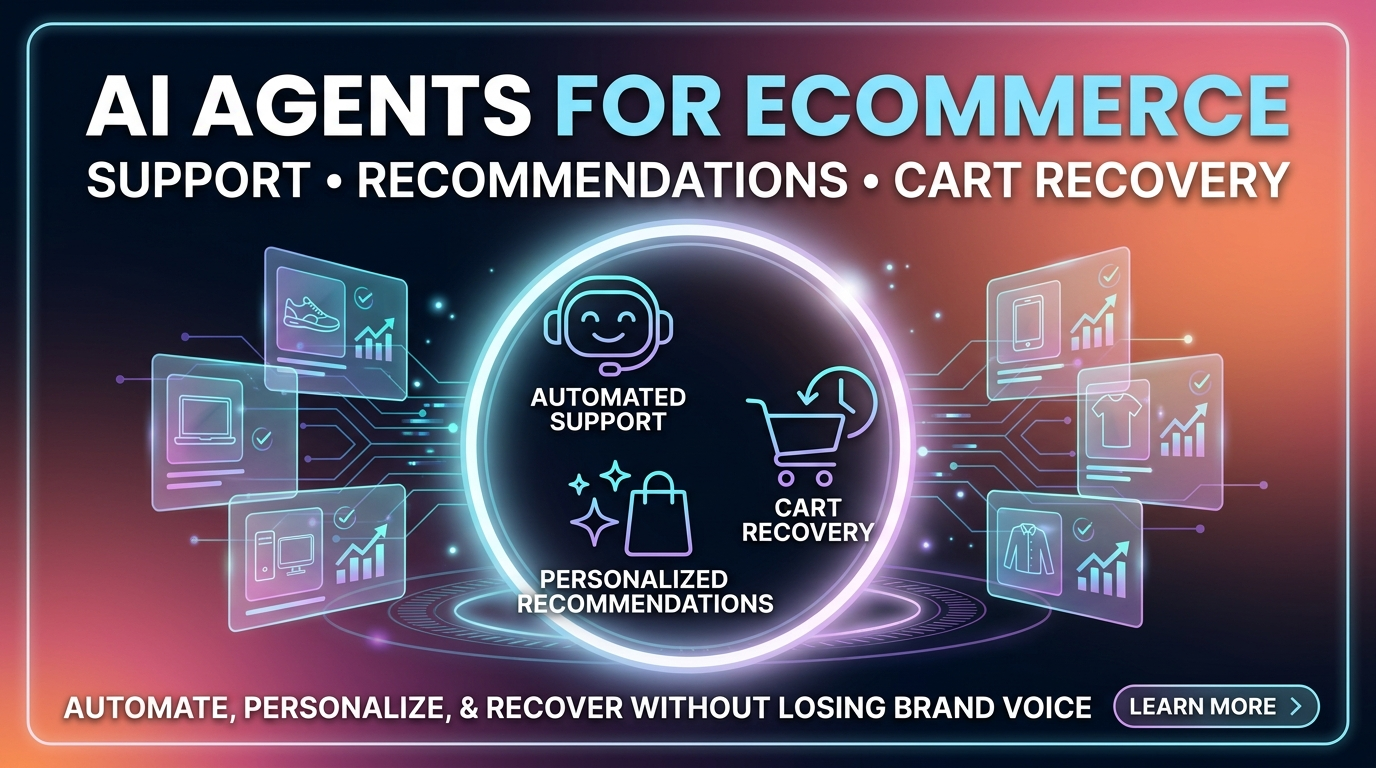
AI agents for ecommerce exist specifically to close these gaps. Unlike a traditional rule-based chatbot that can only follow a fixed decision tree, a modern AI agent can hold a genuine conversation, pull real order and inventory data, understand context across multiple messages, and act — issuing a refund, applying a discount code, or recommending a specific product — rather than simply routing the shopper to a help article. For stores in Lebanon and across the GCC, where customer service expectations increasingly include instant response regardless of time zone or language, this shift from static automation to conversational, action-capable agents is becoming a genuine competitive differentiator rather than a novelty.
Where AI Agents Deliver the Most Value in Ecommerce?
Customer Support That Doesn’t Sleep
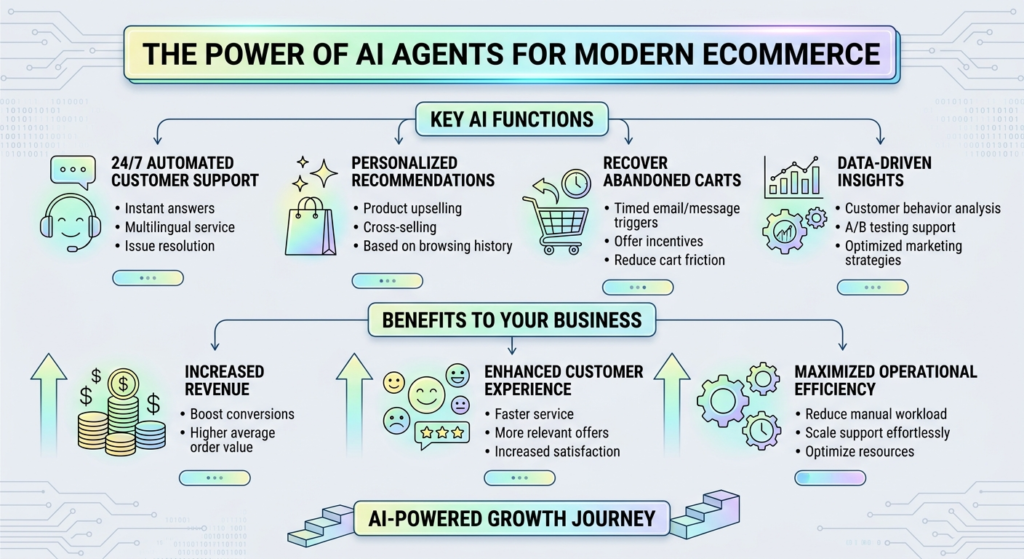
The most immediate return from an ecommerce chatbot comes from handling the volume of repetitive, predictable questions that make up the bulk of any support inbox: order status, return policy, shipping timelines, and product availability. A well-configured AI agent can answer these instantly, at any hour, in the shopper’s preferred language, while pulling live data from the order management system rather than giving a generic scripted answer. This does not eliminate the need for human support — it removes the repetitive load so human agents can focus on the complex, high-value conversations that actually require judgment.
Personalized Product Recommendations at Scale
A human merchandiser cannot realistically tailor product suggestions for every individual visitor, but an AI agent can, by analyzing browsing behavior, past purchases, and even the specific wording a shopper uses in a chat conversation. This is where AI product recommendations move beyond the generic “customers also bought” widget into something that responds to what this particular shopper is actually looking for in this specific session, which materially improves both average order value and the likelihood of conversion.
Recovering Revenue From Abandoned Carts
Cart abandonment is one of the largest sources of lost ecommerce revenue, and it is also one of the most addressable through automation. An AI agent can identify the moment a cart is abandoned, understand why based on available signals (price sensitivity, shipping cost shown late in checkout, a question left unanswered), and follow up with a message tailored to that likely reason rather than a generic reminder. Done well, abandoned cart automation recovers a meaningful share of revenue that would otherwise be written off entirely.
The Real Mechanics of Cart-Recovery Automation
What Triggers an Abandoned Cart Sequence?
An effective recovery sequence does not fire immediately the moment a shopper leaves the checkout page — many shoppers step away briefly and return on their own within minutes. The trigger should typically wait a defined window (commonly 30 minutes to an hour for the first touchpoint) before initiating contact, and the message content should reflect what stage of checkout the shopper reached. A cart abandoned at the shipping-cost step warrants a different message than one abandoned at the payment step, since the underlying hesitation is almost certainly different.
Channel Strategy: Chat, Email, and SMS Working Together
The strongest cart-recovery programs rarely rely on a single channel. Email remains the most common first touchpoint because it requires no prior opt-in beyond the checkout process itself, but SMS and in-app or website chat notifications tend to produce faster response times when the shopper has already opted in. An AI agent coordinating across these channels can avoid the common mistake of sending duplicate, conflicting messages — for example, offering a discount code by email while a chat widget simultaneously prompts the same shopper with a different offer — by tracking a single conversation state across every channel the shopper interacts through.
Measuring Recovery Rate the Right Way
Recovery rate should be measured as completed purchases directly attributable to the recovery sequence, not simply as “carts that were eventually purchased,” since some shoppers would have returned and completed the purchase regardless of any automated follow-up. Isolating the incremental effect of the automation — comparing a holdout group that receives no automated follow-up against the group that does — gives a far more honest picture of whether the abandoned cart automation is actually generating revenue or simply taking credit for purchases that would have happened anyway.
How AI Product Recommendation Engines Actually Work?
Behavioral Signals vs. Static Rules
Older recommendation systems relied on static rules: if a shopper views category A, show more of category A. Modern AI product recommendations weigh a much wider set of behavioral signals — time spent on a page, items added and removed from the cart, search terms used on-site, and even the sequence in which products were viewed — to build a much more accurate picture of intent than any single rule could produce. This is also why recommendation quality tends to improve meaningfully over the first few weeks after launch, as the system accumulates enough behavioral data to move beyond generic defaults.
Common Pitfalls That Hurt Recommendation Accuracy
The most common failure mode is treating the recommendation engine as a set-and-forget feature rather than something that needs regular review. Recommending out-of-stock items, showing the exact item already sitting in the shopper’s cart, or continuing to promote a discontinued product line are all avoidable errors that quietly damage both conversion rate and trust in the recommendation feature itself. A recurring audit of what the engine is actually surfacing, cross-checked against current inventory and merchandising priorities, prevents these errors from accumulating unnoticed.
Balancing Automation With Brand Voice
Training the Agent on Your Tone, Not Just Your Catalog
An AI agent that answers questions accurately but sounds nothing like the rest of the brand creates a jarring experience that undermines the premium positioning many stores have worked to build. The agent needs to be configured not just with product data and policies, but with explicit guidance on tone — formal or conversational, the specific phrases the brand uses or avoids, and how the brand typically handles an apology or a difficult conversation. This is a genuine configuration task, not a one-time setup step, and it deserves the same attention a business would give to training a new human support hire.
Knowing When to Hand Off to a Human
No AI agent, however well configured, should be positioned as a full replacement for human judgment in every situation. Complaints involving genuine dissatisfaction, high-value orders, or ambiguous situations that fall outside the agent’s training data should trigger a clear, fast handoff to a human team member, with full conversation context carried over so the shopper never has to repeat themselves. Stores that get this balance right see AI automation as an amplifier of good service rather than a replacement for it, while stores that push automation too far into situations requiring genuine empathy or discretion tend to see the opposite effect on customer trust.
Choosing the Right AI Agent Platform for Your Store
Integration Requirements With Your Ecommerce Platform
An AI agent is only as useful as the data it can access. Before evaluating vendors, confirm that a platform can connect directly to your ecommerce backend — order management, inventory, and customer account data — rather than operating on a static knowledge base that needs manual updates every time a policy or product changes. Agents that read live data can answer “where is my order” accurately on the first attempt; agents limited to pre-written scripts frequently give outdated answers that erode trust faster than having no automation at all.
Multilingual Support for Lebanon and GCC Markets
For stores serving Lebanon and the wider GCC, genuine multilingual capability matters more than it does in most other markets. A shopper switching between Arabic, French, and English within the same conversation — common in this region — needs an agent that can follow that switch naturally rather than forcing a single language for the entire interaction. This is one of the clearest differentiators between a genuinely capable AI agent and a chatbot that has simply been translated into multiple languages without real localization behind it.
Measuring ROI From AI Automation
Support Cost Savings vs. Revenue Recovery
The return from AI agents for ecommerce typically comes from two distinct sources that should be tracked separately: reduced support cost from automating repetitive inquiries, and incremental revenue recovered through cart automation and improved recommendations. Blending these two into a single vague “automation benefit” number makes it difficult to know which part of the deployment is actually working and which needs further tuning. Reporting them side by side gives a clearer basis for deciding where to invest further configuration effort.
Setting Realistic Timelines for Results
Support cost savings tend to appear almost immediately after deployment, since repetitive questions get answered instantly from day one. Revenue gains from personalized recommendations and cart recovery typically take several weeks longer to materialize, since these systems improve as they accumulate real behavioral data from actual shoppers. Setting this expectation upfront prevents a premature judgment that the automation “isn’t working” when the recommendation engine simply has not yet had enough traffic to reach its full accuracy.
Frequently Asked Questions
A traditional chatbot follows a fixed decision tree and can only respond within scripted paths. An AI agent understands natural language, holds context across a conversation, pulls live data such as order status or inventory, and can take action — like applying a discount or processing a return request — rather than simply directing the shopper elsewhere.
No, and stores that try this typically see customer satisfaction drop. The most effective setup uses AI agents to handle repetitive, predictable questions instantly, while routing complex, high-value, or emotionally sensitive conversations to a human team member with full context preserved.
Most effective sequences wait roughly 30 minutes to an hour before the first message, since many shoppers return and complete the purchase on their own within that window. Sending the first message immediately often reaches shoppers who were never truly abandoning the cart in the first place.
They perform better with more behavioral data, but a well-configured system can still generate reasonable initial recommendations from browsing behavior alone and improve meaningfully within the first few weeks as it accumulates more signals from actual visitors.
The most common risk is a mismatch between the agent’s tone and the brand’s, or the agent recommending out-of-stock or discontinued products because inventory data was not properly connected. Both issues are avoidable with proper setup and a recurring review process, but both quietly damage conversion and trust when left unaddressed.
Ready to Put AI Agents to Work for Your Store?
Support that never sleeps, recommendations that reflect what a shopper is actually looking for, and cart-recovery sequences that recover real revenue rather than just activity — this is what AI agents for ecommerce can add when configured properly. Creative 4 All’s automation team designs and deploys AI agents tailored to your catalog, your brand voice, and your customer base across Lebanon and the GCC. Book a Free AI Automation Assessment to see where the highest-impact opportunities are for your store.