
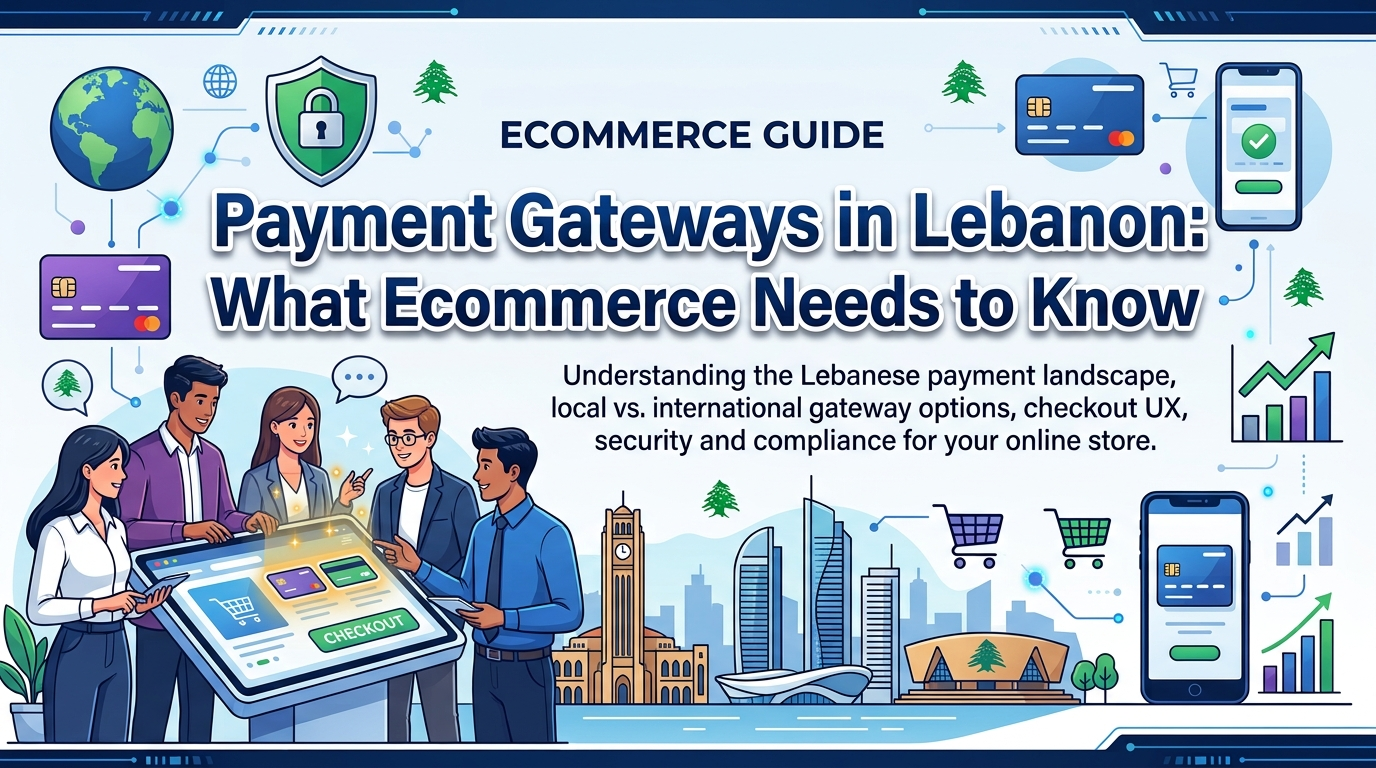
A store built beautifully, stocked with the right products, and driving genuine traffic can still lose the sale at the very last step if checkout doesn’t accept the card a customer is actually holding. Payment gateways Lebanon ecommerce businesses choose from involve constraints that generic international ecommerce guides never address, because Lebanon’s banking and currency environment creates a genuinely different set of practical realities than the assumptions built into most global payment advice.
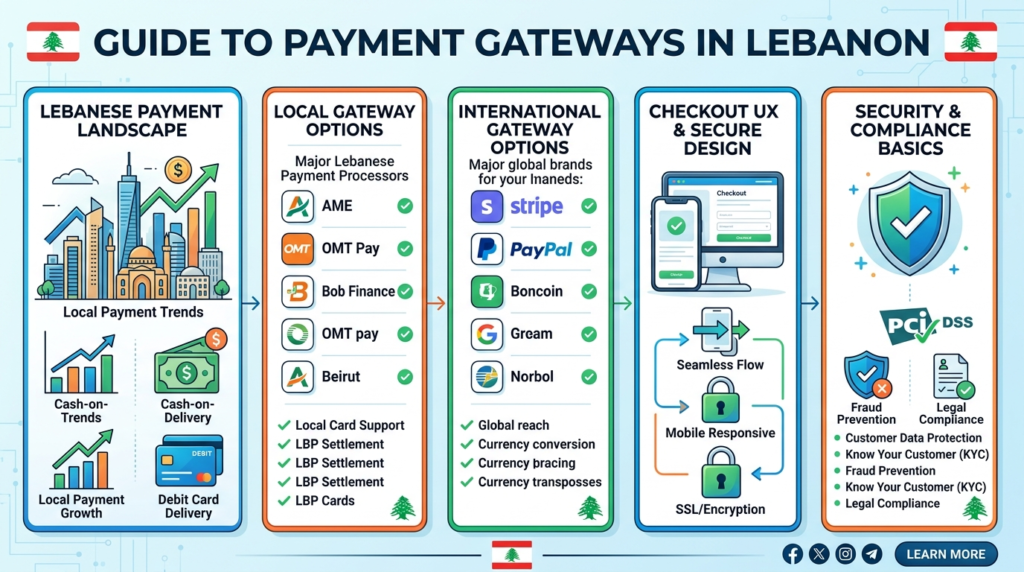
This guide covers the local payment landscape and its specific constraints, how payment gateway integration methods work, how local and international payment gateways Lebanon businesses choose from compare, checkout UX practices that reduce abandonment, and the security and compliance basics every ecommerce business needs to understand before choosing a provider.
The Local Payment Landscape and Its Constraints
Currency and Banking Realities
Lebanon’s dual-currency environment and its distinct banking landscape mean payment gateways Lebanon businesses use often need to account for pricing and settlement in a way that generic international payment advice simply doesn’t anticipate. A business needs clarity on which currency it’s actually pricing in, which currency a gateway settles funds in, and how any conversion between the two is handled, since assuming this works the same way it would for a business operating in a single stable currency creates real risk of miscalculating actual revenue.
Why International Guides Fall Short?
Most ecommerce payment guides are written from the perspective of a US or European business choosing between well-established, broadly compatible providers, and that framing simply doesn’t transfer cleanly to Lebanon’s specific banking relationships and card network realities. A business relying purely on generic international advice risks choosing a gateway that looks reputable globally but doesn’t actually integrate cleanly with the local banking infrastructure a Lebanese customer’s card depends on.
Payment Gateway Integration Methods
Hosted Checkout vs. Direct API Integration
Payment gateways Lebanon businesses can choose from typically offer two integration approaches: a hosted checkout page that redirects a customer to the gateway’s own secure page to complete payment, or a direct API integration that keeps the customer on the business’s own checkout page throughout. Hosted checkout is simpler to implement and shifts more of the PCI compliance burden to the gateway provider, while direct API integration offers a more seamless, branded experience but requires more careful security implementation on the business’s own side.
Matching Integration Complexity to Business Resources
A smaller business without dedicated technical resources generally benefits from the simpler hosted checkout approach, accepting a slightly less seamless customer experience in exchange for faster setup and lower ongoing technical maintenance. A larger business with development resources and a strong reason to prioritize checkout experience — high transaction volume where even small conversion improvements matter significantly — may find the additional investment in direct API integration worthwhile.
Local vs. International Gateway Options
What Local Providers Offer?
Local payment providers, working directly with Lebanese banks, often provide more reliable compatibility with locally issued cards and more straightforward settlement into a Lebanese business bank account, though the specific feature set, supported card networks, and fee structure varies meaningfully between providers and needs direct comparison rather than assumption. Confirming a local provider’s actual track record with businesses of a comparable size and transaction volume gives a more reliable signal than marketing claims alone.
What International Providers Offer?
International payment gateways generally offer broader compatibility with foreign-issued cards, which matters directly for a business selling to diaspora customers or international buyers, along with more mature fraud protection and reporting tools built for a global merchant base. The tradeoff is that some international providers have inconsistent or limited support for Lebanese merchant accounts specifically, making upfront verification of actual compatibility essential before committing rather than assuming global reputation guarantees local functionality.
Choosing Based on Actual Customer Base
The right choice between local and international providers, or a combination of both, depends directly on a business’s actual customer mix — a business selling primarily to a local Lebanese audience has different priorities than one serving significant diaspora or international demand, and understanding that mix before selecting a gateway prevents choosing a provider optimized for the wrong audience.
Checkout UX Best Practices
Minimizing Friction at the Critical Moment
Checkout is the single highest-stakes moment in the entire customer journey, and unnecessary friction here — excessive required fields, confusing payment method selection, unclear error messages when a transaction fails — causes abandonment that no amount of earlier marketing effort can recover. Minimizing required fields to genuinely necessary information, and clearly displaying accepted payment methods before a customer even reaches checkout, reduces the uncertainty that causes hesitation at exactly the wrong moment.
Handling Payment Failures Gracefully
A failed transaction handled poorly — a generic, unhelpful error message with no clear next step — often ends the purchase entirely, while a clear explanation of what went wrong and a straightforward path to try again or use an alternative payment method recovers a meaningful share of transactions that would otherwise be lost. This matters specifically in a market where card compatibility issues are genuinely more common than in markets with more standardized payment infrastructure.
Security and Compliance Basics
PCI Compliance Fundamentals
Any business processing card payments needs to understand basic PCI DSS compliance requirements, even when a payment gateway handles most of the technical security burden — using a properly PCI-compliant gateway and never directly storing raw card data on a business’s own systems covers the fundamentals for most small to mid-sized ecommerce businesses without requiring extensive additional infrastructure.
Building Customer Trust at Checkout
Beyond formal compliance, visible trust signals at checkout — recognizable payment method logos, clear security messaging, a professional and consistent checkout design — directly affect whether a hesitant customer completes a purchase, particularly for a first-time buyer without prior experience with a specific business. This trust-building matters as much as the technical security infrastructure itself, since a customer abandoning checkout due to perceived risk represents a lost sale regardless of how technically secure the actual system is.
Frequently Asked Questions
This depends on the actual customer base — a business serving primarily local customers often benefits from a local provider’s banking compatibility, while one serving significant diaspora or international demand needs broader international card support, and many businesses benefit from offering both.
Assuming a globally reputable payment gateway automatically works well for Lebanese merchant accounts and locally issued cards without confirming actual compatibility, which can create checkout failures that are invisible until customers start abandoning purchases.
Costs vary by provider and typically include both setup fees and ongoing per-transaction fees, making direct comparison of total cost at expected transaction volume more useful than comparing headline rates alone.
Often yes — supporting international cards reliably may require an international payment gateway or a combination of local and international providers, since not every local gateway handles foreign-issued cards with the same reliability as domestic ones.
Account verification, business documentation review, and integration testing typically take longer than most businesses expect, making it worth starting this process well before a planned launch date rather than treating it as a quick final step.
Ready to Choose the Right Payment Gateway for Your Business?
Payment gateway selection in Lebanon involves constraints generic international guides never address. Request an ecommerce consultation with Creative 4 All and get a payment gateways Lebanon recommendation built around your actual customer base and business needs.