Ask ten Lebanese business owners where their website is hosted and you will get a surprising range of answers. Some insist on a Lebanese provider because “the visitors are here.” Others use a big international company because “everything in Lebanon goes down.” Many simply do not know, because their developer chose a server years ago and nobody has asked since.
The local vs international web hosting decision deserves more thought than that. It affects how fast your site loads, how often it is unavailable, who you call at midnight when something breaks, what you pay and even which data protection rules apply. This guide compares hosting in Lebanon with hosting in Europe or the GCC, explains what actually drives speed for Lebanese visitors, and gives you a practical way to decide.
What “Local” and “International” Hosting Really Mean?
The terms are less clear than they sound, so it helps to define them before comparing.
Local hosting means your website runs on servers physically located in a Lebanese data center. Be aware that some companies selling hosting in Lebanon are actually resellers of servers based abroad, usually in Europe. That is not necessarily bad, but if local server location matters to you, ask directly where the hardware sits.
International hosting means your server is outside Lebanon. For Lebanese businesses, the common choices are European data centers such as Frankfurt, Amsterdam, Paris or Marseille; GCC cloud regions in the UAE, Bahrain or Saudi Arabia offered by the major cloud providers; and occasionally the United States, which is usually the furthest option from your visitors.
A third piece sits on top of either option: a content delivery network (CDN), which stores copies of your images, scripts and sometimes whole pages on servers around the world. As our guide to how a CDN speeds up a website explains, a CDN can make the distance between server and visitor matter much less.
Speed and Latency: Where Are Your Visitors?
Speed is the reason most people care about server location, and it is where the most misunderstandings happen.
Latency: Lebanon Hosting vs Abroad
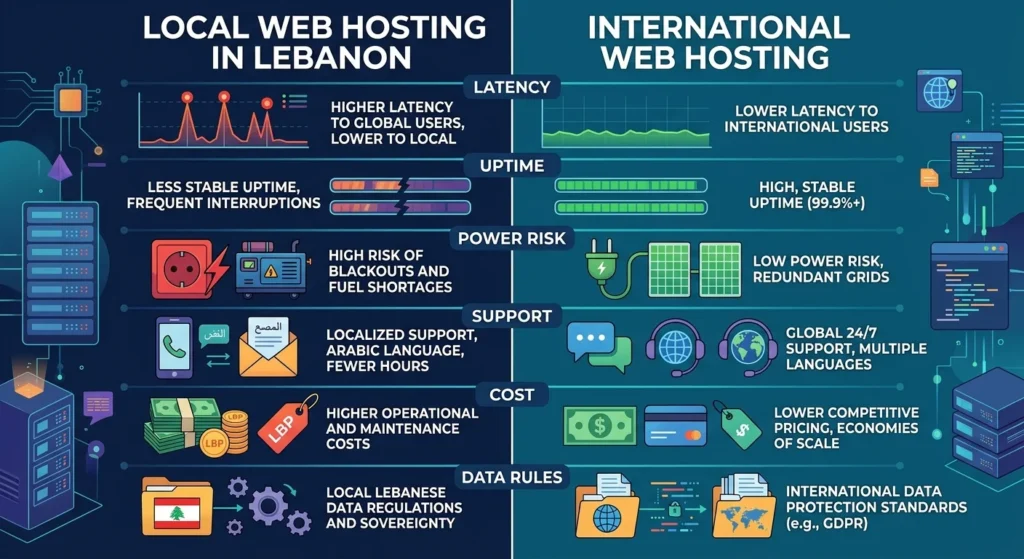
Latency is the time it takes for data to travel between a visitor’s device and your server and back. Physical distance matters, but the route matters more. Lebanon’s international internet connectivity relies on a small number of submarine cable systems linking the country to Cyprus, Europe and Egypt, so a large share of traffic from Lebanese users travels through European exchange points on its way to many destinations.
That has two practical consequences for latency in Lebanon hosting. A server in Beirut on a well-connected network can be very fast for visitors inside Lebanon. But a server in a nearby European hub can also perform well for Lebanese users, while a server in the Gulf is not automatically faster for them just because it is geographically closer, since traffic may still be routed through Europe. The only reliable answer is to measure: run ping and traceroute tests from several Lebanese networks, fixed and mobile, to the candidate locations, or ask providers for a test server before you commit.
If Your Audience Is in the GCC
If most customers are in the UAE or Saudi Arabia, hosting in a GCC cloud region or a nearby European location usually serves them better than a server in Beirut. For an ecommerce brand selling mainly to Gulf customers, a Lebanese data center is rarely the best primary location.
If Your Audience Is Mixed
Many Lebanese businesses serve local customers, Gulf clients and the diaspora in Europe, Africa and North America. In that case, the server location matters less than using a CDN and keeping the site itself lean. When comparing hosting in Lebanon vs Europe for a mixed audience, a well-configured European server with a CDN often gives the best balance.
Server Speed Matters as Much as Location
Distance is only part of load time. A slow, overloaded shared server in the “right” country will lose to a well-tuned server further away. Look at time to first byte (TTFB) and your Core Web Vitals, not just geography. Plan type matters too, as we explain in shared vs VPS vs dedicated hosting.
Reliability: Power, Networks and Uptime
Reliability is where the local vs international web hosting comparison becomes most specific to Lebanon. Any data center needs uninterrupted power, cooling and network connectivity. In a country where grid electricity has been unreliable for years, Lebanese data centers depend heavily on generators, fuel supply and battery systems, and the quality of that backup varies widely between providers.
Network redundancy matters just as much. A provider with multiple upstream connections is far more resilient to a single link or cable problem than one relying on a single path. Good Lebanese providers invest in both, and some deliver excellent uptime. But you should verify it rather than assume it.
Large international data centers and cloud regions typically operate with redundant power feeds, multiple network carriers and formal uptime commitments. They are not immune to outages, but their failure modes are less tied to local power and fuel conditions. Whichever route you choose, ask for the uptime service level agreement (SLA), what compensation it offers, and how the provider handled its last major incident.
Support, Language and Time Zone
Support is the strongest argument for many local providers. A Lebanese host usually works in your time zone, speaks Arabic, English and often French, and may understand local quirks such as .lb domain procedures or how local payment works. When your site is down during a campaign, being able to call someone who answers can be worth a lot.
International providers range from excellent managed services with fast expert support to large self-service platforms where you open a ticket and wait. If your team has no technical staff, either choose an international provider known for strong support or work with an agency that manages the hosting for you, so that one accountable party deals with the provider.
Cost and Payment
Prices vary more by plan type and service level than by country, so compare like with like: shared versus shared, managed VPS versus managed VPS. Local providers often bill in US dollars with flexible payment options, which can be convenient. International providers generally require payment by card, and since the financial crisis that began in 2019, some Lebanese bank cards have been difficult to use for recurring international payments. Check this before committing, especially for services that renew automatically; a failed renewal can take a site offline.
Also consider the hidden costs on both sides: paid backups, SSL certificates, email hosting, migration fees, and the price of the support level you actually need.
Data, Privacy and Compliance
For most small business websites, data location is not a legal barrier, but it should still be a conscious choice. Lebanon’s Law No. 81 of 2018 on electronic transactions and personal data sets out obligations for processing personal data, and your website collects personal data through contact forms, newsletters and online orders. If you serve customers in Saudi Arabia, the Kingdom’s Personal Data Protection Law adds its own requirements, including rules on transferring personal data outside the country. Banks, healthcare providers and government-related organisations may have stricter requirements for where data is stored.
The practical steps are straightforward: know where your server and backups are located, choose providers with clear data processing terms, and take legal advice if you handle sensitive data or operate in regulated sectors. This is general information, not legal advice.
Does Server Location Affect SEO?
Less than many people think. Google relies mainly on signals such as your domain, language, hreflang annotations, content and links to understand which country and audience a site targets. Server location is a minor signal at most. What does affect SEO is speed and availability: a slow site can suffer on Core Web Vitals and user experience, and a site that is frequently down may be crawled less often. Choose the location that gives your actual visitors the fastest, most reliable experience, and use hreflang and local content to communicate targeting.
Which Option Fits Your Business?
There is no single right answer, but most cases fall into a few patterns:
- Mostly Lebanese visitors, strong local support needed: a reputable Lebanese data center with proven power and network redundancy, plus a CDN.
- Mostly GCC customers: a GCC cloud region or nearby European data center, with a CDN.
- Mixed local, Gulf and diaspora audience: a well-connected European location with a CDN.
- Ecommerce or high-traffic sites: managed cloud or VPS hosting with monitoring and tested backups, wherever measurements show the best performance.
- Regulated data: whatever location your legal obligations require, confirmed with an adviser.
Treat the local vs international web hosting question as a decision based on measurement, not national preference in either direction.
Questions to Ask Any Hosting Provider
Before signing, get clear answers to these questions:
- Where exactly are the servers and backups located?
- What uptime does the SLA guarantee, and what happens if it is missed?
- How are power and network failures handled, and how many upstream carriers are used?
- What support hours, channels and response times are included?
- How are backups taken, how often, and how quickly can a site be restored?
Restoring from backup is the test that matters most. Our website backup strategy guide explains how to make sure backups actually work when you need them.
Moving Hosts Without Downtime
If you decide to switch, plan the migration rather than rushing it. Take a full backup, set up the new server, copy files and databases, and test the site on the new host using a temporary address before changing DNS. Lower the DNS time-to-live a day in advance so the switch propagates quickly, keep the old hosting active for a few days, and check email, forms and SSL after the move. A careful migration is invisible to visitors and to Google.
Frequently Asked Questions
Not necessarily. Hosting in Lebanon can be fast for local visitors and offers convenient support, but reliability depends heavily on the provider’s power and network redundancy. A well-connected European server with a CDN often performs just as well for Lebanese users. Measure from Lebanese networks before deciding.
Not automatically. Traffic from Lebanon is often routed through Europe, so a Gulf server is not always faster for local visitors despite being geographically closer. GCC hosting makes most sense when most of your customers are in the Gulf.
Only minimally. Google uses your domain, language, hreflang and content to understand your target audience. Speed and uptime matter more, so choose the location that gives your visitors the best performance.
The best hosting for Lebanese websites is the one with reliable uptime, good speed for your actual audience, responsive support and tested backups. For many businesses that means a reputable managed provider plus a CDN, located wherever measurements show the best results.
Start with where your visitors are, then compare measured latency, uptime commitments, support quality, payment practicality and any data rules that apply to you. The local vs international web hosting choice should follow those facts rather than assumptions.
Get Hosting That Fits Your Audience
The right server location is the one that keeps your site fast, available and supported for the people who actually visit it. For some businesses that is a strong Lebanese data center; for others it is Europe or the Gulf, almost always combined with a CDN and a solid backup plan.
If you would like help comparing options, testing performance or migrating safely, the Creative 4 All team can advise on local vs international web hosting and manage the move for you. Explore our web hosting and domain services in Lebanon.