
AI automation has become crowded with vendors making similar-sounding promises, and the pitch itself rarely reveals which ones can actually deliver. Choosing an AI automation partner well means looking past polished demos and confident language to the specifics that actually determine whether an implementation succeeds: who owns the data, how deeply the system integrates with what a business already uses, and what happens after launch when something inevitably needs adjusting. This article walks through the red flags worth watching for and twelve concrete questions to ask any AI automation vendor before signing an agreement.
Red Flags in AI Vendor Pitches
Overpromising Generic “AI Magic” Without Specifics
A vendor pitch heavy on phrases like “AI-powered transformation” and “cutting-edge automation” but light on how the system will actually handle a business’s specific workflows is a genuine warning sign. Legitimate AI automation vendor evaluation should focus on concrete capability: what specific tasks the system will handle, what data it needs to function, and what a realistic outcome looks like given the business’s actual scale and complexity, not generic language that could apply to literally any company in any industry.
No Willingness to Discuss Limitations
Every AI automation implementation has genuine limitations — situations the system cannot handle well, edge cases that need human review, or integration constraints with certain legacy systems. A vendor unwilling to discuss these limitations honestly, presenting the technology as capable of anything with no caveats, is either inexperienced with real-world implementation or deliberately avoiding a conversation that might complicate the sale. The vendors worth taking seriously tend to be the ones who bring up limitations unprompted.
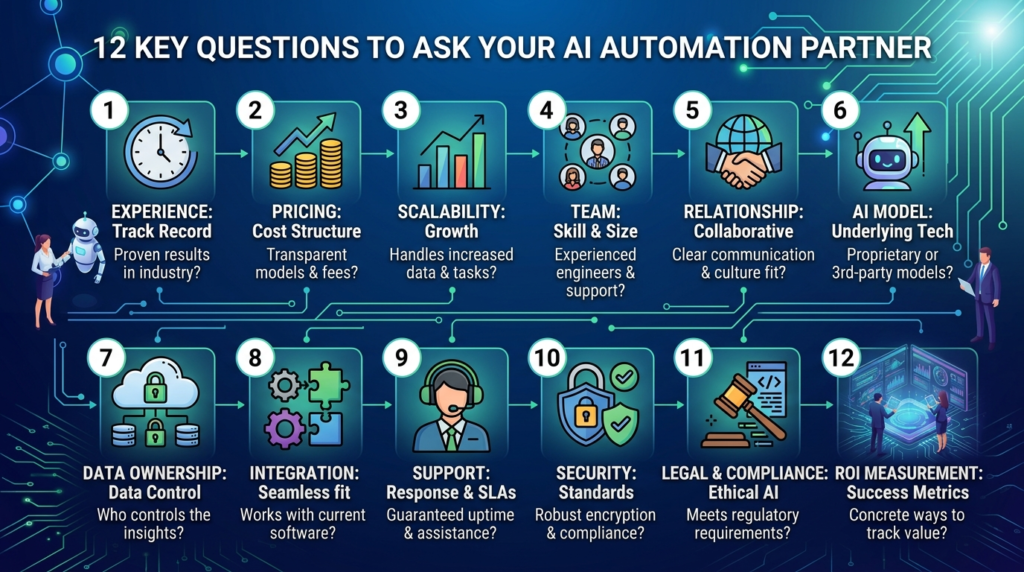
Twelve Questions Covering Data Ownership, Integration, and Support
Questions About Data Ownership (1–3)
1. Who owns the data the system processes and the models trained on it? This should have a clear, specific answer, not a vague reference to a standard terms-of-service document.
2. Can we export our data and configurations if we switch providers later? A vendor unwilling to guarantee data portability is effectively locking a business into a permanent relationship regardless of future performance.
3. Where is our data physically stored, and does this comply with our industry’s data protection requirements? This matters particularly for businesses handling sensitive customer information subject to regulatory requirements.
Questions About Integration Capability (4–7)
4. Which of our existing systems does this integrate with directly, and which would require custom development? A specific answer here reveals genuine technical depth; a vague “we can integrate with anything” answer often signals the opposite.
5. What happens if one of our existing tools updates or changes its API? This reveals whether the vendor has a maintenance plan for integration stability or expects the business to absorb that risk.
6. Can you show a reference implementation with a business using similar tools to ours? A vendor with genuine integration experience should be able to point to comparable prior work.
7. What is the actual implementation timeline, including any custom integration work required? This should be a specific number of weeks tied to defined milestones, not an open-ended estimate.
Questions About Ongoing Support (8–10)
8. What does support look like after launch, and what response time can we expect for issues? Vague assurances of “ongoing support” without specific response time commitments are worth pressing on directly.
9. Who is responsible for monitoring and improving the system’s performance over time? AI systems typically need ongoing tuning as usage patterns evolve, and it should be clear whether this falls to the vendor, the business, or a shared arrangement.
10. What happens if the system produces an error that affects a customer? A clear escalation and correction process, agreed upon in advance, prevents confusion and finger-pointing when something inevitably goes wrong.
Questions About Pricing and Scope (11–12)
11. What exactly is included in the quoted price, and what would trigger additional charges? Implementation support, ongoing maintenance, and future feature additions are common areas where scope and pricing assumptions diverge after signing.
12. What does a realistic timeline to measurable results look like, based on similar past implementations? A vendor grounding this answer in specific past client outcomes is more trustworthy than one offering only a generic, universally optimistic timeline.
How to Evaluate a Proof of Concept?
What a Meaningful POC Should Demonstrate?
A proof of concept worth taking seriously should demonstrate the system handling a genuinely representative sample of the business’s actual use case, not a simplified demo scenario designed to showcase the technology’s best-case performance. The POC should use real (or realistically representative) data and workflows, since a system that performs beautifully on clean, curated demo data can behave very differently once it encounters the actual variability of a business’s real operations.
Red Flags During the POC Phase
A POC that consistently requires the vendor’s direct hands-on involvement to produce good results is not actually testing whether the system will work independently once deployed. Similarly, a vendor reluctant to let the business’s own team test the system directly, insisting instead on guided demonstrations only, may be managing the demo more carefully than the underlying technology’s actual capability would otherwise allow.
What a Transparent AI Partner Should Offer?
Clear Pricing and Scope
A trustworthy AI automation vendor provides a detailed, itemized scope of work and pricing structure upfront, specifying exactly what is included, what would count as a change in scope, and how ongoing costs are calculated. Vendors who resist putting specifics in writing, preferring to keep pricing conversations verbal and flexible, make it considerably harder to hold the relationship accountable once the engagement is underway.
Honest Timelines and Realistic Expectations
The most trustworthy AI agency questions to ask are the ones about timeline and expected results, since a vendor’s willingness to give an honest, appropriately cautious answer here says a great deal about how they will handle the inevitable complications of a real implementation. A partner who acknowledges that results may take longer than an initial optimistic estimate, and explains why, is generally more reliable than one promising immediate, dramatic transformation with no caveats.
Comparing Multiple Vendors Fairly
Using the Same Question Set Across Every Vendor
When evaluating several AI automation vendors simultaneously, asking each one the exact same set of questions, in the same order, makes the resulting answers genuinely comparable rather than shaped by whatever each vendor chose to emphasize in their own pitch. Businesses that let each vendor structure the conversation around their own strengths often end up comparing incompatible information rather than making a fair, apples-to-apples decision.
Weighing Cost Against Capability, Not Cost Alone
The cheapest quote and the most capable vendor are not always the same choice, and treating cost as the primary deciding factor without weighing it against the specificity and quality of answers to the questions above frequently leads to a disappointing implementation that costs more to fix later than it would have cost to do properly the first time. A slightly higher upfront cost from a vendor who answered every question specifically and confidently is often the more economical choice once the full lifecycle cost of the relationship is considered. This is ultimately what choosing an AI automation partner well comes down to: weighing demonstrated substance over polished presentation.
Setting Up the Relationship for Long-Term Success
Documenting Everything Before Work Begins
Once a vendor is selected, documenting the answers to all twelve questions in the signed agreement itself — not just discussed verbally during the sales process — protects both sides if expectations diverge later. Specific commitments on data ownership, support response times, and pricing scope written into the contract prevent the common scenario where verbal assurances made during the pitch quietly disappear once the relationship moves into an ongoing working arrangement.
Planning for a Realistic Adjustment Period
Even a well-chosen AI automation partner typically requires a period of adjustment after launch, as the system encounters real-world edge cases the initial proof of concept did not fully anticipate. Setting this expectation explicitly with the vendor before launch, including how adjustment requests will be handled and what falls inside versus outside the original scope, prevents this normal part of implementation from becoming a source of conflict later.
Frequently Asked Questions
Who owns the data and the trained models is arguably the most consequential question, since the answer determines how much flexibility a business retains if the relationship needs to end or the vendor’s performance disappoints. A vague or evasive answer here is a serious warning sign regardless of how strong the rest of the pitch sounds.
Most meaningful POCs run two to six weeks, long enough to test the system against a genuinely representative slice of real business data and workflows without dragging on so long that it becomes a de facto free implementation. A POC significantly shorter than this rarely provides enough evidence to make a confident decision.
Not automatically, but a price significantly below market rate deserves specific questions about what is actually included, since AI automation with genuine ongoing support and integration work is rarely dramatically cheaper than competitors without cutting corners somewhere in scope, support, or data handling practices.
Good integration support includes a specific, named point of contact for technical issues, documented response time commitments, and a clear plan for handling changes to the business’s existing tools that the automation depends on. Vague assurances of “we’ll be here if you need us” without specifics are a weaker signal than a documented support agreement.
Yes, and a vendor with genuine successful implementations should be able to provide at least one reference from a business with a comparable scale or use case. Reluctance to provide any verifiable reference, especially from a vendor claiming extensive experience, is worth taking seriously as a red flag.
Ready to Evaluate an AI Automation Partner the Right Way?
Choosing an AI automation partner well means asking the specific questions that separate genuine capability from a polished pitch. Creative 4 All offers transparent AI automation services for businesses across Lebanon and the GCC, with clear data ownership terms, documented integration support, and honest timelines from the start. Book a Free AI Automation Assessment to see what a properly scoped implementation would look like for your business.