
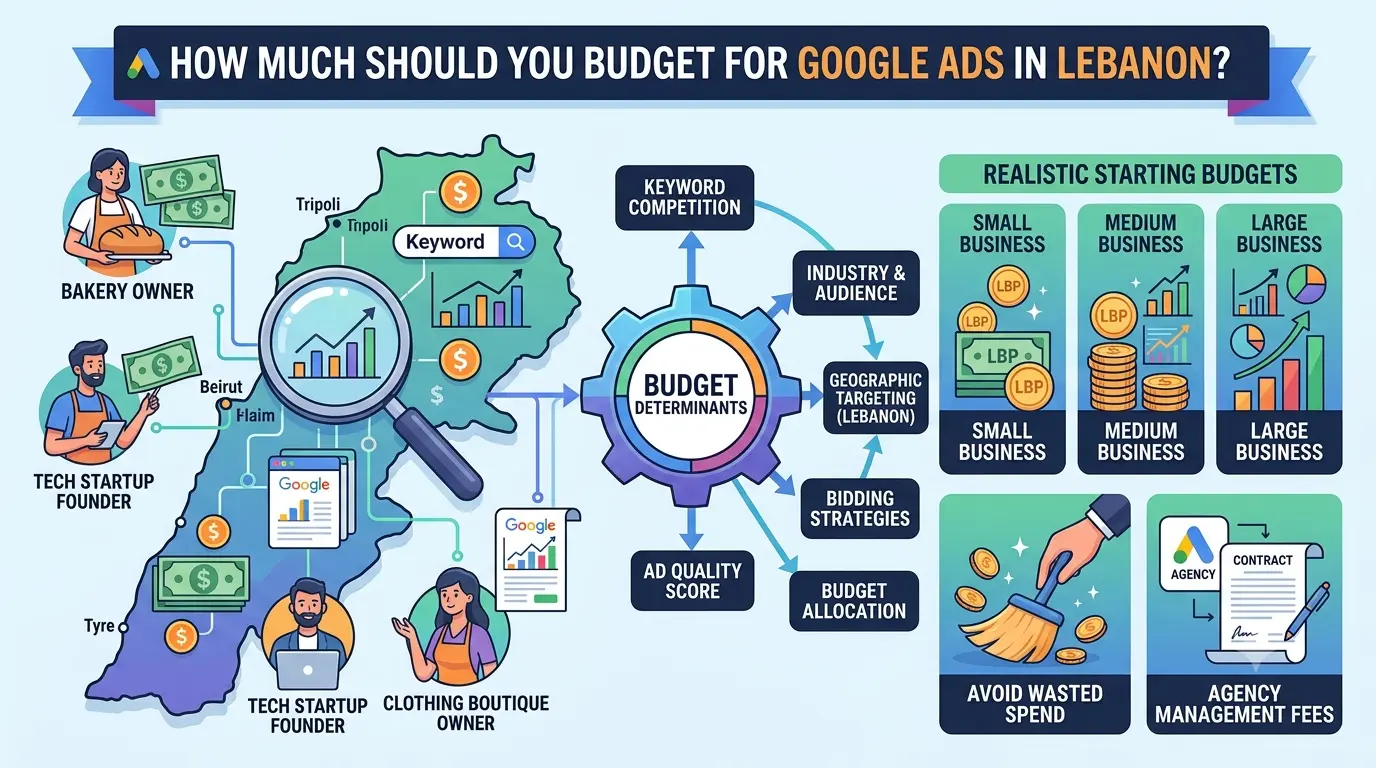
Ask five different agencies what a reasonable Google Ads budget Lebanon businesses should plan for, and the honest answer from any of them should start the same way: it depends on the category, the competition, and how tightly the campaign is managed, not on a single number that applies equally to a dentist and a construction company. Most of the content answering this question online skips straight to a made-up dollar figure without explaining any of the variables that actually determine it, which leaves business owners either wildly overestimating what they need or setting a Google Ads budget so low it can’t realistically generate meaningful data.
This guide breaks down the real factors that affect Google Ads cost, realistic starting budgets described by business size and category rather than fixed numbers, the most common ways ad spend gets wasted, and how agency management fees typically work so a total cost picture — not just ad spend — is clear before committing.
Factors That Affect Google Ads Cost
Industry and Competition Level
The single biggest driver of cost per click, and therefore of overall Google Ads budget requirements, is how competitive a given industry and keyword set already are. Categories like legal services, real estate, and cosmetic or dental procedures tend to carry meaningfully higher cost per click than less competitive local service categories, simply because more advertisers are bidding on the same limited pool of searches. A business entering a highly competitive category should expect to need a larger budget to gather meaningful data and compete for visibility than a business in a niche category with less advertiser competition, regardless of how well-optimized either campaign is.
Quality Score
Google’s Quality Score system rewards ads and landing pages that are genuinely relevant to the searches they’re targeting with lower costs per click, and penalizes poorly matched or low-quality campaigns with higher costs for the same position. This means two businesses bidding on the same keyword can pay meaningfully different amounts per click based purely on how well their ad copy, keyword targeting, and landing page experience align with what the searcher is actually looking for. A well-structured campaign with tight keyword-to-ad-to-landing-page alignment doesn’t just perform better — it directly reduces the budget required to achieve the same visibility as a poorly structured one.
Campaign Structure and Match Types
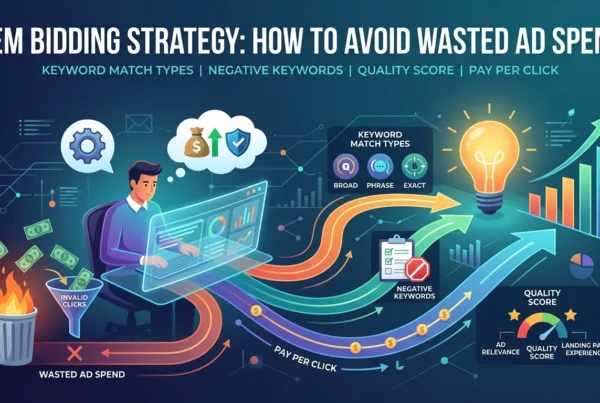
How a campaign is structured — tightly themed ad groups versus broad, mixed keyword lists, and the match types used to control how closely a search needs to match a keyword before triggering an ad — directly affects how efficiently a budget gets spent. Broad match types can capture more volume but often at the cost of relevance, pulling in clicks from searches only loosely related to what the business actually offers. A more disciplined structure using tighter match types typically produces a lower total spend for the same number of qualified clicks, which is precisely why two campaigns with identical budgets can produce very different results depending on how they’re built.
Realistic Starting Budgets by Business Size
Rather than quoting a fixed number that quickly becomes inaccurate or misleading, it’s more useful to describe how a reasonable Google Ads budget Lebanon businesses should plan for tends to scale by size and category. A small, local service business in a moderately competitive category typically needs a modest daily budget sufficient to generate enough clicks over a month to draw meaningful conclusions about which keywords and ad variations perform — testing on too small a budget for too short a period is one of the most common reasons a business concludes “Google Ads doesn’t work” when the real issue was never giving the campaign enough data to prove itself.
A mid-sized business competing across a broader area or in a more contested category typically needs a moderately larger daily budget to maintain visibility throughout the day rather than exhausting the budget by mid-morning and going dark for the rest of the day, which quietly caps how much of the day’s search volume the campaign can actually capture. A business in a highly competitive, higher cost-per-click category, or one running ecommerce campaigns with a large product catalog, generally needs the largest budget of the three, reflecting both the higher cost per click and the broader keyword coverage needed to represent a full product range.
Lebanon-Specific Considerations for Google Ads Budgeting
Setting a Google Ads budget Lebanon businesses can actually manage day to day involves a few practical wrinkles worth planning for upfront. Billing currency is one of the first: Google Ads typically bills in USD or another major currency depending on account settings, and a business budgeting in Lebanese Lira internally needs to translate that budget clearly into the billing currency to avoid under- or over-spending relative to what was actually intended. Payment method compatibility is another factor — not every local card works smoothly with Google’s billing system, which sometimes means routing ad spend through an international card or a payment method specifically confirmed to work reliably.
Time zone and local search behavior also matter more than they might seem. Scheduling ads to run during the hours when a Lebanese audience is actually searching, rather than defaulting to a generic all-day schedule, makes a given Google Ads budget Lebanon businesses set aside stretch further, since spend concentrated during genuinely active search hours produces more clicks and conversions than the same budget spread thin across low-traffic overnight hours.
Avoiding Wasted Spend
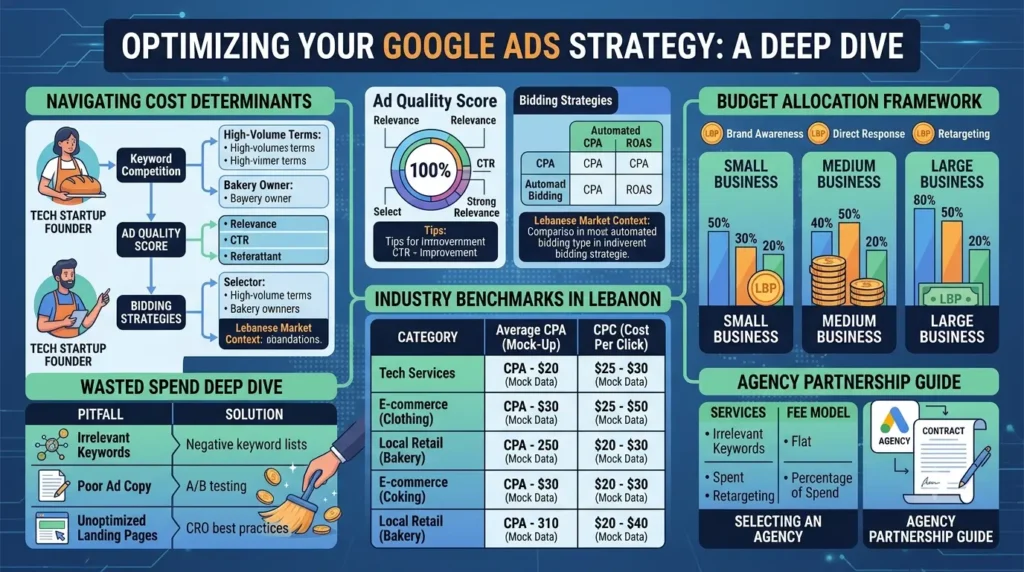
A handful of specific mistakes account for most of the wasted budget businesses experience with Google Ads. Broad match keywords left unrefined pull in irrelevant searches that consume budget without any realistic chance of converting, and reviewing the search terms report regularly to add negative keywords — explicitly excluding irrelevant search queries — is one of the most direct ways to stop this leak. Poor ad-to-landing-page alignment wastes spend by driving clicks to a page that doesn’t match what the ad promised, producing a click without a conversion regardless of how well-targeted the original keyword was.
Neglecting campaigns after initial setup is another common source of waste — a campaign left entirely on autopilot for months without review tends to drift toward broader, less efficient targeting as Google’s automated systems optimize for volume rather than the specific outcomes that matter to the business. Regular review of search terms, keyword performance, and conversion data, at minimum monthly, catches this drift before it accumulates into significant wasted spend.
How Agency Management Fees Typically Work?
Understanding the total cost of running Google Ads through an agency means separating two distinct costs: the actual ad spend paid directly to Google, and the agency’s management fee for building, monitoring, and optimizing the campaign. Management fees are typically structured either as a flat monthly rate or as a percentage of ad spend, and each model has different implications depending on budget size — a percentage-based fee scales naturally with a growing budget but can become disproportionately expensive at higher spend levels, while a flat fee stays predictable regardless of budget size but may not reflect the added complexity of managing a much larger account.
A transparent agency should be able to clearly separate these two numbers in any proposal, rather than presenting a single bundled figure that makes it difficult to understand how much is actually going toward advertising versus management. This distinction matters directly when comparing agency quotes, since a lower total number might reflect a smaller ad budget with the same management fee, rather than genuinely lower-cost management. Asking any agency to break out ad spend and management fee separately, and to explain what specific work the management fee actually covers — campaign setup, ongoing optimization, reporting, strategic adjustments — turns a vague total price into something a business can actually evaluate against what it’s getting.
Frequently Asked Questions
It depends on the category’s cost per click, but the budget should be large enough to generate a meaningful number of clicks over a full month — testing with too few clicks makes it impossible to draw reliable conclusions about which keywords or ads are actually working.
Not automatically. A larger budget spent on a poorly structured campaign with weak keyword targeting and landing page alignment often underperforms a smaller, tightly managed budget, since Quality Score and campaign structure affect efficiency independently of raw spend.
Most campaigns need at least four to six weeks of consistent spend to move past Google’s initial learning phase and accumulate enough conversion data to evaluate performance reliably, rather than judging results from the first week or two.
A business owner with time to learn the platform can manage a simple, small-budget campaign directly. Larger budgets, competitive categories, or campaigns needing ongoing optimization typically benefit from professional management, where the added management fee is usually offset by reduced wasted spend and better overall efficiency.
Yes, Google Ads allows a daily budget cap, though actual daily spend can fluctuate somewhat above that average on higher-traffic days, evening out over the course of a month rather than being strictly capped on any single day.
Ready to Find Out What Your Google Ads Budget Should Actually Be?
Getting an accurate answer to what your Google Ads budget Lebanon businesses like yours should set requires looking at your specific category, competition, and goals rather than a generic recommendation. Get a free PPC account review from Creative 4 All and find out exactly what budget makes sense for your business.