
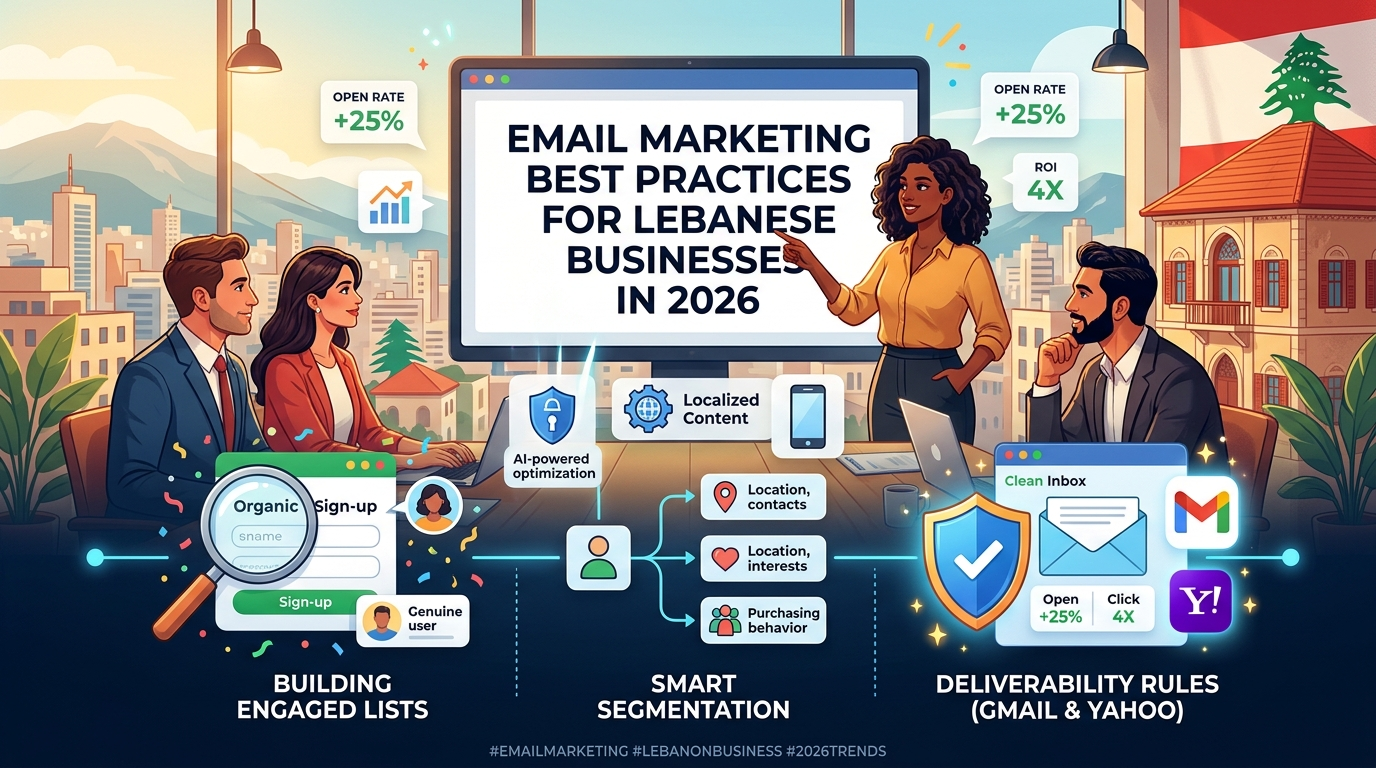
Email marketing rarely gets the attention it deserves in a marketing budget conversation, largely because it lacks the visual appeal of a social media campaign or the immediacy of a paid ad. Yet email consistently outperforms most other digital channels on return per dollar spent, and 2026 has made the channel both more demanding and more rewarding at the same time: Gmail, Yahoo, and Microsoft have all moved from recommending strong sending practices to strictly enforcing them, which means businesses that get the fundamentals right now have a real advantage over those still sending the way they did a few years ago. This guide covers the full picture — from why the channel still performs, to building a list the right way, to the technical deliverability rules that now determine whether any of it actually reaches an inbox.
Why Email Still Outperforms Most Channels on ROI?
The Owned-Audience Advantage
An email list is one of the few marketing assets a business actually owns outright, unlike a social media following that exists at the mercy of a platform’s algorithm and terms of service. A follower can be reached only if a platform’s algorithm chooses to show them a post; a subscriber can be reached directly, every time, without paying a platform for the privilege. This ownership is precisely why email marketing best practices remain relevant even as social platforms rise and fall in relevance — the list itself is a durable business asset that survives algorithm changes, platform shutdowns, and shifting social media trends.
Real Benchmarks Worth Comparing Against
Open rate benchmarks vary meaningfully by industry, but a well-run email campaign strategy for a small to mid-sized business typically sees open rates in the 20 to 35 percent range and click-through rates between 2 and 5 percent, figures that consistently outperform average organic reach on most social platforms for an equivalent piece of content. These benchmarks matter less as a scorecard to obsess over and more as a sanity check — a list performing dramatically below these ranges usually signals a list quality or deliverability problem worth investigating before blaming the content itself.
Building a List Without Spam Tactics
Opt-In Compliance and Consent
A list built through genuine opt-in consent — someone actively choosing to subscribe, understanding what they are signing up for — performs better in every meaningful way than a list built by purchasing contacts or scraping addresses from other sources. Beyond the ethical and increasingly legal concerns around consent, purchased or scraped lists produce dramatically higher spam complaint rates, and mailbox providers now treat spam complaints as one of the most serious signals in determining whether a sender’s mail reaches the inbox at all.
Lead Magnets That Attract the Right Subscribers
An effective lead magnet — a useful guide, a discount code, an exclusive resource — should attract people genuinely interested in what the business offers, not simply the largest possible number of email addresses. A lead magnet promoted broadly without regard for relevance often produces a list full of subscribers who never engage, which drags down engagement metrics and, over time, damages the sender reputation that healthy deliverability depends on. Building a smaller, genuinely interested list consistently outperforms a larger, disengaged one over any meaningful time horizon.
Segmentation and Personalization Basics
Basic Segments Every Business Should Start With
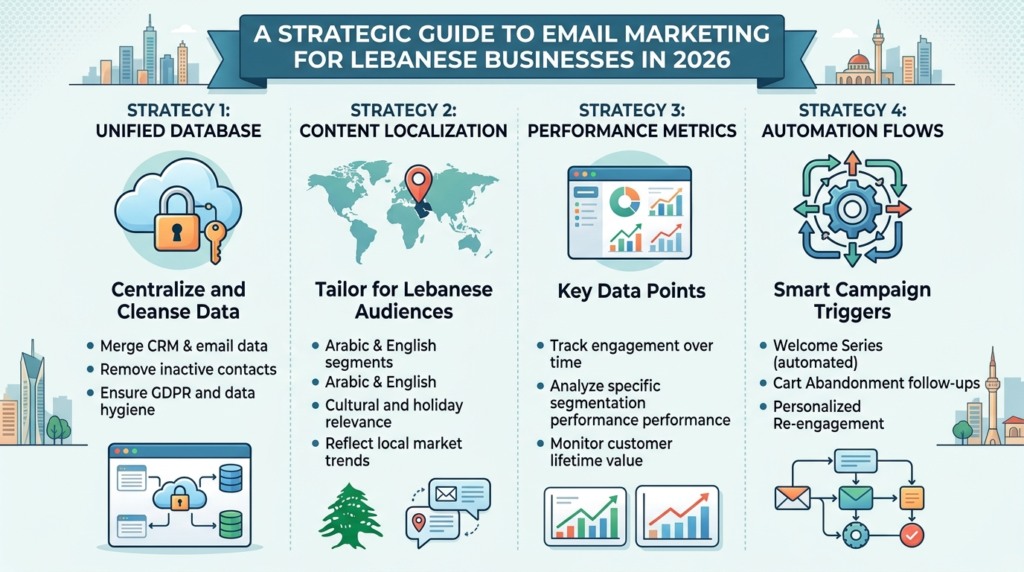
Segmentation does not need to be elaborate to produce real results. A useful starting structure divides a list by purchase history (customers versus prospects who have not yet bought), engagement level (recently active versus long-dormant subscribers), and where relevant, language preference for a trilingual business serving English, Arabic, and French audiences. Even this basic level of segmentation allows messaging to be meaningfully more relevant than a single blast sent identically to an entire list regardless of where each recipient actually stands.
Personalization Beyond First-Name Merge Fields
Genuine personalization goes well beyond inserting a subscriber’s first name into a greeting. Automation triggers based on actual behavior — a follow-up sent after someone abandons a cart, a re-engagement sequence triggered after a period of inactivity, a targeted message sent to someone who viewed a specific product category repeatedly — produce meaningfully higher engagement than static, generic content sent to the full list on the same schedule regardless of individual behavior.
Deliverability Fundamentals for 2026
Authentication: SPF, DKIM, and DMARC
Email deliverability in 2026 depends heavily on proper authentication, and the major mailbox providers have moved from recommending this to strictly requiring it. Gmail and Yahoo began enforcing authentication requirements for bulk senders in 2024, and by late 2025 Gmail moved to permanently rejecting non-compliant bulk mail outright rather than merely routing it to spam. Microsoft implemented equivalent requirements for Outlook, Hotmail, and Live accounts in 2025. Practically, this means any business sending marketing email needs SPF, DKIM, and DMARC properly configured on its sending domain — technical authentication records that verify a message genuinely comes from who it claims to, which mailbox providers now treat as a baseline requirement rather than an optional best practice.
Engagement Signals and List Hygiene
Beyond authentication, mailbox providers weigh recipient engagement heavily when deciding whether a sender’s mail reaches the inbox. Consistently low open rates, high unsubscribe rates, or a spam complaint rate above roughly 0.3 percent all signal to Gmail, Yahoo, and Microsoft that a sender’s mail may not be wanted, which can affect inbox placement even for genuinely engaged subscribers on the same list. Regular list hygiene — removing addresses that have not opened anything in six months or more, honoring unsubscribe requests immediately, and including a genuine one-click unsubscribe option as required by current mailbox provider rules — protects sender reputation and keeps deliverability strong for the subscribers who actually want to hear from the business.
Newsletter Marketing as a Relationship-Building Tool
The Difference Between a Promotional Blast and a Newsletter
Newsletter marketing serves a genuinely different purpose than a purely promotional campaign. Where a promotional email pushes a specific offer or announcement, a well-run newsletter builds an ongoing relationship through consistent, valuable content — industry updates, behind-the-scenes stories, useful tips related to the business’s products or services — that keeps a business present in a subscriber’s inbox even during periods with no active offer to promote. Businesses that rely exclusively on promotional blasts often see engagement decline over time, since every email asks for something rather than occasionally just providing value.
Balancing Newsletter Content With Promotional Sends
A healthy email program typically blends both approaches rather than choosing one exclusively. A reasonable starting ratio sends roughly three newsletter-style, value-focused emails for every one purely promotional send, keeping subscribers engaged with useful content while still creating regular opportunities to highlight offers, new products, or services. Businesses that skew too heavily toward constant promotion tend to see rising unsubscribe rates, while those that never ask for anything miss straightforward revenue opportunities sitting within an already-engaged list.
Choosing the Right Email Marketing Platform
Features That Actually Matter for a Small Business
Not every feature offered by email marketing platforms matters equally for a small to mid-sized business. Reliable deliverability infrastructure, straightforward segmentation tools, and genuine automation capability (behavior-triggered sequences, not just scheduled blasts) matter far more than an extensive template library or advanced features designed for enterprise-scale sending. Businesses evaluating platforms should prioritize deliverability track record and ease of setting up authentication records over purely cosmetic features that look impressive in a sales demo but rarely affect actual campaign performance.
Multilingual Support for Trilingual Sending
For a business sending to English, Arabic, and French subscribers, confirming that a chosen platform genuinely supports right-to-left text rendering for Arabic content, rather than treating it as an afterthought, prevents formatting problems that can make an otherwise well-designed email look broken to a significant portion of the list. This is worth testing directly during platform evaluation rather than assuming based on a platform’s general international marketing claims.
Frequently Asked Questions
Yes, and arguably more than ever, since the tightened deliverability requirements have pushed out low-quality senders and rewarded businesses that follow proper list-building and authentication practices. A well-maintained list with genuine engagement continues to outperform most other channels on cost per result.
SPF, DKIM, and DMARC authentication records configured on the sending domain, along with a genuine one-click unsubscribe option, are now baseline requirements enforced by Gmail, Yahoo, and Microsoft. Businesses sending through a reputable email marketing platform typically have guided setup for these records, but they still need to be configured correctly rather than left as platform defaults.
There is no universal number, but consistency matters more than frequency itself. A weekly or biweekly cadence works well for most small to mid-sized businesses, and tracking unsubscribe rates over time is the most reliable way to tell if the current frequency is too aggressive for a specific list.
Ideally yes, both in language and in cultural framing rather than a direct word-for-word translation. Segmenting a list by language preference allows each version to be genuinely tailored rather than forcing a single generic version across a trilingual audience.
Most well-run small to mid-sized business campaigns see open rates between 20 and 35 percent, though this varies by industry and list quality. A list performing well below this range is usually signaling a deliverability or list-quality issue worth investigating rather than a content problem alone.
Ready to Turn Your Email List Into a Real Revenue Channel?
Email marketing best practices in 2026 require more technical rigor than they used to, but the channel remains one of the strongest return-on-investment options available. Creative 4 All builds compliant, well-segmented email marketing programs for businesses across Lebanon and the GCC, from list-building through deliverability setup. Request an Email Marketing Audit to see how your current email program measures up.