

A business that has outgrown its website often doesn’t realize that’s the actual problem. Symptoms show up first: a team drowning in manual spreadsheet work, customers calling to check something a self-service portal should handle, or an internal process held together by shared documents and someone’s memory of how things are supposed to work. Investing in the right business software addresses a fundamentally different need than a website does, and understanding that difference is the first step toward recognizing when a business has genuinely reached the point where a standard site can no longer keep up. This article walks through that difference, the practical signs worth watching for, common use cases seen across Lebanese businesses, and how to think through the decision between building custom software and adopting an existing product.
Website vs. Web Application: What’s the Difference
What a Standard Website Is Built to Do?
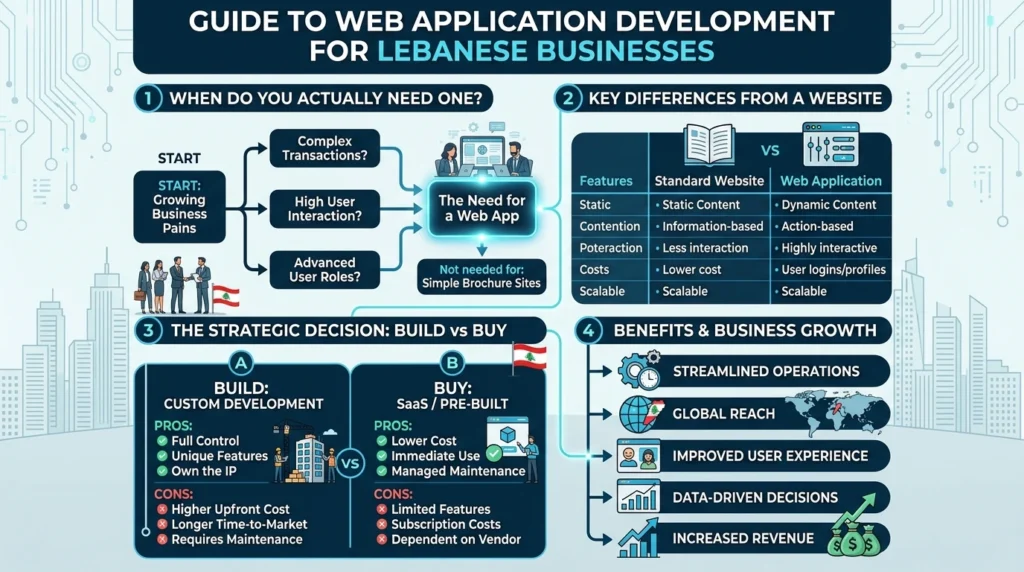
A standard website exists primarily to present information and persuade a visitor to take an action — read about services, view a product catalog, fill out a contact form, or make a purchase through a relatively simple, standardized checkout flow. Even a sophisticated website with a blog, service pages, and an ecommerce store is still fundamentally a presentation layer, built to display content and capture straightforward conversions rather than to manage complex, ongoing interactions between a business and its users.
What Makes Something a Web Application?
A web application, by contrast, is built to let users do something — log into a personalized account, interact with data specific to them, complete a multi-step process, or perform tasks that involve genuine business logic beyond simply viewing a page. The distinguishing feature is interactivity tied to a persistent, personalized state: a customer portal that remembers a specific user’s order history, a booking system that checks live availability before confirming a reservation, or an internal dashboard that pulls and updates real operational data. Once a project requires this kind of ongoing, stateful interaction rather than one-way information delivery, it has moved from website territory into web application territory.
Signs a Business Has Outgrown a Standard Website
Manual Processes That Should Be Automated
A clear signal that a business needs web application development is when staff spend significant time manually performing tasks a properly built system could handle automatically — manually checking a spreadsheet before confirming a booking, manually emailing customers with information they should be able to look up themselves, or manually reconciling data that exists in multiple disconnected places. Each of these manual workarounds represents real, recurring labor cost that a custom system could eliminate, and the cumulative cost of that ongoing manual work often exceeds the cost of building a proper solution within a surprisingly short timeframe.
Growing Complexity in Customer or Internal Workflows
As a business grows, the interactions customers or employees need to have with it tend to grow in complexity too — more account types, more steps in a process, more data that needs to be tracked and cross-referenced. A website built for a simpler version of the business often gets stretched to accommodate this growing complexity through workarounds (embedded third-party forms, manually updated PDFs, disconnected tools bolted together), and at some point the workaround itself becomes more expensive and error-prone to maintain than building custom software that actually fits how the business operates today.
Common Web Application Use Cases for Lebanese Businesses
Customer Portals and Self-Service Accounts
A customer portal allowing clients to log in, view their order or service history, update their own information, and access documents or resources specific to their account reduces support burden significantly while improving the customer experience, since many customers genuinely prefer self-service over waiting for an email response. This use case applies broadly — professional services firms managing client documents, subscription businesses managing account details, or service providers tracking ongoing project status all benefit from this kind of dedicated portal.
Booking and Scheduling Systems
Businesses managing appointments, reservations, or resource scheduling — clinics, salons, equipment rental, event spaces — frequently reach a point where a generic booking plugin bolted onto a website no longer handles the specific rules and complexity their business actually requires (multiple staff schedules, resource conflicts, deposit handling, automated reminders). A custom-built booking system designed around the business’s actual rules, rather than forced into a generic plugin’s limitations, both reduces double-booking errors and improves the customer experience.
Internal Tools and Operational Dashboards
Not every web application faces customers directly. Internal tools — inventory tracking dashboards, custom reporting systems, workflow management tools connecting different departments — often deliver the strongest return on investment precisely because they are invisible to customers but directly reduce the operational friction and manual labor a growing business accumulates. These tools frequently pay for themselves through time saved alone, independent of any customer-facing benefit.
Build vs. Buy: Custom Development vs. Off-the-Shelf SaaS
When an Existing SaaS Solution Makes More Sense?
Not every business need justifies this level of custom development. When an existing SaaS product already solves the specific problem well — a standard CRM, an established booking platform, a well-regarded project management tool — adopting that existing solution is almost always faster and cheaper than building something custom to replicate functionality that already exists and is already well-tested. Custom development makes sense specifically when the business’s actual workflow does not fit neatly into what existing SaaS products offer, not as a default preference over buying an existing solution.
When Custom Development Is Worth the Investment?
Building a custom system from scratch becomes the better investment when a business’s specific process, data structure, or customer experience genuinely cannot be replicated by adapting an existing product, when API integrations need to connect several different existing systems in ways no off-the-shelf tool supports natively, or when the business’s competitive advantage is meaningfully tied to how a specific workflow operates rather than being a generic process any competitor could replicate with the same off-the-shelf tool. Businesses should approach this decision by first genuinely evaluating existing SaaS options before assuming custom development is necessary, since underestimating what an existing product can already do is a common and costly mistake.
Custom Web App Lebanon: Local Market Considerations
Why Local Context Shapes the Right Approach?
A custom web app Lebanon project needs to account for practical realities that differ from building the same kind of system in a market with more consistent infrastructure — planning for occasional connectivity interruptions, ensuring the application degrades gracefully rather than failing completely during a brief outage, and building with hosting and backup considerations suited to the local environment. A development partner without genuine local experience sometimes designs around assumptions that don’t hold up once the system is actually running for a Lebanese business day to day.
Multilingual Requirements From the Start
Most custom web app Lebanon projects need to support English, Arabic, and often French from the outset, which affects decisions far earlier in development than businesses often expect — database structure, user interface framework choices, and content management approach all need to account for multilingual support rather than treating translation as something to bolt on after the core application is built. Planning for this upfront avoids a costly restructuring later once a business realizes its single-language application needs to serve a genuinely multilingual customer base.
SaaS Development vs. Custom Internal Tools
When a Business Considers Building Its Own SaaS Product?
Some Lebanese businesses reach a point where the internal tool they built for their own operations could genuinely serve other businesses facing the same problem, opening the door to SaaS development as a product in its own right rather than purely an internal efficiency tool. This is a meaningfully different undertaking than building software for internal use only, since a genuine SaaS product needs to handle multiple customer accounts securely, scale reliably, and include the customer support and onboarding infrastructure that internal tools never required.
Distinguishing Internal Tooling From Product Development
Businesses considering this path should be honest about which category their project actually falls into before committing resources, since building genuinely multi-tenant SaaS development requires meaningfully more architectural planning than an internal tool used by one company’s own staff. Treating an internal tool build as a stepping stone toward eventual SaaS development, rather than assuming the two are the same undertaking, leads to better decisions about how the initial system gets architected.
Frequently Asked Questions
If the core need is presenting information and capturing simple conversions, a website update usually suffices. If the need involves ongoing, personalized user interaction — accounts, live data, multi-step processes — that a standard website’s templating cannot accommodate, that points toward web application development instead.
Web application development generally costs meaningfully more than a standard website, since it involves genuine software development rather than content and template configuration. The specific cost depends heavily on complexity, but businesses should expect a considerably larger investment and longer timeline than a typical website project.
Yes, this should generally be the first step. Existing SaaS products are usually faster to implement and cheaper than custom development, and custom development is only the better choice when a business’s actual needs genuinely cannot be met by adapting an existing solution.
Scope that expands significantly beyond the original plan is one of the most common and costly risks, since web applications involve more moving technical pieces than a website and requirements often become clearer only once development is already underway. Working with a development partner who scopes carefully upfront and communicates clearly about changes helps manage this risk.
Yes, API integrations are one of the most common reasons businesses invest in this kind of custom software specifically — connecting a new system to existing accounting software, a CRM, or other business tools rather than requiring staff to manually transfer data between disconnected systems.
Ready to Find Out if Your Business Needs a Web Application?
Web application development is the right investment when a business has genuinely outgrown what a standard website can do, not a default upgrade every growing business needs. Creative 4 All builds custom web applications for businesses across Lebanon and the GCC, from customer portals to internal operational tools. Discuss Your Web Application Project to get an honest assessment of whether custom development is the right fit for your business.