A restaurant group in Beirut spends months building a beautiful ordering app. It launches on both stores with an English-only listing, a description copied from the website and five screenshots of the login screen. Downloads come almost entirely from paid ads, and when the ads stop, installs stop too. Nobody searching “توصيل اكل” or “food delivery Beirut” ever finds the app on their own.
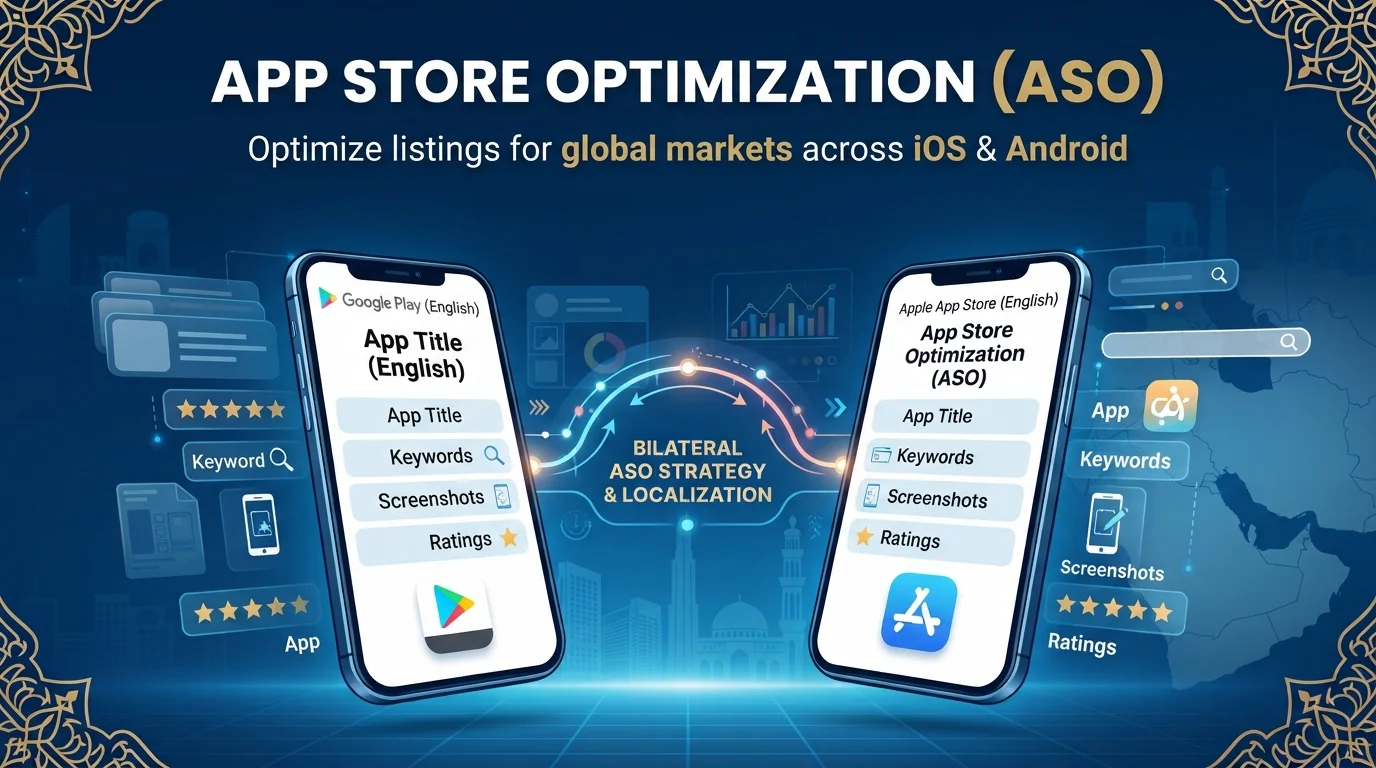
That is the gap app store optimization fills. ASO is the practice of improving how your app ranks in App Store and Google Play search and how convincingly its listing turns views into installs. This app store optimization guide is written for app owners and product managers in Lebanon and the GCC, where most apps need to work in both Arabic and English. It explains what each store uses for ranking, how to research keywords in two languages, how to design listings that convert, and how to measure progress.
Why ASO Matters for Apps in Lebanon and the Gulf?
Most people discover apps in one of three ways: searching inside the store, browsing store charts and features, or clicking an external link such as an ad, a website or a social post. Store search is usually the largest organic source, and it is free. If your listing does not appear for the words people type, you are paying for every install that search could have delivered.
Bilingual markets add a twist. In Lebanon, users search in English, Arabic and sometimes Arabizi; in Saudi Arabia and the UAE, Arabic searches are common alongside English. An app with an English-only listing is invisible to a large part of its audience. Good ASO for Arabic apps is therefore not a translation task but a second, parallel optimisation.
ASO vs SEO: Similar Principles, Different Rules
ASO vs SEO is a common question, because the ideas overlap: both are about relevance, keywords, authority and user behaviour. But the stores use a much smaller set of signals than Google uses for websites. There are no backlinks in the usual sense, metadata fields have strict character limits, and conversion rate, ratings and download velocity weigh heavily. The two also support each other: a strong website and good web SEO send branded traffic to your store page, and branded downloads help store rankings. Our Arabic SEO guide covers the website side for bilingual brands.
How the App Store Ranks Apps?
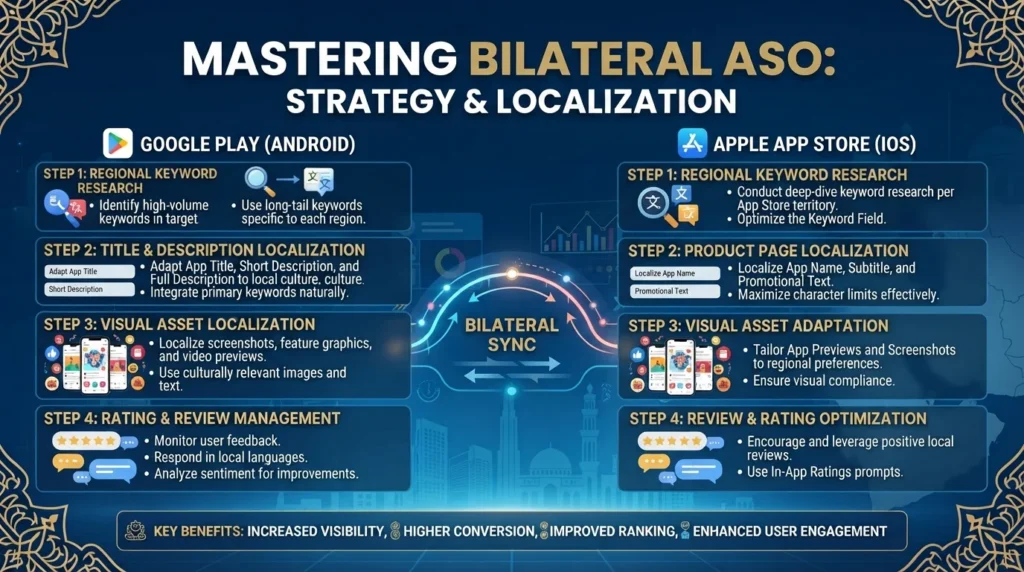
Apple’s App Store relies mainly on a few text fields, plus performance signals such as downloads, engagement and ratings.
App Name and Subtitle
The app name (up to 30 characters) carries the most keyword weight, followed by the subtitle (also up to 30 characters). Include your brand and one or two high-value terms naturally, for example a brand name followed by a short descriptor. Avoid stuffing; Apple reviews names and may reject misleading ones.
The Keyword Field
The hidden keyword field allows 100 characters. Use single words separated by commas without spaces, avoid repeating words already in the name or subtitle, skip plurals Apple can infer, and leave out your brand name if it already appears elsewhere. This field is where much of your secondary keyword coverage lives.
Description and Promotional Text
On the App Store, the long description does not influence search ranking, but it does influence conversion, so write it for people. The promotional text (170 characters) can be updated without a new app release, which makes it useful for seasonal messages such as Ramadan offers or White Friday deals.
Localizations and Storefronts
Apple lets you create localized metadata for each language. In many storefronts, including Middle East markets, the store indexes more than one localization, which means you can cover Arabic and English keywords with separate name, subtitle and keyword fields. Check which localizations apply in each target storefront, and use each one deliberately rather than duplicating the same English text.
Google Play Keyword Optimization
Google Play keyword optimization works differently, because Google reads more of your listing.
Title, Short Description and Full Description
The title (up to 30 characters) is the strongest field. The short description (up to 80 characters) appears prominently and carries ranking weight. Unlike the App Store, the full description (up to 4,000 characters) is indexed, so it should cover your main features and keywords in natural, readable language. Repeat important terms a few times where they fit, but write for users; keyword-stuffed descriptions perform poorly and can break store policies.
Localized Listings and Custom Store Listings
Add Arabic translations for every listing field, written natively rather than machine-translated. Google Play also supports custom store listings by country, so a Lebanese app expanding to Saudi Arabia can show Saudi-specific messaging, screenshots and offers in that market.
ASO for Arabic Apps: Keyword Research in Two Languages
Keyword research is where ASO Arabic apps most often fall short. Start from what users want to do, then list how they would type it in each language: “food delivery,” “توصيل اكل,” “طلب اكل,” and so on. Arabic search terms vary by dialect and spelling, just as on the web, so check variants such as different hamza forms and colloquial words. Use the stores’ own search suggestions in each target country, review competitors’ names and subtitles, and use ASO tools where available, keeping in mind that their Arabic data can be thinner than for English.
Prioritise terms that are relevant to what your app actually does, have meaningful search interest and where you can realistically compete. Our guide to keyword research for Lebanese businesses explains the same prioritisation logic for websites.
App Store Screenshots and Conversion
Ranking gets you seen; your listing gets you installed. App Store screenshots conversion is often the fastest lever, because most visitors decide from the first screenshots without reading the description.
Design screenshots as a short story: the first two or three should show the core benefit clearly, with short captions in the user’s language. Create separate Arabic screenshot sets with right-to-left layouts and Arabic captions, rather than placing Arabic text on English interface screenshots. Show the real app, not generic marketing images. Add an app preview video if it genuinely demonstrates value in the first few seconds. On Google Play, design a clear feature graphic and test your icon, since it appears in search results.
Both stores let you test variations. Apple offers product page optimization tests and custom product pages for different audiences and campaigns, and Google Play offers store listing experiments. Test one element at a time, such as the first screenshot or the icon, and let tests run long enough to reach meaningful results.
Ratings and Reviews
Ratings influence both ranking and conversion. Ask for reviews at positive moments, such as after a successful order or booking, using the official in-app review prompts each store provides; Apple limits how often its prompt can appear to a user, so time it carefully. Reply to reviews in the reviewer’s language, thank people for positive feedback and address complaints constructively. Fixing the issues users mention repeatedly is the most reliable way to raise your rating over time. If you want to understand the cost of building these features well, our mobile app development cost guide explains what drives budgets.
Measuring ASO Results
Track a small set of numbers monthly in App Store Connect and the Google Play Console: impressions or store listing visitors, conversion rate from page view to install, installs from search versus other sources, keyword rankings for your priority terms in each language, and average rating with review volume. Review results by country, since Lebanon, Saudi Arabia and the UAE often behave differently. When you change metadata or creative, note the date so you can connect changes to results.
Applying This App Store Optimization Guide
Treat ASO as an ongoing process rather than a launch task. Update keywords and promotional text with seasons and product changes, refresh screenshots after major updates, keep replying to reviews and revisit keyword research every few months. Following this app store optimization guide consistently in both Arabic and English usually produces steady gains in organic installs, reducing dependence on paid campaigns. A strong store listing also benefits from the bilingual interface principles in our Arabic RTL design guide, because what users see in screenshots must match the real app.
A 30-Day Plan to Start
If you want to put this app store optimization guide into practice quickly, a simple first month looks like this:
- Week 1: research keywords in Arabic and English for each target country.
- Week 2: rewrite names, subtitles, keyword fields and Google Play descriptions in both languages.
- Week 3: redesign the first three screenshots in Arabic and English versions.
- Week 4: set up in-app review prompts and start one listing test.
- Ongoing: record baseline metrics and review them monthly.
This app store optimization guide works best when one person owns the listing and checks it every month.
Frequently Asked Questions
App store optimization (ASO) is the process of improving an app’s visibility in App Store and Google Play search and its conversion from listing views to installs. It covers keywords in metadata fields, screenshots and videos, ratings and reviews, and localization for each market.
Both rely on relevance, keywords and user behaviour, but ASO works within store listings with strict character limits and no traditional backlinks, while SEO optimises websites for search engines. They complement each other, since web traffic and branded searches can lift store performance.
Yes, if your audience includes Arabic speakers. Create native Arabic metadata and screenshot sets alongside English ones, because many users search and decide in Arabic, especially in Saudi Arabia and the UAE.
Yes. Unlike the App Store, Google Play indexes the full description, so it should cover your main features and keywords in natural language. On the App Store, the description affects conversion rather than search ranking.
Metadata changes can affect rankings within days to weeks after an update is approved, while conversion improvements from new screenshots can show quickly once enough visitors see them. Sustained growth comes from regular testing, updates and review management over several months.
Turn Store Search Into a Free Growth Channel
An app that cannot be found depends on paid campaigns forever. Thoughtful app store optimization in Arabic and English, covering keywords, listings, screenshots, ratings and measurement, turns store search into a steady source of organic installs across Lebanon and the Gulf.
If you would like an expert review of your App Store and Google Play listings, the Creative 4 All team can audit your metadata and creative, research keywords in both languages and set up a testing plan. Explore our app store optimization services in Lebanon and request an ASO audit through the form.