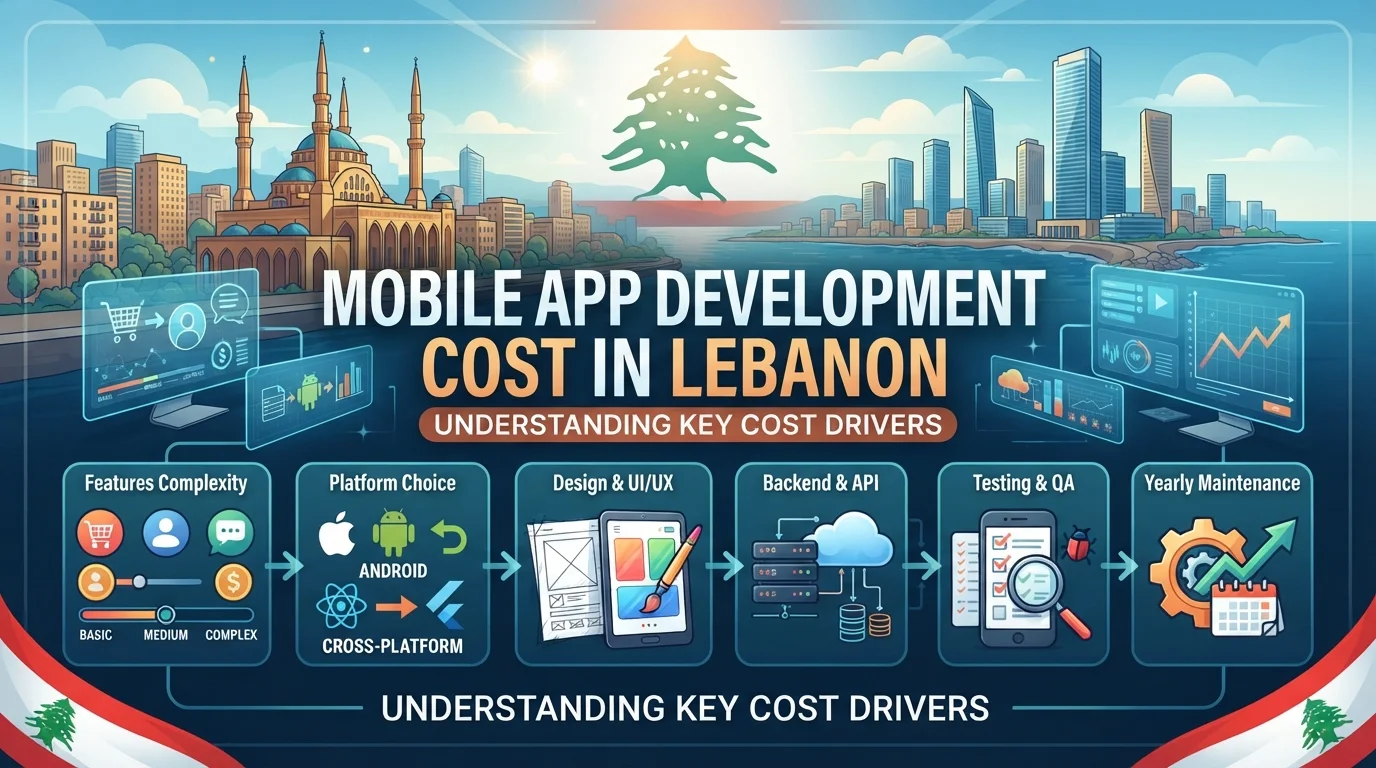
Ask three companies in Beirut to quote for “an app like Talabat but for our business” and you may receive three quotes that differ by a factor of five. One promises delivery in a month, another proposes a six-month project, and the third asks forty questions before giving any number at all. None of them is necessarily wrong. They are simply pricing different apps, because the brief left almost everything open.
Understanding mobile app development cost in Lebanon starts with understanding what you are actually paying for. This guide breaks down the factors that drive cost, explains the difference between native and cross-platform development, covers the costs that appear after launch and shows how to prepare a brief that produces comparable quotes. It is written for founders, SMEs and corporate teams in Lebanon and the Gulf who need a realistic budget before they talk to developers.
Why App Quotes Vary So Much?
A mobile app is rarely just the app on the phone. Most business apps have three parts: the app itself on iOS and Android, a backend server and database that stores users, orders and content, and an admin panel your team uses to manage everything. Many first-time buyers only picture the first part.
Quotes also vary because of team structure and approach. A freelancer, a small studio and an established agency carry different overheads, processes and guarantees. Some quotes include design, testing, project management and post-launch support; others list only development hours. The mobile app development cost you see on a proposal is meaningful only when you know exactly what it includes.
What Drives Mobile App Development Cost?
Most of the budget is determined by a handful of factors. Knowing them helps you control scope rather than react to quotes.
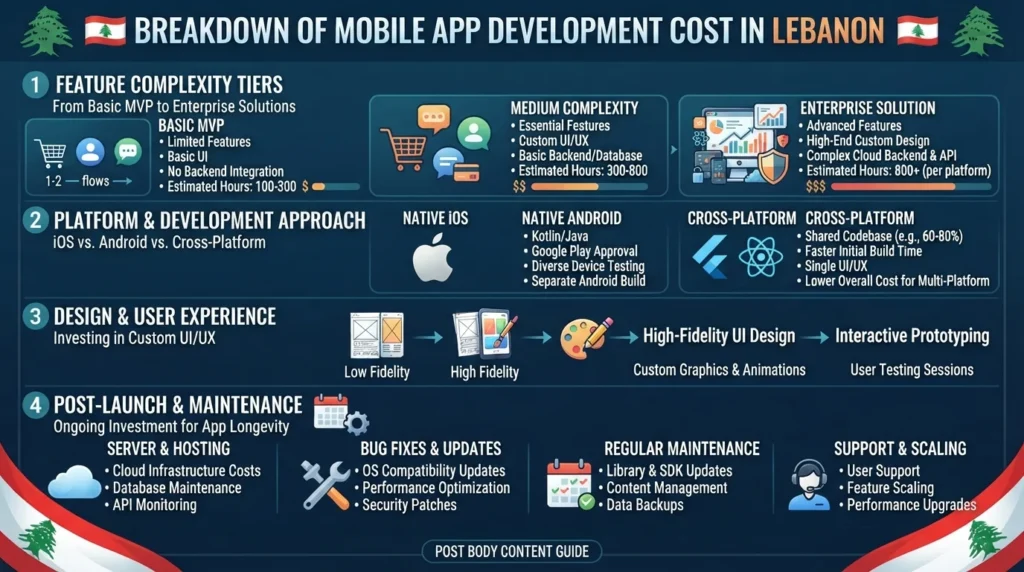
Features and Complexity
Each feature adds design, development and testing time. User registration, profiles, search, product catalogues, carts, payments, bookings, chat, notifications, maps and loyalty programmes all carry their own effort. Integrations with existing systems, such as an ERP, CRM, POS or delivery platform, often take longer than expected because they depend on the quality of those systems’ APIs.
Platforms: iOS, Android or Both
In Lebanon and the Gulf, most consumer apps need both iOS and Android. Building both natively means two codebases; building with a cross-platform framework means one shared codebase. That choice is one of the biggest drivers of iOS Android app cost, discussed in the next section.
Design and User Experience
A polished, custom interface with animations, illustrations and careful user testing costs more than a functional design based on standard components. For bilingual apps, Arabic right-to-left layouts add design and testing work, because every screen must be checked in both directions. Our guide to Arabic RTL design covers the principles, which apply to apps as much as websites.
Backend and Admin Panel
The backend handles data, user accounts, business logic and integrations, and the admin panel lets your team manage content, orders and users. For many business apps, this part represents a large share of the total effort. Using managed backend services can reduce initial cost, while custom backends offer more control and flexibility. If your project leans heavily on the server side, our article on web application development in Lebanon explains the trade-offs.
Testing and Quality Assurance
Proper testing across devices, screen sizes, operating system versions, both languages and weak network conditions takes time, and it is the step most often cut from cheap quotes. Skipping it usually means paying later through bad reviews and emergency fixes.
Native vs Cross-Platform: The Biggest Cost Decision
Native development means building separate apps in Swift for iOS and Kotlin for Android. It offers the best performance and full access to device features, but you build and maintain two codebases.
Cross-platform development uses frameworks such as Flutter or React Native to build one codebase that runs on both platforms. For most business apps, including ecommerce, booking, loyalty, service and content apps, cross-platform development delivers good performance at a noticeably lower mobile app development cost, because much of the work is shared. Native remains the better choice for apps that depend heavily on advanced device features, complex graphics or very high performance.
For many Lebanese and GCC businesses, a cross-platform app is the practical default. The right decision depends on your features, not on a general preference.
Scope Tiers: From Simple to Complex
Rather than quoting a single price, it helps to think in tiers. The exact figures depend on the team, features and design level, so treat these as scope descriptions rather than fixed prices.
Simple Apps
Apps with a few screens, basic content, a contact or booking form and limited user accounts. Examples include a clinic information app or a simple event app. These are usually the fastest and least expensive to build and maintain.
Standard Business Apps
Apps with user accounts, a product or service catalogue, ordering or booking, online payments, push notifications, a custom admin panel and both Arabic and English. Most restaurant, retail, loyalty and service apps in Lebanon fall into this tier, and they typically involve a few months of work by a small team.
Complex Apps
Marketplaces with multiple user types, real-time tracking, in-app chat, complex integrations with ERP or delivery systems, advanced security requirements or very high traffic expectations. These need larger teams, longer timelines and ongoing development budgets.
Starting With an MVP
If your budget is limited, consider a minimum viable product: the smallest version that solves the core problem for real users. An MVP lets you test demand and gather feedback before investing in every feature, and it is often the smartest way to answer how much does an app cost in Lebanon for a new idea: less at the start, with spending guided by evidence.
Mobile App Development Cost Beyond the Build
The build is only part of the budget. Plan for these recurring and one-off costs from the start.
App Store Accounts and Fees
Publishing on Apple’s App Store requires an Apple Developer Program membership, currently 99 US dollars per year, and organisations generally need a D-U-N-S number to enrol as a company. Google Play charges a one-time 25 US dollar registration fee. If you sell digital goods or subscriptions inside the app, Apple and Google take a commission on those payments, commonly 15% for qualifying smaller developers and up to 30% otherwise; sales of physical goods and real-world services generally pay through your own payment gateway instead. Check current terms for your region, as these rules change.
Hosting, Services and Third-Party Tools
Backend hosting, databases, file storage, push notification services, maps, SMS or WhatsApp messaging, analytics and crash reporting each carry costs that grow with usage. Payment processing adds transaction fees; our guide to payment gateways in Lebanon explains local options.
App Maintenance Cost
Apps need ongoing work: updates for new iOS and Android versions, security patches, bug fixes, server monitoring and small improvements. A common rule of thumb is to budget roughly 15–20% of the initial development cost per year for maintenance, more if you plan regular new features. App maintenance cost is the item first-time buyers most often forget, and it is the main reason apps quietly break a year after launch.
Lebanon-Specific Factors in Mobile App Development Cost
A few local realities influence budgets. Apps used in Lebanon should handle weak or intermittent connectivity gracefully, with sensible loading states and, where useful, offline caching. Payment options may need to include cash on delivery and local gateways alongside cards. Developer accounts and many cloud services require international card payments, which some Lebanese bank cards handle poorly, so check payment logistics early. And bilingual or trilingual content multiplies copywriting, translation and testing effort.
On the positive side, Lebanese development teams often offer strong skills at competitive rates compared with Gulf-based agencies, which is one reason many GCC companies build their apps with Lebanese partners.
How to Get Comparable Quotes?
The best way to control mobile app development cost in Lebanon is a clear brief. Before contacting developers, prepare:
- The goal: what problem the app solves and how you will measure success.
- Users and roles: customers, staff, drivers, admins and what each can do.
- Core features: a prioritised list, separating must-haves from nice-to-haves.
- Integrations: existing systems the app must connect to.
- Languages, platforms and timeline: including any fixed launch date.
Ask every company to break its quote into discovery, design, development, testing, launch and first-year support, and to state the technology it proposes. Then compare like with like. Our article on website development timelines explains how scope and timing interact in digital projects generally.
Frequently Asked Questions
It depends on features, platforms, design level and integrations. Simple information apps cost far less than standard business apps with accounts, payments and admin panels, while marketplaces and apps with complex integrations require the largest budgets. Ask for itemised quotes based on a clear brief to get reliable numbers.
Usually yes. Cross-platform frameworks such as Flutter or React Native let one codebase serve both platforms, which reduces development and maintenance effort for most business apps. Native development is worth the extra cost mainly for apps that need advanced device features or very high performance.
Expect annual Apple developer fees, a one-time Google Play fee, hosting and third-party services, store commissions on digital sales, and maintenance. A common rule of thumb is to budget around 15–20% of the initial build cost per year for maintenance and updates.
Simple apps can take a few weeks, standard business apps typically take a few months, and complex platforms can take considerably longer. Discovery, design, testing and app store review all add time, so plan for more than development alone.
If the idea is new or the budget is limited, yes. A minimum viable product focuses on the core feature set, lets you test with real users and guides further investment with evidence rather than assumptions.
Plan Your App Budget With Confidence
Mobile app quotes stop looking random once you understand what drives them: features, platform approach, design, backend, testing and the costs that continue after launch. With a clear brief and itemised proposals, the mobile app development cost becomes a planning decision rather than a guess.
If you are planning an app for your business in Lebanon or the Gulf, the Creative 4 All team can help scope it, recommend the right approach and provide a detailed estimate in English, Arabic or French. Explore our mobile app development services in Lebanon and request a mobile app estimate.