
At some point in the past year, someone in your leadership team has probably asked a simple question: “When people ask ChatGPT about our industry, do we come up?” And the honest answer in most companies is: “We don’t know.”
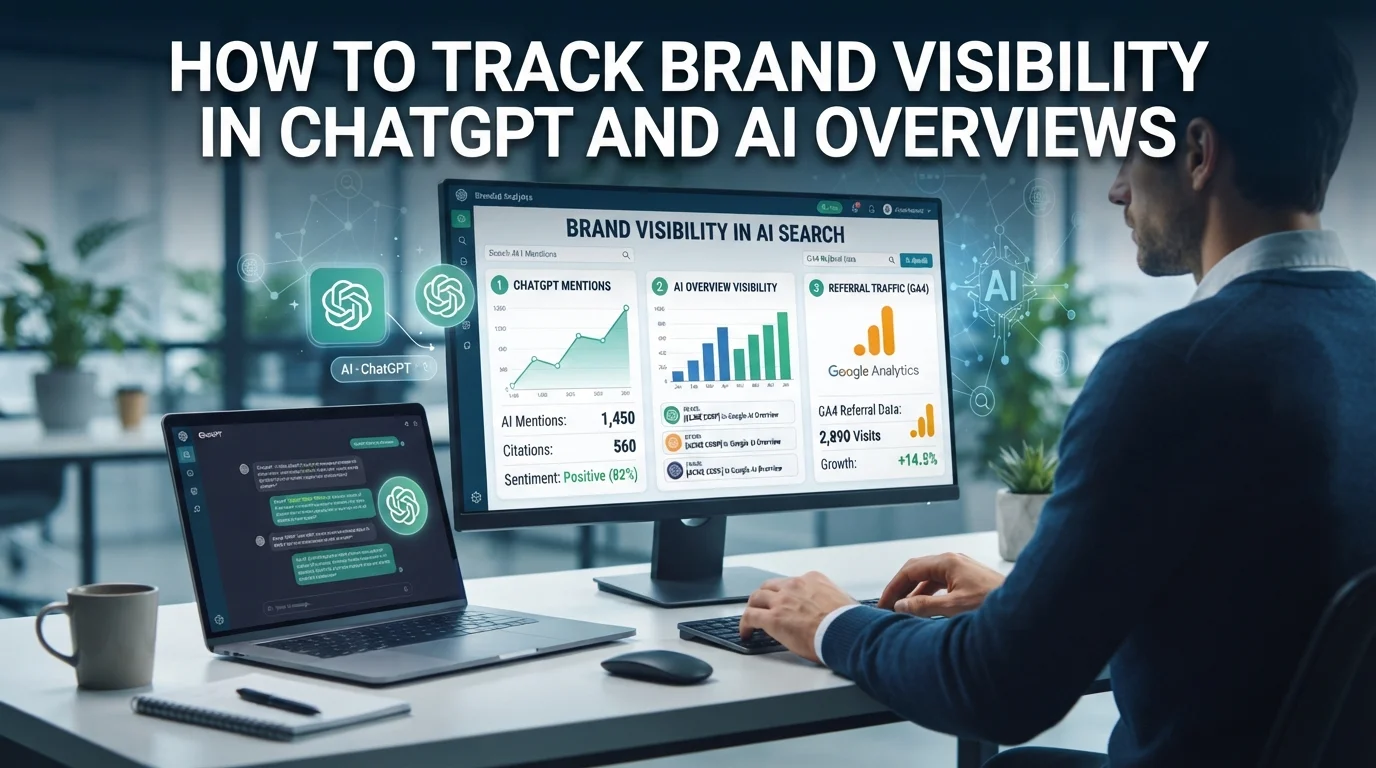
That gap is becoming harder to ignore. Buyers in Lebanon and the Gulf now use AI assistants to shortlist suppliers, compare services and check whether a company is credible. Google shows AI Overviews above many results. Yet most marketing reports still stop at rankings and website traffic. This guide explains how to track brand visibility in AI search in a structured, repeatable way: what to measure, how to build a prompt set, which data sources and tools to use, and how to turn the results into a report your management team can act on.
If you are looking for how to improve your visibility rather than measure it, start with our guide to optimizing for AI Overviews and ChatGPT. This article focuses on measurement.
Why Brand Visibility in AI Search Is Hard to Measure?
Traditional SEO has clear measurement tools. You can see rankings, impressions and clicks for each query. AI search is different for several reasons:
- Answers change. Ask the same question twice and an AI assistant may give a different answer, list different brands or cite different sources.
- Answers are personalised. Location, language, conversation history and account settings can all influence results.
- There is no full query report. OpenAI, Perplexity and others do not give businesses a report of every prompt that mentioned them.
- Not every mention creates a click. A user may read your name in an answer and later search for you directly, so the influence shows up as branded searches or direct visits rather than referrals.
This does not make measurement impossible. It means you need to combine several imperfect signals and track trends over time, rather than expecting one precise number.
What to Measure?
Before choosing tools, define the metrics. For most businesses, AI search visibility tracking comes down to five questions:
- Mention rate: in what share of relevant prompts is your brand mentioned at all?
- Citation rate: how often is your website linked or cited as a source?
- Position and prominence: are you the first recommendation, one of many, or a passing mention?
- Accuracy and sentiment: is the information about you correct, current and positive?
- Competitive share of voice: how often are competitors mentioned compared with you?
Add two business metrics that connect visibility to results: AI referral traffic to your website and leads or sales from those visits.
Step 1: Build a Prompt Set
A prompt set is a fixed list of questions you will ask AI assistants regularly. It is the foundation of any method to track brand visibility in AI search, because it lets you compare results month to month.
Build it around how your customers actually ask:
- Category prompts: “What are the best digital marketing agencies in Beirut?” or “Which companies install solar systems in Lebanon?”
- Problem prompts: “How can a clinic in Lebanon get more patient bookings online?”
- Comparison prompts: “[Your brand] vs [competitor]: which is better for…?”
- Brand prompts: “What is [your brand]?”, “Is [your brand] reliable?”, “Who founded [your brand]?”
- Local and regional prompts: the same questions for Beirut, Jounieh, Tripoli, Dubai, Riyadh or Doha, depending on your markets.
Then repeat key prompts in Arabic and French. AI assistants often give different answers in different languages, and many Lebanese and Gulf buyers search in Arabic. A brand that appears in English answers may be invisible in Arabic ones. Our Arabic SEO guide explains why Arabic content needs its own strategy.
Start with 20 to 50 prompts. Keep the wording identical each time you test, and add new prompts only as a separate group so trends remain comparable.
Example: A Starter Prompt Set for a Beirut Clinic
To make this concrete, here is how a dental clinic in Beirut might start to track brand visibility in AI search. The clinic and prompts are illustrative.
| Group | Example prompt (repeated in English, Arabic and French) |
|---|---|
| Category | “Best dental clinics in Beirut for implants” |
| Problem | “Where can I get emergency dental care in Achrafieh on a Sunday?” |
| Comparison | “Dental implants in Beirut vs Dubai: cost and quality” |
| Brand | “Is [clinic name] a good dental clinic?” |
| Trust | “Which dentists in Lebanon are specialists in implants?” |
Ten to fifteen prompts like these, tested monthly on four platforms in three languages, already produce a meaningful baseline. The clinic would then add the same prompts for any Gulf city where it attracts patients, and track whether its own website, its Google Business Profile or third-party directories are the sources AI tools cite.
Step 2: Choose the Platforms to Track
Focus on the AI tools your customers actually use. For most businesses in the region, that means:
- Google AI Overviews and AI Mode, because they appear in ordinary Google searches.
- ChatGPT, the most widely used standalone assistant.
- Perplexity, which cites sources prominently and is popular with researchers and professionals.
- Gemini and Microsoft Copilot, especially for business users working in Google Workspace or Microsoft 365.
Test in conditions as close as possible to a real customer: logged out or in a clean account, without previous conversation history, and from the relevant country where possible.
Step 3: Track Manually First
Manual tracking is the best way to start, even if you later use tools. It costs little, helps you understand how AI answers are built, and gives you a baseline.
Create a spreadsheet with columns for:
- Date, platform and language
- Prompt
- Brand mentioned (yes/no)
- Position in the answer (first, top three, other)
- Website cited or linked (yes/no, and which page)
- Competitors mentioned
- Accuracy issues (wrong address, outdated services, confusion with another company)
- Sources the AI cited
Run each prompt at least twice per platform, since answers vary, and record the overall pattern. Repeat monthly. After three months, you will have a reliable picture of your ChatGPT brand mentions, your presence in AI Overviews and how you compare with competitors.
Step 4: Use Search Console for AI Overviews Tracking
Google has started to give site owners direct data on generative AI features. In June 2026, Google introduced generative AI performance reports in Search Console, and by the end of August 2026 they had been rolled out to sites worldwide. The reports show impressions from AI Overviews, AI Mode and generative AI features in Discover, broken down by page, country, date and, for Search, device.
At launch, these reports focused on impressions rather than clicks, and sites with too few AI impressions may not see a report. Check which metrics are currently available in your property. Even with these limits, the data answers useful questions: which of your pages appear in AI features, in which countries, and whether that exposure is growing. Our Google Search Console guide explains how to navigate the reports.
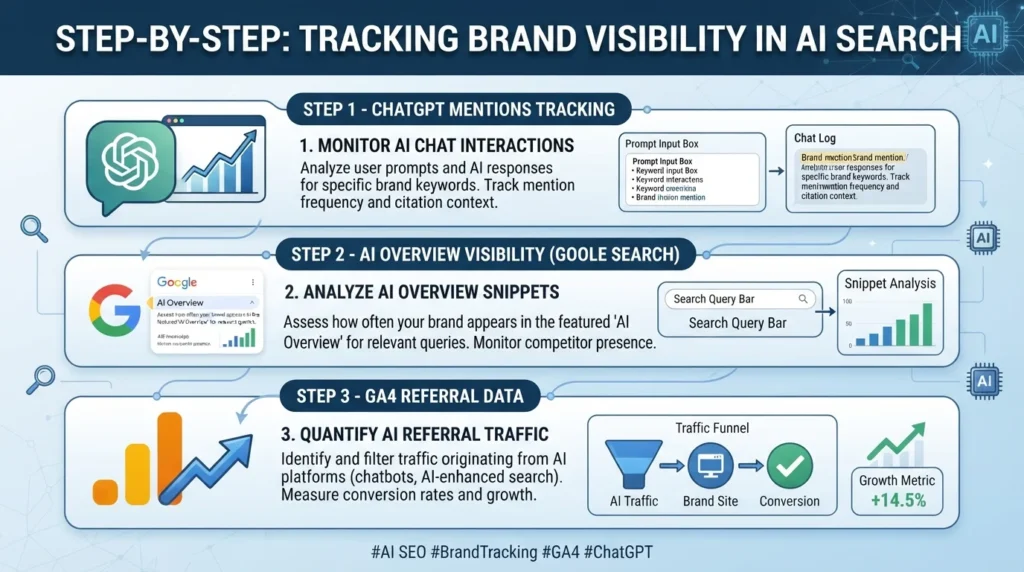
Step 5: Measure AI Referral Traffic in GA4
When AI assistants link to your website and users click, the visit can be recorded in Google Analytics 4. ChatGPT adds a
utm_source=chatgpt.com
parameter to many outgoing links, and other platforms such as Perplexity, Gemini, Copilot and Claude usually pass a referrer that identifies them.
To see this traffic clearly:
- Create a custom channel group in GA4 with an “AI assistants” channel.
- Define it with a condition on session source matching AI domains, for example a regular expression covering chatgpt.com, perplexity.ai, gemini.google.com, copilot.microsoft.com and claude.ai. Review the list periodically as new tools appear.
- Place the AI channel above “Referral” in the channel order so these sessions are not grouped with ordinary referrals.
- Connect it to conversions. Track form submissions, WhatsApp clicks and calls, as explained in our guide to GA4 lead tracking, so you can see whether AI visitors become leads.
Remember that some AI-influenced visits arrive as direct traffic or branded Google searches, with no AI referrer at all. Watch for growth in branded search impressions in Search Console alongside your AI referral numbers.
Step 6: Consider AI Visibility Tools
A growing number of LLM visibility tools automate prompt testing across platforms, track mentions and citations over time and benchmark competitors. Some are features within established SEO platforms; others are specialist products.
When evaluating them, ask:
- Which platforms and countries do they test from? Results from the United States may not reflect what users in Lebanon or the Gulf see.
- Do they support Arabic and French prompts?
- How often do they run prompts, and how many times each? Single runs can mislead because answers vary.
- Can you export the raw answers, not only a summary score?
- How do they calculate visibility or share of voice? Make sure you understand the formula before reporting it to management.
Tools save time at scale, but they do not replace judgement. Review a sample of the actual answers each month to check that the scores reflect reality.
Step 7: Turn Data Into a Monthly Report
A useful AI visibility report is short and decision-focused. Include:
- Headline metrics: mention rate, citation rate and share of voice versus key competitors, by platform and language.
- Trend over time, compared with previous months.
- Search Console AI impressions for your key pages and countries.
- AI referral sessions and conversions from GA4.
- Accuracy issues found and their likely sources.
- Actions for next month.
Connect AI visibility to your wider measurement framework rather than reporting it in isolation. Our guide to SEO KPIs and SEO ROI shows how to link visibility metrics to revenue.
What to Do With the Results?
The point of trying to track brand visibility in AI search is to improve it. Measurement only matters if it leads to action. Common findings and responses include:
- The brand is not mentioned at all: strengthen authoritative content on core topics, earn coverage in sources AI tools cite, and build clear entity signals. Our guide to entity SEO explains how.
- The brand is mentioned with wrong information: trace the source, usually an outdated directory, old article or inconsistent website content, and correct it.
- Competitors appear more often: study which sources the AI cites for them and where you are missing.
- Visible in English but not Arabic: invest in genuine Arabic content and Arabic-language coverage.
- Negative sentiment: address the underlying reviews or issues, as covered in our guide to online reputation management in Lebanon.
Frequently Asked Questions
Build a fixed set of prompts your customers would ask, test them regularly in ChatGPT, Perplexity, Gemini and Google’s AI features, and record mentions, citations, accuracy and competitors. Combine this with Search Console’s generative AI reports and AI referral traffic in GA4.
Yes. Search Console now includes generative AI performance reports showing impressions from AI Overviews, AI Mode and AI features in Discover, broken down by page, country and date. Check which metrics are available for your property, since Google has said it may add more over time.
ChatGPT adds a utm_source=chatgpt.com parameter to many links. Create a custom channel group in GA4 that groups sessions from AI domains such as chatgpt.com and perplexity.ai, and connect it to your conversion events.
They are useful for trends and scale, but AI answers vary by location, language and time. Check which countries and languages a tool tests from, how often it repeats prompts, and review sample answers yourself.
Monthly is a practical cadence for most businesses. Keep the prompt set consistent so results are comparable, and review trends over at least three months before drawing conclusions.
Know Where You Stand in AI Search
You cannot manage what you do not measure. With a consistent prompt set, regular testing in the platforms your customers use, Search Console’s AI reports and clean AI referral data in GA4, you can finally answer the question your leadership is asking, and show whether your efforts to track brand visibility in AI search are leading to more visibility, better accuracy and more enquiries.
If you want a clear baseline of how ChatGPT, Perplexity and Google’s AI features describe your brand in English, Arabic and French, the Creative 4 All SEO team can run an AI visibility audit and set up the tracking for you. Explore our SEO services in Lebanon and request a free SEO audit through the form or on WhatsApp.