
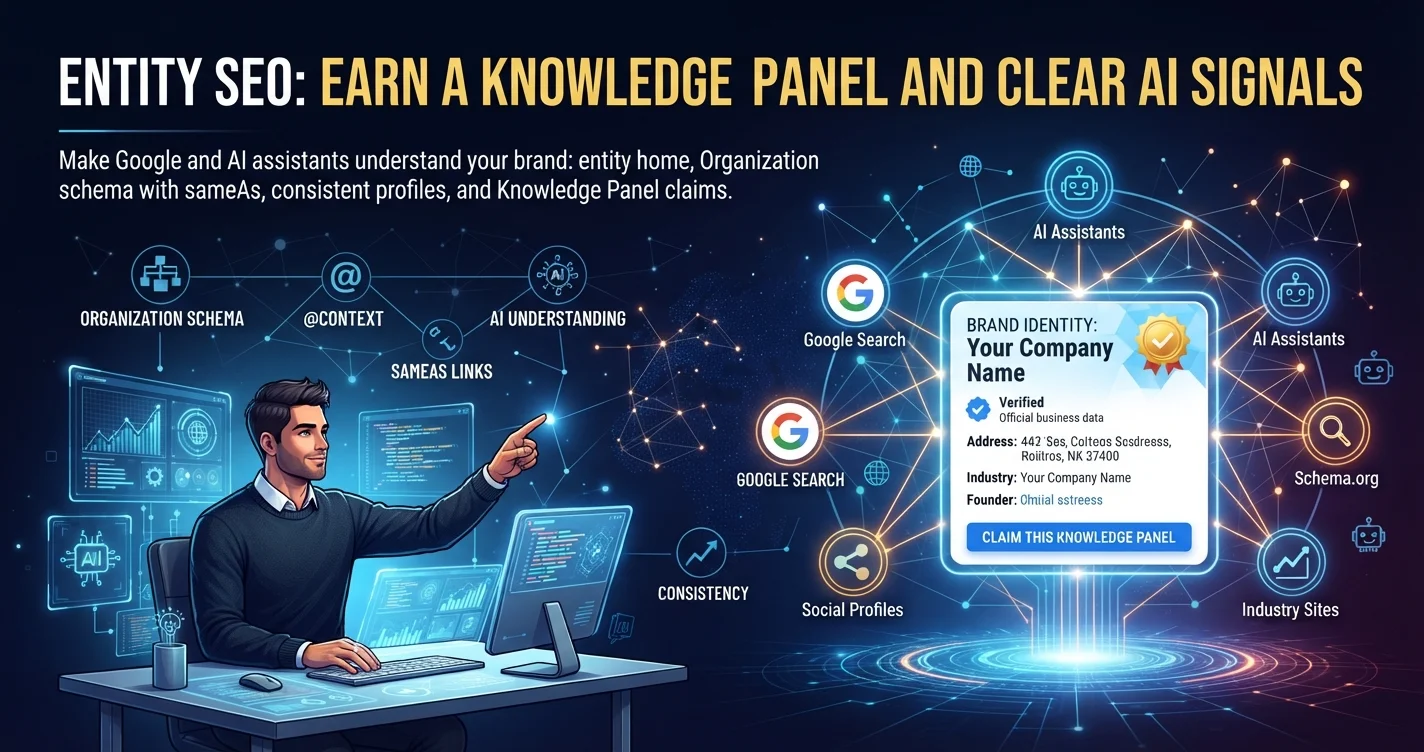
Search for your company name on Google. What appears? For some brands, the first page is clear: their website, a Knowledge Panel with their logo and description, their social profiles and recent news. For many others, especially in Lebanon, the picture is messy. A company with a similar name shows up first. The logo is missing. An old address appears. And when someone asks ChatGPT or Gemini about the brand, the answer mixes it up with another business or says it has no information.
This is the problem entity SEO solves. Instead of focusing only on keywords and pages, entity SEO helps search engines and AI systems understand your brand as a distinct, well-defined thing: who you are, what you do, where you operate, who runs you, and which profiles on the web belong to you. This guide explains how entities work, how to build clear brand signals, and how to improve your chances of earning and managing a Google Knowledge Panel.
What Is an Entity, and Why Does It Matter Now?
An entity is a uniquely identifiable thing: a company, a person, a place, a product or an idea. Google stores information about entities and the relationships between them in its Knowledge Graph. When Google is confident it understands an entity, it can show a Knowledge Panel, connect searches for different spellings of the name, and use that understanding when ranking and summarising results.
AI assistants work in a related way. Large language models and AI search features build answers from information they have seen about a brand across the web. If that information is consistent, they describe you accurately. If it is thin, outdated or contradictory, they guess, or confuse you with someone else.
That is why entity SEO has moved from a niche technical topic to a practical business concern. Your brand SERP, meaning the results people see when they search your name, is often the last thing a prospect checks before contacting you, and AI-generated answers increasingly shape that first impression. Our guide to AI SEO and GEO covers the broader shift in how AI systems choose sources.
Why Lebanese and GCC Brands Face Extra Entity Challenges?
Brands in Lebanon and the Gulf often face specific obstacles that make brand entity optimization more important:
- Multiple name versions. A brand may be written in English, in Arabic script, and in French, with several transliterations of the Arabic name. Without clear signals, search engines may treat these as different entities.
- Common family and company names. Many Lebanese businesses share surnames or similar trading names, which increases the risk of confusion.
- Legal names that differ from brand names. A company registered as “Example Trading s.a.r.l.” may trade under a short brand name. Both need to be connected.
- Thin English-language coverage. Local press coverage may exist mainly in Arabic or French, or only on social media.
- Outdated listings. Addresses and phone numbers change, and old directory entries rarely get updated.
The solution is not to choose one name and ignore the rest, but to tell search engines clearly that all these versions refer to the same entity.
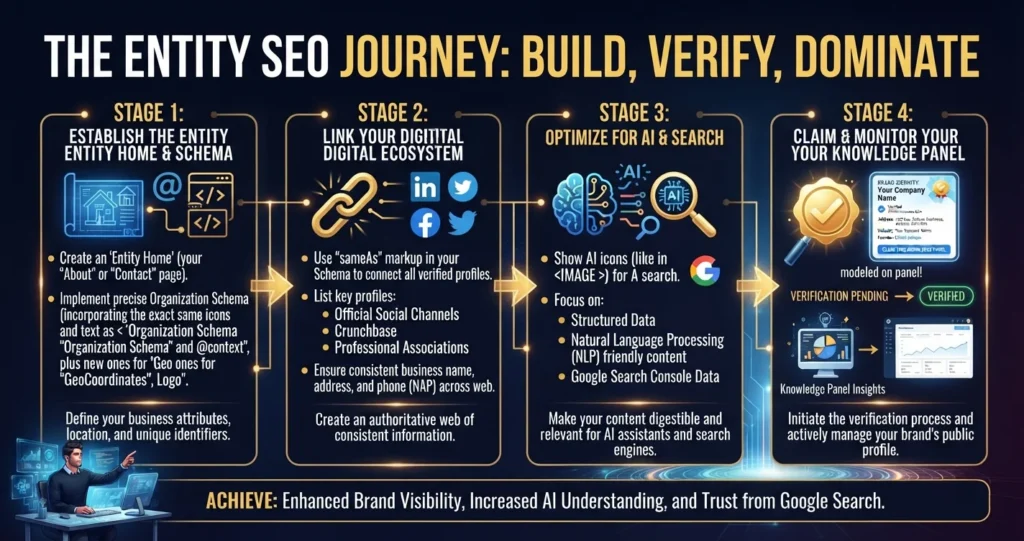
Step 1: Build Your Entity Home
The foundation of entity SEO and brand entity optimization is an entity home: one page on your own website that serves as the authoritative description of your brand. For most companies, this is the About page or, for smaller sites, the homepage.
A strong entity home includes:
- The official brand name, legal name and common alternative names, including the Arabic and French versions.
- A clear, factual description of what the company does, where it operates and who it serves.
- Founding date, founders and key leaders, with links to their own profile pages where appropriate.
- Address, phone and contact details that match your Google Business Profile.
- Links to all official profiles: LinkedIn, Instagram, Facebook, YouTube, TikTok, X and relevant directories.
- Evidence of credibility: awards, memberships, notable clients, press coverage and certifications.
Write it for people first. The same facts that reassure a prospect also help Google and AI systems confirm who you are. This connects directly to trust, as explained in our guide to E-E-A-T.
Step 2: Add Organization Schema with sameAs
Structured data lets you state facts about your brand in a machine-readable format. Google’s documentation recommends Organization structured data on your official site, including to specify the logo it can use in search results and the Knowledge Panel.
For entity SEO, the most important properties are:
- name, legalName and alternateName: the brand name, registered name and other versions, including Arabic and French.
- url and logo: your official website and a high-quality logo file.
- description, foundingDate, founder, address and contactPoint.
- sameAs: links to your official profiles elsewhere on the web.
The sameAs schema property is particularly valuable. It explicitly connects your website to your verified profiles, telling search engines “these accounts are the same entity as this website.” Only include profiles you actually own and control, and keep the list up to date.
A simplified example for a fictional company:
{
"@context": "https://schema.org",
"@type": "Organization",
"name": "Example Foods",
"legalName": "Example Foods s.a.r.l.",
"alternateName": ["إكزامبل فودز", "Example Foods Liban"],
"url": "https://www.example.com/",
"logo": "https://www.example.com/logo.png",
"foundingDate": "2010",
"address": {
"@type": "PostalAddress",
"addressLocality": "Beirut",
"addressCountry": "LB"
},
"sameAs": [
"https://www.linkedin.com/company/example-foods",
"https://www.instagram.com/examplefoods",
"https://www.facebook.com/examplefoods",
"https://www.youtube.com/@examplefoods"
]
}
Businesses with a physical location can use a more specific type, such as LocalBusiness or one of its subtypes. Validate your markup with Google’s Rich Results Test, and see our guide to schema markup for businesses for implementation details. On a multilingual site, keep the core facts identical across language versions so they reinforce each other rather than conflict.
Step 3: Make Every Profile Tell the Same Story
Consistency is the quiet engine of entity SEO. Structured data on your website is only one source. Search engines and AI systems cross-check it against the rest of the web. Consistency is what builds confidence.
Audit every place your brand appears:
- Google Business Profile: name, category, address, phone, hours and website. Our Google Business Profile optimization guide covers this in detail.
- Social profiles: the same brand name, logo, description and website link.
- Directories and citations: local business directories, chambers of commerce, industry associations and marketplaces.
- Partner and client websites that mention or link to you.
Use the same core description everywhere, adapted for length. Fix outdated addresses and phone numbers. Close or merge duplicate pages and listings. Our guide to building brand consistency shows how to keep this under control as your team grows.
Step 4: Earn Mentions from Trusted Sources
Entities become stronger when credible, independent sources describe them. A Knowledge Panel is rarely built from your own website alone.
Useful sources include:
- News and industry publications in Lebanon and the Gulf, in any of your languages.
- Interviews, podcasts and conference speaker pages featuring your founders or experts.
- Industry associations, award listings and government or chamber registries.
- Wikidata and Wikipedia, where appropriate. These are significant sources of structured knowledge, but they have strict notability and conflict-of-interest rules. Do not create or edit entries about your own company in ways that break those rules; poorly sourced or promotional entries are often removed and can harm credibility.
This is where digital PR and link building overlap with entity SEO. A mention in a respected publication helps people discover you, strengthens your backlink profile and confirms your identity as an entity. Our guide to link building in 2026 explains how to earn these mentions ethically.
Step 5: Connect People to the Brand
People are an often-overlooked part of entity SEO. Brands are also understood through the people behind them. Founders, executives and expert authors can be entities too. Create author and leadership pages with accurate bios, link them to their LinkedIn profiles, and use Person schema where relevant, with properties such as worksFor connecting them to your Organization.
This strengthens both entities: the person’s expertise supports the brand’s authority, and the brand’s reputation supports the person’s credibility.
Step 6: Getting and Claiming a Google Knowledge Panel
There is no form to request a new Knowledge Panel, and no entity SEO agency can guarantee one. Google shows one when its systems are confident they understand an entity and that it is relevant to a search. The steps above increase that confidence, but they cannot guarantee a panel.
If a Knowledge Panel already appears for your brand, you can claim it. According to Google’s help documentation, you search for the entity, select the option to claim the Knowledge Panel, and verify by signing in to one of the official sites or profiles Google associates with it, such as your Search Console property or YouTube channel. Once verified, you can suggest changes to information in the panel.
It is important not to confuse a Knowledge Panel for business with a Google Business Profile. Local businesses that serve customers at a location or within a service area manage their local panel through Google Business Profile, which is a separate product. Many Lebanese businesses need both: a Business Profile for local searches and maps, and a broader brand entity for searches about the company itself.
If the panel shows wrong information, Google recommends waiting at least a week after it last crawled your updated, marked-up page before reporting a problem, since updates take time to appear.
Step 7: Monitor Your Brand SERP and AI Answers
Entity SEO is ongoing work, not a one-off project. Every few months, check:
- Your brand SERP in English, Arabic and French, on desktop and mobile, from Lebanon and from your key Gulf markets.
- Branded queries in Search Console, including misspellings and Arabic versions, to see how people search for you.
- AI assistants: ask ChatGPT, Gemini, Perplexity and Google’s AI features simple questions such as “What is [brand]?” and “Who founded [brand]?” Note what they get right, what they get wrong and which sources they cite.
- Reviews and reputation signals, since negative or outdated content often appears in brand results. Our guide to online reputation management in Lebanon covers how to respond.
When AI answers are wrong, look for the source of the error. Usually it is an outdated directory listing, an old article or inconsistent information on your own website. Fixing the source is more effective than trying to influence the AI system directly.
Common Entity SEO Mistakes
- Using different brand names across the website, social profiles and listings.
- Listing profiles in sameAs that you do not control, or that belong to other businesses.
- Marking up facts that are not visible on the page or not true.
- Creating promotional Wikipedia pages that break the platform’s rules.
- Forgetting Arabic and French versions of the brand name.
- Treating schema as a one-time task and never updating it after a rebrand, move or leadership change.
Frequently Asked Questions
Entity SEO is the practice of helping search engines and AI systems clearly understand your brand as a distinct entity: who you are, what you do and which profiles belong to you. It uses an authoritative entity home, structured data, consistent profiles and trusted third-party mentions.
You cannot request one directly. Google shows a Knowledge Panel when it is confident about an entity. Build a clear entity home, add Organization schema with sameAs links, keep profiles consistent and earn coverage from credible sources. If a panel appears, claim it through Google’s verification process.
sameAs is a property in structured data that lists the official profiles and pages that represent the same entity as your website, such as your LinkedIn, Instagram or YouTube accounts. It helps search engines connect these sources to your brand.
No. A Google Business Profile manages local business information for Maps and local search. A Knowledge Panel describes an entity such as a company, person or organisation more broadly. Many businesses benefit from both.
It can help. AI systems draw on information available across the web. Clear, consistent and well-sourced information about your brand improves the chances that AI answers describe you accurately, although no one can control those answers directly.
Make Your Brand Unmistakable
Strong entity SEO makes your brand easy to recognise for people, search engines and AI systems alike. With a clear entity home, accurate structured data, consistent profiles in every language and credible mentions across the web, you reduce confusion, protect your brand SERP and give Google the confidence it needs to show your brand the way you intend.
If Google or AI assistants are confusing your brand, missing your details or showing outdated information, the Creative 4 All SEO team can audit your brand entity in English, Arabic and French and build a clear plan to fix it. Explore our SEO services in Lebanon and request a free SEO audit through the form or on WhatsApp.